

The debate over who represents the face of women’s basketball has taken another dramatic turn after a social media post attributed to rapper Cardi B praised Angel Reese while taking aim at Caitlin Clark. The statement has reignited discussions about race, popularity, on-court performance, and the growing influence of two of the WNBA’s most recognizable young stars.
The post features a provocative quote attributed to Cardi B: “White people is mad that Angel Reese is actually better than Caitlin Clark.” However, the screenshot alone does not establish whether Cardi B actually made the statement, and the quote should not be treated as verified without a reliable original source.
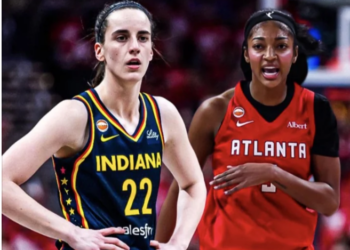
Still, the underlying debate is real. Clark, the Indiana Fever’s dynamic guard, and Reese, the Chicago Sky’s influential forward, have become central figures in conversations about the WNBA’s growing popularity. Their contrasting playing styles, enormous followings, and passionate fan bases have helped turn their rivalry into one of the most discussed storylines in women’s basketball.
But there is a bigger question behind the latest controversy: Does being the best player automatically make someone the face of women’s basketball, or does that title depend on something much bigger than statistics?
CARDI B’S REPORTED COMMENTS PUT ANGEL REESE AND CAITLIN CLARK BACK IN THE SPOTLIGHT
The screenshot presents a statement attributed to Cardi B suggesting that criticism of Angel Reese stems from people refusing to acknowledge her superiority over Caitlin Clark.
The wording is designed to provoke a reaction, particularly among fans who believe the conversation surrounding the two players has become unnecessarily personal.
However, without a verifiable interview, original social media post, or other reliable confirmation, it remains unclear whether Cardi B actually made the statement. That distinction matters because a celebrity endorsement can quickly influence an online debate, even when the quotation being circulated has not been authenticated.
What cannot be disputed is that Clark and Reese occupy important positions in the modern WNBA conversation.
Clark has attracted enormous attention through her long-range shooting, passing ability, and capacity to change the pace of a game. Reese has built her reputation through rebounding, physical interior play, relentless effort, and a personality that keeps her in the public conversation.
Their differences make comparisons inevitable, but those differences also demonstrate how many ways a player can influence basketball.
Rather than reducing the discussion to a simple argument over who is better, fans should consider what each player contributes to her team and to the league’s expanding audience.
WHY ANGEL REESE DESERVES MORE THAN A SOCIAL MEDIA DEBATE
Angel Reese has established herself as a prominent figure in women’s basketball, with a playing style that brings intensity and physicality to the frontcourt.
Her rebounding, work around the basket, and willingness to compete through contact give her a distinct role on the court. Those qualities can create additional possessions, limit opponents’ second chances, and help a team maintain pressure throughout a game.
Reese’s influence also extends beyond basketball.
Her confidence, fashion presence, media appearances, and ability to generate discussion have helped establish her as a recognizable personality among younger sports fans.
That commercial and cultural influence is important in a league where players increasingly operate as athletes, entertainers, and independent brands.
Nevertheless, being a major star does not mean every comparison must end with Reese being declared superior to Clark.
The two players perform different roles, and their individual strengths should be evaluated in the context of their positions, responsibilities, and contributions to winning.
Reese’s greatest argument is not that another player must be diminished for her to receive recognition. It is that her own accomplishments deserve serious attention without being reduced to a rivalry narrative.
CAITLIN CLARK’S IMPACT ON THE INDIANA FEVER AND THE WNBA
For the Indiana Fever, Caitlin Clark’s importance extends well beyond her ability to score from distance.
Her court vision, passing range, and willingness to attempt difficult shots can force opposing defenses to change their approach. Defenders must account for her shooting threat well beyond the three-point line, creating opportunities for teammates when opponents commit additional attention to her.
That influence can be particularly valuable when Clark is working alongside frontcourt players such as Aliyah Boston, whose interior presence can complement a guard capable of stretching the defense.
Clark’s impact also reaches the business side of basketball.
Her popularity has helped bring additional attention to the Fever and women’s basketball more broadly. Increased interest can translate into stronger television audiences, merchandise demand, sponsorship opportunities, and greater visibility for teammates and opponents.
The important point is that this attention does not belong exclusively to Clark.
When the Fever play the Chicago Sky, the matchup can attract interest in both Clark and Reese. When Clark faces other WNBA stars, those players also gain exposure to an audience that might not otherwise have followed their teams as closely.
In that sense, Clark’s popularity can help elevate the entire league, including players who compete against her.
The Fever’s challenge is to turn that attention into sustained basketball success. Commercial popularity can strengthen a franchise’s profile, but championships ultimately depend on roster construction, player development, health, coaching, and execution.
Clark can help raise the Fever’s ceiling, but she cannot accomplish the team’s ambitions alone.
IS ANGEL REESE ACTUALLY BETTER THAN CAITLIN CLARK?
This is the question most likely to dominate the discussion following the circulation of the screenshot.
The difficulty is that the answer depends on what fans mean by better.
If the comparison centers on rebounding and physical presence near the basket, Reese has a compelling case. Her ability to pursue missed shots and create additional possessions is a meaningful basketball skill that can change the outcome of individual games.
If the discussion focuses on perimeter shooting, playmaking, and creating offensive opportunities for teammates, Clark brings a different set of strengths.
Neither skill set should be dismissed simply because it does not match the other’s.
A fair comparison would consider several factors:
- SCORING: How efficiently does each player generate points, and how does that production affect the team’s offense?
- PLAYMAKING: How effectively does each player create opportunities for teammates?
- REBOUNDING: How consistently does each player secure possessions and limit opponents’ second chances?
- DEFENSE: How well does each player defend her position and contribute to the team’s overall defensive performance?
- TEAM SUCCESS: How much does each player’s contribution help her team compete against the strongest opponents?
- OVERALL IMPACT: What happens to the team’s performance when each player is on the court compared with when she is off it?
The appropriate statistical comparisons would also account for minutes played, efficiency, turnovers, defensive assignments, and team context.
Without that information, declaring one player categorically superior risks turning a basketball discussion into a popularity contest.
There is another important consideration: a player can be more effective in a particular role without being the more valuable player in every situation.
Reese and Clark offer different strengths. The most meaningful comparison should identify those differences rather than pretend they do not exist.
THE RACE CONVERSATION SURROUNDING CLARK AND REESE
One reason the Clark-Reese debate generates such intense reactions is that discussions about their basketball performances frequently overlap with conversations about race, representation, and media coverage.
Some fans believe Clark receives disproportionate attention because of her popularity and the audiences she attracts. Others argue that Reese and other Black athletes do not always receive equal recognition for their accomplishments, personalities, and influence.
These concerns deserve thoughtful discussion.
Women’s basketball has a long history of talented Black athletes whose contributions helped shape the sport. Any discussion about the league’s growth should recognize that history and acknowledge the importance of representation.
At the same time, it is unfair to assume that every Clark supporter is motivated by race or that every Reese supporter is dismissing Clark’s accomplishments.
Fans can admire Reese’s physicality while appreciating Clark’s playmaking. They can criticize media coverage without attacking individual athletes. They can also recognize that both players have contributed to a larger conversation about the value and visibility of women’s sports.
The danger comes when the discussion shifts from evaluating basketball to making sweeping claims about entire groups of people.
That approach does little to advance the sport.
The WNBA benefits when fans debate performances, celebrate different playing styles, and challenge unfair treatment without turning every disagreement into a personal or racial confrontation.
WHO IS THE REAL FACE OF WOMEN’S BASKETBALL?
The phrase face of women’s basketball sounds straightforward, but it can describe several different things.
It might refer to the player with the greatest public recognition, the athlete who attracts the largest audiences, the player with the strongest commercial influence, or the individual whose performances most directly affect championship outcomes.
Those categories do not always produce the same answer.
Clark has a strong claim based on her visibility, offensive profile, and influence on the public conversation surrounding the WNBA.
Reese has a strong claim as a highly recognizable young star whose personality, playing style, and cultural influence have helped keep women’s basketball in the spotlight.
Other established stars also belong in this conversation. A’ja Wilson, for example, has built an outstanding basketball résumé and has been central to the Las Vegas Aces’ championship success.
That distinction matters because public visibility and basketball achievement are related, but they are not identical.
A player can be the most recognizable name without being the league’s best player. Another can dominate the championship conversation without receiving the same level of attention from casual fans.
The WNBA does not necessarily need one athlete to represent every part of its identity.
Instead, the league can benefit from having multiple stars who appeal to different audiences and bring different strengths to the game.
Clark can attract fans through spectacular perimeter play. Reese can draw attention through rebounding, physical competition, and personality. Wilson can demonstrate what sustained excellence and championship-level performance look like.
These stories can coexist.
WHY THIS RIVALRY MATTERS FOR THE INDIANA FEVER AND CHICAGO SKY
The attention surrounding Clark and Reese has implications for both franchises.
For Indiana, Clark’s presence gives the Fever a recognizable centerpiece around whom the organization can build its basketball identity. The challenge is assembling a team capable of converting that attention into consistent postseason success.
That requires more than highlight plays. The Fever need effective spacing, reliable defense, strong frontcourt production, and enough depth to withstand the demands of a full season.
The relationship between Clark and Boston is particularly important because a productive guard-center partnership can create multiple offensive options. When opponents focus on Clark’s perimeter threat, Indiana must be able to punish defensive adjustments elsewhere on the floor.
For Chicago, Reese’s development remains an important part of the Sky’s broader competitive picture.
Her rebounding and interior presence can help establish a physical identity, but the team’s long-term progress also depends on shooting, playmaking, defensive consistency, and the ability to build a complementary roster.
Neither organization can afford to treat social media popularity as a substitute for sound basketball decisions.
The rivalry may help draw attention to their meetings, but the more consequential question is which team can develop its young talent and consistently compete against the league’s strongest opponents.
Ultimately, fans will remember more than online arguments. They will remember meaningful wins, postseason performances, individual improvement, and the ability to deliver when the pressure is highest.
COULD THIS DEBATE MAKE THE WNBA EVEN MORE POPULAR?
There is a positive side to the continued attention surrounding Clark and Reese.
Rivalries give casual viewers a reason to watch games, follow storylines, and learn more about players they might not otherwise know.
When those viewers become interested in one star, they may discover the strengths of her teammates and opponents. That can deepen their appreciation for the sport and encourage them to follow more than one franchise.
However, there is a difference between a rivalry that promotes competition and one that becomes dominated by personal hostility.
If every matchup is framed as a battle between opposing fan bases, the actual basketball can become secondary. Players may be reduced to symbols in arguments they did not create, and genuine achievements can be overlooked in favor of provocative headlines.
The league’s long-term growth depends on maintaining interest beyond individual controversies.
That means highlighting tactical adjustments, player development, coaching decisions, defensive performances, and the competitive stories that unfold throughout the season.
The strongest rivalries are not necessarily those in which fans dislike one another. They are the ones in which both players continue to improve and give audiences compelling reasons to watch.
WHAT HAPPENS NEXT IN THE CLARK-REESE DEBATE?
The discussion is unlikely to disappear anytime soon.
As Clark and Reese continue their professional careers, fans will keep comparing their statistics, performances, awards, and influence. Every strong game by either player will create another opportunity for supporters to argue that their favorite deserves greater recognition.
The most revealing developments will come from their continued growth.
For Clark, the focus will remain on how effectively she controls games, creates opportunities for teammates, and helps Indiana compete at the highest level.
For Reese, attention will center on her continued development, her impact on both ends of the court, and how her individual strengths translate into team success.
Their careers will not necessarily follow the same path, and that is precisely why the comparison is so interesting.
It is also worth remembering that one social media statement, whether authentic or not, cannot settle a debate involving two players with different roles and responsibilities.
The next chapter will be written on the basketball court.
FINAL VERDICT: WOMEN’S BASKETBALL DOES NOT NEED TO CHOOSE ONLY ONE STAR
The reported Cardi B quote has added fresh fuel to an already heated discussion about Angel Reese, Caitlin Clark, and the future of women’s basketball. But the authenticity of the statement remains unverified based on the screenshot alone.
The larger conversation deserves more nuance than a simple declaration that one player is better than the other.
Reese brings rebounding, physicality, and a distinctive public presence. Clark offers elite perimeter skills, playmaking, and an ability to attract attention to the Indiana Fever and the wider WNBA.
Both have helped make women’s basketball a bigger part of the sports conversation, and their continued development could make their matchups even more compelling.






Discussion about this post