

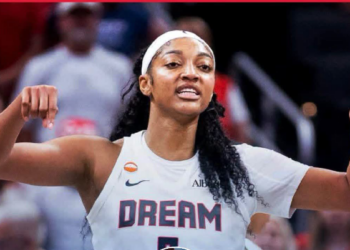
Angel Reese is once again at the center of a heated basketball debate, with questions about her popularity, fan support, and place in the WNBA taking center stage. This time, a controversial remark from sports commentator Jason Whitlock has added fresh fuel to the discussion surrounding the Chicago Sky star.
Whitlock reportedly took a sarcastic shot at Reese amid discussions about seating arrangements for her supporters during the WNBA Finals.
“If Angel Reese wants to sell out the arena for her fans, they should move the WNBA Finals to a high school gym.”
The remark quickly became a talking point among basketball fans, raising questions about whether the criticism was a fair assessment of Reese’s drawing power or simply another personal jab at one of women’s basketball’s most recognizable personalities.
However, another claim circulating alongside the debate suggests that Reese has won Defensive Player of the Year and is the greatest female basketball player in history. That statement requires clarification: without an official award announcement confirming the honor, it should not be presented as an established fact.
Nevertheless, the broader conversation highlights an important question for the WNBA: how should a player’s popularity be measured, and why does Reese continue to attract such intense attention?
JASON WHITLOCK’S REMARK PUTS ANGEL REESE BACK IN THE SPOTLIGHT
Few WNBA players generate as much conversation beyond the basketball court as Angel Reese.
The Chicago Sky forward has built a recognizable public profile through her competitive personality, rebounding ability, confidence, and willingness to embrace the spotlight. Those qualities have helped make her a prominent figure in the sport, but they have also made her a frequent target of criticism.
Whitlock’s reported comment takes aim at the question of whether Reese can attract enough supporters to justify a larger venue for her fans.
The remark is clearly sarcastic. However, determining whether it represents a fair criticism requires more than a punchline.
Arena attendance depends on several factors, including ticket availability, venue capacity, scheduling, ticket prices, team performance, and the popularity of the matchup. A player’s individual following is only one part of that equation.
Without verified attendance figures or specific details about the reported seating concerns, it would be premature to conclude that Reese’s fan base cannot fill a major basketball arena.
The more meaningful question is whether the criticism is supported by measurable evidence or driven primarily by the controversy surrounding her name.
ANGEL REESE’S POPULARITY IS BIGGER THAN ONE ARENA DEBATE
Reese’s influence extends beyond the traditional measures of basketball success.
Her presence generates discussions about fashion, personal branding, rivalries, social media, and the changing business of women’s professional basketball. That visibility can attract new viewers while also creating expectations that every public appearance, statement, or performance must be evaluated as a referendum on her entire career.
For the WNBA, that attention can be valuable.
Professional sports leagues need recognizable personalities who encourage casual viewers to become regular fans. Players who generate discussion can help bring attention to games, merchandise, sponsorships, and the league’s broader commercial opportunities.
However, attention does not automatically translate into sold-out arenas, and online engagement is not the same as ticket revenue.
A meaningful assessment of Reese’s commercial influence would consider actual attendance, television audiences, merchandise sales, sponsorship interest, and sustained fan engagement.
The distinction matters because the WNBA benefits most when conversations about its players lead people to watch more basketball, not simply argue about individual personalities.
THE DEFENSIVE PLAYER OF THE YEAR CLAIM NEEDS FACT-CHECKING
Another headline circulating alongside the controversy describes Reese as the winner of the WNBA Defensive Player of the Year award and calls her the greatest female basketball player in history.
Those are two separate claims, and neither should be accepted without appropriate evidence.
The Defensive Player of the Year award recognizes exceptional defensive performance over a WNBA season. Evaluating candidates involves considering their defensive impact, rebounding, ability to contest shots, versatility, and contributions to their team’s overall defensive performance.
Reese has demonstrated notable rebounding ability and a willingness to compete physically around the basket. Those qualities are important, particularly for a frontcourt player responsible for protecting possessions and limiting opponents’ second-chance opportunities.
Nevertheless, strong rebounding numbers alone do not establish that a player has won Defensive Player of the Year. An official league announcement is needed to confirm the award.
Similarly, describing someone as the greatest female basketball player in history is a matter of opinion rather than an official statistical designation.
Such a debate would need to consider the achievements of players across different generations, including their championships, individual awards, statistical production, international accomplishments, and lasting influence on the sport.
Reese can continue building an impressive career without requiring every discussion of her achievements to declare her the greatest player ever.
The key distinction is simple: recognize her accomplishments, but verify award claims before presenting them as facts.
WHAT ANGEL REESE BRINGS TO THE COURT
Beyond the headlines, Reese’s basketball value deserves serious consideration.
Her rebounding is one of her most recognizable strengths. Offensive rebounds can create additional scoring opportunities, while defensive rebounds help teams complete possessions and initiate transition offense.
That ability can influence games even when a player’s shooting numbers are not particularly impressive.
Reese’s physical presence also creates opportunities for teammates. Opponents who devote additional defensive attention to her around the basket may leave openings elsewhere, provided her team can capitalize on those situations.
However, her continued development also depends on improving other aspects of her game.
Finishing efficiency, offensive versatility, defensive positioning, and decision-making will all influence how much she can contribute against the league’s strongest teams.
For Reese to move from being a prominent young star to a consistent championship-level difference-maker, she must continue translating her individual strengths into winning basketball.
That is a more useful measure of her progress than whether a commentator believes her fans need a smaller arena.
WHY THIS CONTROVERSY MATTERS TO THE WNBA
The debate surrounding Reese reflects a larger challenge for women’s basketball.
The league is increasingly discussed through the personalities and rivalries that attract attention from casual fans. While that visibility can help grow the sport, it can also encourage commentators and audiences to reduce complex basketball careers to arguments about popularity.
There is nothing wrong with debating a player’s performance, marketability, or place among the league’s best.
The problem emerges when criticism becomes detached from evidence.
If Reese deserves criticism for a particular performance, the strongest argument will examine the game itself. If questions arise about attendance, reliable ticketing and attendance figures should provide the starting point.
The same standard should apply to claims about awards and historical greatness.
A healthier basketball conversation would allow Reese to receive credit for her strengths while examining her weaknesses without turning every disagreement into a personal battle.
That approach benefits the player, her team, competing stars, and the league as a whole.
WHAT THIS MEANS FOR THE CHICAGO SKY
For the Chicago Sky, Reese’s growing profile presents both an opportunity and a responsibility.
A recognizable star can help maintain public interest in a team, but long-term success depends on building a roster capable of competing consistently.
The Sky need effective offensive execution, reliable outside shooting, strong defensive communication, and a supporting cast that complements Reese’s rebounding and interior presence.
They also need to make sure that attention surrounding individual players does not overshadow the team’s collective goals.
If Reese continues improving her offensive efficiency while maintaining her effectiveness on the boards, she could become an increasingly influential part of Chicago’s long-term plans.
But the team’s progress should ultimately be measured through performance on the court.
Winning games, developing young talent, and establishing a consistent competitive identity would provide a stronger response to critics than any social media argument.
COULD ANGEL REESE BECOME ONE OF THE WNBA’S ALL-TIME GREATS?
Reese has the opportunity to build a significant legacy, but historical greatness is established over time.
The strongest candidates for all-time recognition typically combine individual excellence with sustained performance, major awards, postseason success, and contributions that change how the game is played or understood.
For Reese, the next stage of her career will be particularly important.
Continued improvement in scoring efficiency, offensive versatility, and defensive impact could strengthen her case as one of the league’s most influential players.
Team success will also matter. Championship contention would give her additional opportunities to demonstrate how her strengths translate to the highest-pressure moments.
Still, it is too early to treat her eventual legacy as settled.
The WNBA has featured exceptional players across multiple generations, and comparisons between them require careful consideration of different eras, playing styles, and competitive environments.
Reese does not need to be declared the greatest female basketball player in history today to be recognized as a player worth watching.
Her career remains a developing story, and her future accomplishments will provide the strongest evidence of where she belongs in the sport’s history.
FINAL VERDICT: THE BASKETBALL SHOULD MATTER MORE THAN THE INSULTS
Jason Whitlock’s reported high-school-gym remark has reignited a familiar argument about Angel Reese’s popularity and her place in women’s basketball.
But sarcasm is not evidence, and neither social media attention nor criticism alone can establish a player’s commercial value.
The fairest assessment would examine verified attendance figures, the circumstances surrounding the reported seating concerns, Reese’s performance, and her measurable influence on the sport.
Likewise, claims that she has won Defensive Player of the Year should be supported by an official award announcement, while declarations about the greatest player in history should be treated as opinions rather than established facts.
Reese has plenty of basketball left to play. Her ability to develop her game, contribute to winning teams, and sustain her performance will ultimately shape her legacy.
The WNBA is better served when debates about its stars encourage people to watch games, evaluate performances, and appreciate the competition.








Discussion about this post