

The Philadelphia Phillies are entering an offseason that could determine whether their championship window remains open or begins to close under the weight of their own financial commitments.
On paper, Philadelphia still has the star power to compete with the National League’s best teams. Bryce Harper, Kyle Schwarber, Trea Turner, and a talented pitching rotation give the organization a foundation many franchises would love to have. But after a disappointing 2026 campaign, a difficult question is becoming harder to ignore: What happens when a team has championship-level salaries but cannot consistently produce championship-level results?
The Phillies finished the regular season fighting for the National League’s final postseason spot before suffering elimination against the Atlanta Braves in the Wild Card round. After winning the NL East in both 2024 and 2025, Philadelphia took a step backward when it needed to prove that its championship ambitions were justified.
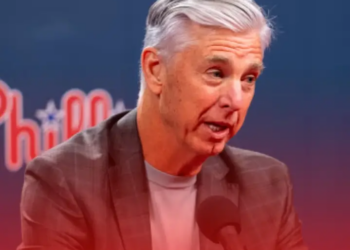
Now, president of baseball operations Dave Dombrowski must confront a complicated offseason. The Phillies need improvements across their lineup, defensive upgrades, and greater offensive consistency. Unfortunately, several expensive contracts could make those changes much more difficult.
THE PHILLIES’ BIGGEST OFFSEASON PROBLEM ISN’T JUST MONEY
Philadelphia’s financial commitments tell a significant part of the story.
Trea Turner is owed approximately $190.9 million through 2033. Jesús Luzardo has a $135 million contract running through 2031, with a club option for 2032. Schwarber is owed $120 million through 2030, while Harper has approximately $118 million remaining through 2031.
Aaron Nola is committed through 2030, with approximately $98.3 million remaining, while Cristopher Sánchez has a $98 million contract running through 2032, with a club option for 2033.
Zack Wheeler, J.T. Realmuto, Brad Keller, and Tim Mayza also represent additional financial commitments.
These contracts are not necessarily mistakes. Philadelphia paid for established talent because the organization wanted to win while its core remained competitive. That strategy helped produce consecutive NL East titles.
The problem is that long-term contracts become more difficult to manage when performance declines, roster weaknesses accumulate, and younger players are not ready to fill the gaps.
The Phillies cannot simply erase those commitments and start over. They must find ways to improve around the players already under contract.
That is where this offseason becomes particularly important.
TREA TURNER’S NEXT SEASON COULD CHANGE THE ENTIRE CONVERSATION
Turner’s offensive struggles were among the most concerning developments of Philadelphia’s 2026 season.
The shortstop was still a major contributor as recently as 2025, making his disappointing follow-up campaign especially frustrating. The Phillies need him to return to a level that justifies his place near the top of the lineup.
If Turner rebounds, Philadelphia could immediately improve its offensive outlook without acquiring another expensive star.
If he struggles again, however, the consequences could extend well beyond his individual statistics.
Turner occupies a premium position in the lineup and carries a substantial long-term salary. Philadelphia needs that investment to produce results, particularly because the organization has other roster weaknesses to address.
The arrival of new hitting coach Peter Fatse could become an important part of the solution. His task will involve more than helping Turner rediscover his swing. The Phillies need a more productive offensive approach throughout the lineup.
Still, coaching changes alone cannot guarantee improvement.
Philadelphia must determine whether Turner’s disappointing season was primarily a temporary slump, a mechanical problem, or evidence of a more persistent decline. Getting that evaluation right could influence how aggressively Dombrowski pursues additional offensive help.
BRYCE HARPER AND KYLE SCHWARBER CANNOT CARRY EVERYTHING
Harper and Schwarber remain central to Philadelphia’s offensive identity, but the 2026 season demonstrated the danger of depending too heavily on a small group of established stars.
Both players provide significant power and name recognition. However, a successful postseason team needs more than two dependable offensive contributors.
The Phillies finished 19th in runs scored and 22nd in OPS, according to the figures reported by FanRecap. Their 28th-place ranking in wRC+ was even more concerning.
Those numbers point toward a broader lineup problem.
A team cannot consistently compete for a championship if too many regulars are producing below league-average offensive results. Even when Harper and Schwarber deliver, opposing pitchers can concentrate on limiting their opportunities if the surrounding hitters are not threatening.
Alec Bohm, Realmuto, and Turner all endured difficult offensive seasons, leaving Philadelphia without enough consistent production from its supporting cast.
The offseason therefore presents a decision.
Dombrowski could pursue another major bat, hoping to create a deeper lineup. Alternatively, he could focus on improving several positions rather than spending heavily on one player.
Given the club’s existing financial commitments, the second approach may offer greater flexibility.
Philadelphia does not necessarily need another superstar. It needs more of its existing lineup to perform like reliable major-league starters.
DEFENSIVE PROBLEMS MAKE THE OFFENSIVE DECLINE EVEN MORE EXPENSIVE
The Phillies’ difficulties were not limited to hitting.
Defensive shortcomings involving Harper, Bohm, and Turner raised additional questions about the team’s overall construction. Stott also experienced a decline in several defensive measures.
That combination creates a particularly difficult situation.
When a team struggles offensively, dependable defense can help keep games close. When its defense also becomes unreliable, the pitching staff has less room for error.
Philadelphia must therefore evaluate its roster beyond batting averages, home runs, and on-base production.
The front office needs to consider whether the current arrangement gives the club the best chance to win over a full season and in a short postseason series.
Could Harper eventually return to first base more regularly? Should the Phillies reconsider their infield alignment? Would a trade involving an established player create better defensive balance?
Those questions are becoming increasingly relevant as the organization evaluates its options.
However, any major adjustment must account for the cost of acquiring replacements and the possibility that moving one player could create another weakness elsewhere.
The objective should be to improve the roster as a whole rather than solve one problem by creating two more.
DAVE DOMBROWSKI HAS LIMITED ROOM FOR ANOTHER EXPENSIVE GAMBLE
Dombrowski has built his reputation around pursuing established talent and putting together rosters capable of competing for championships.
That approach has helped Philadelphia remain a serious contender, but the next phase requires careful decisions.
The Phillies cannot assume that adding another expensive veteran will automatically solve their problems.
They must also consider whether the existing roster can improve through better health, stronger coaching, internal development, and more effective defensive positioning.
Philadelphia has already made significant changes to its coaching staff. Kevin Long and Bobby Dickerson will not return, while Carlos Mendoza has been hired to replace Dickerson and Peter Fatse is reportedly set to take over the hitting coach position.
Those appointments could help address the team’s offensive and defensive shortcomings, but the real test will come when the regular season begins.
Dombrowski must also determine which players are worth retaining, which options should be exercised, and whether any current roster members could become trade candidates.
The challenge is balancing short-term urgency with long-term financial responsibility.
The Phillies still have players capable of producing at a high level. But spending more money without correcting the underlying problems could leave the organization in a worse position a year from now.
THE FARM SYSTEM COULD HELP, BUT PHILADELPHIA CANNOT RUSH ITS NEXT GENERATION
Prospect development could provide another path toward improving the roster without adding significant salary commitments.
Aidan Miller is approaching the major-league conversation, but his limited playing time in 2026 complicates any immediate projection. A back injury interrupted his season, and he appeared in only four minor-league games.
That makes it difficult to assume he will be ready to solve Philadelphia’s infield problems immediately.
The organization needs to resist the temptation to treat a promising prospect as a guaranteed solution simply because the major-league roster has weaknesses.
Young players can become valuable contributors, but their development timelines are rarely perfectly predictable.
Philadelphia should continue evaluating its prospects while remaining open to opportunities to strengthen the roster through trades and free agency.
The ideal scenario would involve young talent gradually taking on larger roles while established players return to form. That would allow the Phillies to improve without relying entirely on expensive external additions.
Nevertheless, the front office must prepare for the possibility that some prospects will need more time.
DON MAT TINGLY’S RETURN ADDS STABILITY, BUT EXPECTATIONS WILL REMAIN HIGH
Philadelphia has already settled one important organizational question by giving Don Mattingly a two-year contract.
After replacing Rob Thomson in late April, Mattingly helped guide the Phillies through a strong stretch of the season. The club went 79-55 under his leadership, a record surpassed by only the Brewers, Rays, and Dodgers during that period, according to the report.
That performance provides a reason for optimism.
Mattingly inherited a team that needed direction and helped it remain competitive enough to reach the postseason. Retaining him also gives the organization continuity while it works through changes elsewhere.
However, a strong managerial record does not eliminate roster deficiencies.
Philadelphia still needs to improve its offense, address defensive concerns, and establish greater consistency across the lineup.
Mattingly’s challenge will be getting more out of the players already in the clubhouse while working with a coaching staff that is being reshaped.
His return should not be interpreted as evidence that the Phillies intend to stand pat.
Instead, it gives the organization a stable foundation from which to pursue the roster improvements it needs.
WHAT SHOULD THE PHILLIES PRIORITIZE THIS OFFSEASON?
Philadelphia’s offseason strategy should begin with three priorities.
First, the Phillies must improve the lineup’s depth.
Harper and Schwarber cannot be expected to compensate for every offensive weakness. The organization needs more consistent production from its other regulars and should identify affordable opportunities to upgrade the lineup.
Second, the front office must improve the defensive alignment.
The Phillies should examine every position individually and determine whether their current arrangement maximizes the roster’s overall value. Defensive improvements could make the pitching staff more effective without requiring another blockbuster contract.
Third, the team must be disciplined with its remaining financial flexibility.
Philadelphia should not avoid every major acquisition simply because it already has expensive players. If the right opportunity emerges, an aggressive move could make sense.
But the front office must distinguish between acquiring a player who addresses a genuine weakness and adding another recognizable name who does little to solve the team’s underlying problems.
That distinction could define the entire offseason.
FINAL VERDICT: THE PHILLIES STILL HAVE A CHAMPIONSHIP WINDOW, BUT TIME IS NOT UNLIMITED
The Philadelphia Phillies do not need to tear down their roster after one disappointing season.
Their established stars, pitching talent, and recent division titles provide reasons to believe that another competitive season is possible.
However, the 2026 campaign exposed problems that cannot be ignored.
The offense was inconsistent, several important players struggled, and defensive concerns complicated the team’s pursuit of another deep postseason run. Meanwhile, long-term contracts limit the front office’s ability to make sweeping changes.
That leaves Dombrowski facing a difficult balancing act.
He must improve the team without sacrificing the flexibility needed to remain competitive in future seasons. He must also determine whether the best solutions are already in the clubhouse or whether outside additions are necessary.
The Phillies’ biggest offseason problem is not simply that they have expensive players. It is that those investments must deliver enough production to justify the roster’s financial structure.
If Turner rebounds, the supporting cast improves, and the coaching changes produce meaningful results, Philadelphia could return to contention without another massive spending spree.
If those improvements fail to materialize, the organization’s financial commitments could become an increasingly difficult obstacle.
The Phillies have already invested heavily in winning. Now they must prove they can turn those investments into postseason success.

Discussion about this post