

The Philadelphia Phillies may have another important contract decision approaching, and this time, the conversation centers on one of their own homegrown players.
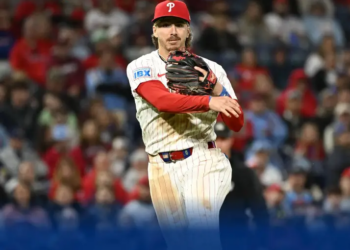
Bryson Stott is heading toward his final season of team control before becoming eligible for free agency after the 2027 campaign. With four major-league seasons behind him and a reputation as one of Philadelphia’s most versatile infield defenders, the second baseman could become a candidate for a contract extension.
Stott has accumulated 10.6 Baseball-Reference wins above replacement over his last four seasons combined, according to the supplied figures. That production highlights the value he has provided beyond his offensive numbers alone.
For president of baseball operations Dave Dombrowski, the decision could come down to a familiar question: should the Phillies secure a valuable player before he reaches the open market, or wait another season to see how his performance develops?
There is a compelling argument for acting early. However, Philadelphia also has several other roster decisions to make, and Stott’s offensive consistency will likely influence how aggressively the organization pursues an extension.
THE PHILLIES HAVE A REASON TO KEEP THEIR HOMEGROWN INFIELDER
Stott represents something increasingly important to the Phillies: a player who developed within the organization and has established himself as a regular contributor at the major-league level.
Philadelphia selected him 14th overall in the 2019 MLB Draft, and he made his major-league debut in 2022. Since then, he has developed into a versatile infielder capable of providing value at multiple positions.
His defensive ability is a major part of his appeal.
Stott offers the Phillies flexibility when constructing their infield, and that could become especially valuable as the organization evaluates its options at second base, shortstop, and third base.
Philadelphia has plenty of expensive veterans under contract. Maintaining a productive player who can contribute defensively while offering speed and offensive upside could help the team balance its roster.
Stott’s value should not be measured exclusively by home runs or batting average.
In an offseason when the Phillies must determine how to improve their lineup without making every problem a costly free-agent signing, retaining a reliable defender could be a sensible part of the plan.
HIS DEFENSIVE VALUE COULD MAKE AN EXTENSION WORTH CONSIDERING
The Phillies have experienced defensive concerns across their infield, making Stott’s versatility particularly relevant.
A strong defender can help a pitching staff by turning difficult ground balls into outs, reducing the number of additional opportunities opponents receive, and providing stability during high-pressure situations.
Stott has the ability to play second base and has experience at shortstop and third base. That flexibility gives Philadelphia options when injuries, roster changes, or matchup considerations affect the lineup.
It also makes him a potentially useful piece as the Phillies consider their longer-term infield structure.
If Philadelphia ultimately changes personnel at other positions, Stott could help provide continuity through the transition.
An extension would give the organization greater certainty about at least one part of its infield while allowing the front office to focus on other needs.
However, defensive versatility alone should not determine the financial terms. The Phillies must consider his overall contribution, projected future performance, and the salary he could command through arbitration and free agency.
The goal should be to secure a fair deal that benefits both the player and the organization.
THE BIGGEST QUESTION IS WHETHER STOTT CAN BECOME MORE CONSISTENT AT THE PLATE
While Stott’s glove strengthens his case for an extension, his offensive production complicates the conversation.
He finished the 2026 regular season with a .256 batting average, 10 home runs, 67 RBIs, and 27 stolen bases, according to MLB’s official statistics. His .735 OPS reflected a solid but not dominant offensive season.
Those numbers show that Stott can contribute in several ways, particularly with his ability to steal bases and create opportunities on the basepaths.
Nevertheless, Philadelphia needs more consistent production from its supporting hitters.
The Phillies struggled offensively in 2026, and Stott’s season included stretches of strong production as well as periods when his bat cooled considerably. That inconsistency is one reason the front office must carefully evaluate his long-term offensive outlook.
An extension would represent a bet that Stott can continue providing defensive value while improving his offensive consistency.
He does not necessarily need to become a power hitter to justify a long-term role. Better on-base production, reliable contact, and continued speed could make him an important contributor in a lineup built around power hitters.
But the Phillies must determine how much improvement they reasonably expect before committing additional years and guaranteed money.
WAITING TOO LONG COULD MAKE THE DECISION MORE EXPENSIVE
One argument for negotiating an extension now is the opportunity to establish financial certainty before Stott reaches free agency.
The Phillies have already demonstrated a willingness to make significant long-term commitments to players they believe can help the organization compete.
A successful extension could provide Stott with security while allowing Philadelphia to retain a familiar contributor beyond 2027.
The challenge is determining the appropriate contract length and value.
If Stott produces a strong offensive season in 2027, his negotiating position could improve. The Phillies might then face a more competitive market if other teams view him as an attractive free agent.
On the other hand, waiting would give Philadelphia another season of evidence before making a long-term commitment.
That distinction matters because the club is trying to build a roster capable of competing for a championship while managing several expensive contracts.
The front office must weigh the potential savings of an early agreement against the risk of guaranteeing money to a player whose offensive production remains inconsistent.
There is no guarantee that an extension would be cheaper, but negotiating before free agency could give both sides an opportunity to explore a deal without the pressure of an open-market bidding process.
THE PHILLIES HAVE OTHER INFIELD DECISIONS TO CONSIDER
Stott’s future cannot be separated from the rest of Philadelphia’s infield planning.
Alec Bohm and Luis Arraez are among the players whose contract situations could influence the team’s plans, while questions about Bryce Harper’s eventual position also affect how the infield might look in future seasons.
Philadelphia must determine which players fit its long-term plans and where it needs to make improvements.
That makes Stott an interesting case.
He is not necessarily the most productive hitter in the lineup, but he provides defensive flexibility and has already accumulated substantial major-league experience.
If the Phillies decide to make changes elsewhere, keeping Stott could provide stability.
However, the organization must avoid treating any extension as a substitute for improving the roster. Retaining Stott would not automatically solve the team’s offensive problems or eliminate its need to evaluate other infield options.
The best outcome would be a contract that preserves his value to the Phillies without limiting their ability to address more pressing weaknesses.
WHY A BRYSON STOTT EXTENSION COULD MAKE SENSE FOR BOTH SIDES
For Stott, an extension would offer long-term financial security and the opportunity to remain with the organization that drafted and developed him.
For Philadelphia, it could secure a versatile infielder entering what should be an important stage of his career.
The two sides would still need to agree on the length and financial structure of a deal. Stott’s defensive contribution, age, offensive track record, and projected future performance would all influence those discussions.
There is also a broader roster-building consideration.
The Phillies cannot rely exclusively on expensive veteran acquisitions to remain competitive. Developing and retaining productive homegrown players can help create a more balanced roster, particularly when those players can fill multiple roles.
Stott fits that profile.
The question is whether the Phillies believe his current level of production represents a reliable foundation for the next several seasons or whether they want to see another year of development before making a decision.
Given his defensive ability and versatility, an extension is a reasonable possibility to explore, even if the precise terms remain uncertain.
FINAL VERDICT: THE PHILLIES SHOULD EXPLORE AN EXTENSION, BUT THE PRICE MUST BE RIGHT
Philadelphia has several difficult decisions ahead, and Stott’s future deserves serious consideration.
His defensive skills, speed, experience, and homegrown status make him a valuable player to keep in the conversation. His combined 10.6 bWAR over the last four seasons, as cited in the supplied information, also provides a strong starting point for evaluating his overall contribution.
Still, the Phillies should not rush into a contract simply to avoid the possibility of losing him.
They need to establish how much they value his defense, what offensive improvement they expect, and how an extension would fit alongside their other financial commitments.
My verdict: The Phillies should explore an extension with Bryson Stott before he reaches free agency, but only at a price that reflects his overall value rather than an expectation that his bat will suddenly become elite.
Keeping Stott could provide valuable infield stability. The right contract could benefit both sides, while a poorly structured deal could create another financial complication for an organization already trying to maximize its championship window.
For now, the most important question is not simply whether Stott deserves to stay in Philadelphia.
It is whether the Phillies can find a deal that makes keeping him a smart baseball decision for the years ahead.



Discussion about this post