

A provocative statement about Caitlin Clark, Sophie Cunningham, Angel Reese, and the WNBA playoffs is reigniting debate about the league’s biggest stars, television ratings, and the growing divide among basketball fans. But is there any evidence that the playoffs were rigged to benefit Reese?
The WNBA has never lacked compelling storylines, but the conversation surrounding its most recognizable players has increasingly extended beyond the basketball court. Now, a controversial graphic attributed to Nick Adams is drawing attention for suggesting that the league’s postseason would be less appealing without Indiana Fever stars Caitlin Clark and Sophie Cunningham.
The graphic also alleges that the WNBA manipulated its playoff format to benefit Angel Reese and predicts that television ratings will suffer following Clark’s elimination.
Those are serious claims, but they should not be confused with established facts. There is no verified evidence presented in the graphic that the WNBA rigged its playoffs to benefit Reese.
Nevertheless, the controversy raises legitimate questions about the relationship between star power, sports marketing, television audiences, and the future of women’s basketball.
For Indiana Fever fans, the discussion is particularly relevant after the team’s season ended in a first-round playoff defeat to the Las Vegas Aces.
THE CONTROVERSIAL CLAIM PUTS CAITLIN CLARK BACK IN THE SPOTLIGHT
Clark remains one of the most recognizable players in women’s basketball, and her influence on the WNBA’s popularity is difficult to ignore.
Since entering the league, the Indiana Fever guard has attracted substantial attention from fans, broadcasters, sponsors, and national media outlets. Her long-range shooting, playmaking ability, and competitive personality have helped bring new viewers to women’s basketball.
That visibility has also created an intense debate about how much of the league’s commercial growth is connected to individual stars.
The graphic attributed to Adams argues that the WNBA would lose interest from some viewers without Clark and Cunningham. However, the suggestion that the league would become irrelevant without them is an opinion rather than an established fact.
The WNBA has featured numerous exceptional players, including A’ja Wilson, Breanna Stewart, Napheesa Collier, and many others whose performances have helped shape the league’s history.
Clark’s popularity and the accomplishments of those players are not mutually exclusive.
The more productive question is whether the league can use the attention surrounding Clark to build a larger audience that continues watching when the Fever are no longer competing.
That challenge will become increasingly important as the WNBA expands its audience and develops new rivalries.
DID THE WNBA RIG ITS PLAYOFFS TO BENEFIT ANGEL REESE?
The most inflammatory part of the graphic is its allegation that the WNBA rigged the playoffs to benefit Reese.
That claim requires evidence, not speculation.
The WNBA’s official 2026 postseason format placed eight qualifying teams into a bracket determined by their regular-season records. The first round was a best-of-three series, followed by best-of-five semifinals and a best-of-seven Finals.
There is no credible evidence in the graphic establishing that the league manipulated those arrangements to favor Reese.
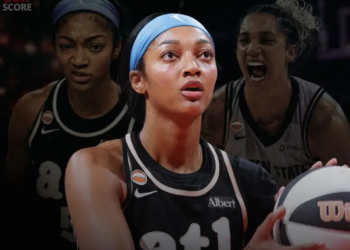
Reese and the Atlanta Dream have attracted considerable attention during their postseason run, but their success should be evaluated through their performances on the court rather than unsupported allegations about league officials.
Atlanta swept the New York Liberty in the semifinals to reach the WNBA Finals, while Golden State eliminated the defending champion Las Vegas Aces in the other semifinal series. Both teams earned their places in the championship round through their results.
Reese’s growing profile is part of the WNBA’s wider commercial story. Her performances, personality, and existing rivalry narratives have helped keep fans engaged.
But there is an important distinction between a league promoting its biggest stars and a league manipulating competition to produce a preferred outcome.
The former is normal sports marketing. The latter is a serious accusation that requires convincing evidence.
Without that evidence, claims of a rigged postseason should not be presented as fact.
ANGEL REESE’S FINALS RUN ADDS ANOTHER CHAPTER TO THE CLARK DEBATE
Reese’s journey to the 2026 WNBA Finals has created another opportunity for comparisons with Clark.
The two players became closely associated in the public conversation during their college careers, particularly after LSU defeated Iowa in the 2023 NCAA championship game.
Since then, their names have frequently appeared together in discussions about popularity, playing styles, media attention, and the growth of women’s basketball.
However, comparing their careers solely through the lens of rivalry overlooks the different roles they play on the court.
Clark is known for her perimeter shooting, passing, and ability to organize an offense. Reese has built her reputation around rebounding, physical interior play, and her ability to contribute around the basket.
Both bring different strengths to their teams.
Reese’s arrival in the Finals with Atlanta is a significant achievement in its own right. It should not automatically be interpreted as proof that she is better than Clark, just as Clark’s popularity does not establish that she is a superior player in every category.
Basketball comparisons are most useful when they account for production, responsibilities, efficiency, defense, and team results.
The real story is that the WNBA has multiple stars capable of attracting attention, and their success does not need to come at one another’s expense.
SOPHIE CUNNINGHAM’S ROLE IN THE FEVER’S GROWING PROFILE
Cunningham is another player mentioned in the controversial graphic.
The Indiana Fever guard has attracted attention for her competitive style, personality, and willingness to speak openly on issues surrounding the league.
Her presence alongside Clark has contributed to the Fever’s visibility, but it would be misleading to assume that the team’s popularity depends entirely on two players.
Indiana’s broader appeal also comes from its history, fan base, team development, and the excitement surrounding its young core.
Aliyah Boston’s interior presence and Kelsey Mitchell’s scoring ability have been important parts of the team’s identity.
Mitchell, in particular, produced an outstanding 2026 campaign, averaging 24.7 points per game, according to reporting on the Fever’s season-ending press conference. Clark averaged 22.3 points and 8.3 assists per game.
Those contributions illustrate why a successful franchise needs more than a recognizable face.
Clark may be a major attraction, but Indiana’s ability to win games depends on the performance of its entire roster.
The Fever’s next challenge will be maintaining that collective strength while continuing to build around their most important players.
WILL WNBA TELEVISION RATINGS SUFFER WITHOUT CAITLIN CLARK?
This is arguably the most commercially important question raised by the graphic.
Clark’s presence has helped attract large television audiences, and her first-round playoff matchup against Las Vegas generated considerable interest.
However, viral claims about the scale of the audience decline after Indiana’s elimination have sometimes exaggerated the available numbers.
A Sports Illustrated analysis of the debate reported that the comparison between the Fever-Aces opening game and the first games of the semifinals indicated a decline of approximately 44% to 47%, rather than the much larger drops claimed in some viral posts. The comparison involved different matchups and broadcasts, so it should not be treated as a precise measurement of Clark’s individual impact.
Television audiences are influenced by several factors, including scheduling, broadcast networks, competing sporting events, the teams involved, and the stage of the competition.
Clark’s popularity is an important part of that equation, but it is not the only factor.
The remaining playoffs also feature compelling stories. Golden State’s rise as a relatively young franchise and Atlanta’s return to the Finals provide narratives that can attract viewers who want to see something unexpected.
The league’s long-term objective should be to convert interest in individual players into sustained interest in the competition itself.
If fans begin watching because of Clark but stay to appreciate Wilson, Reese, Boston, and other stars, the entire league benefits.
WHY THE FEVER’S ELIMINATION MATTERS TO INDIANA FANS
Indiana’s season ended with a 94-83 loss to Las Vegas in Game 3 of their first-round series on October 1.
The Fever had responded to their opening defeat with a 99-89 victory in Game 2, forcing a decisive matchup before the Aces advanced.
Although the result ended Indiana’s championship hopes, the series demonstrated that the Fever could compete against an experienced contender.
The offseason now presents important questions about the team’s roster, player development, and ability to improve defensively.
Clark’s future partnership with Mitchell is especially significant. Mitchell is entering unrestricted free agency, and Clark has publicly expressed her desire to continue playing alongside her teammate.
Keeping the backcourt together could help Indiana maintain its offensive firepower, although the final decision will depend on the organization’s roster plans and Mitchell’s own priorities.
The Fever also need to consider how to make their offense more resilient when opponents focus their defensive attention on Clark.
That means improving off-ball movement, developing secondary playmakers, and ensuring the team can generate reliable scoring opportunities in difficult situations.
The controversy surrounding television ratings may dominate social media conversations, but Indiana’s basketball decisions will ultimately determine how competitive the team becomes next season.
THE BIGGER PICTURE: THE WNBA NEEDS RIVALRIES WITHOUT UNNECESSARY DIVISION
The WNBA benefits from strong rivalries.
Fans enjoy debating players, comparing teams, and predicting which stars will emerge victorious. Those conversations can increase engagement and introduce new audiences to the sport.
However, there is a difference between healthy competition and unsupported accusations that undermine the credibility of the league.
Clark and Reese can both succeed. Cunningham can attract attention without diminishing other players. And the WNBA can promote its most marketable athletes without suggesting that every other player matters less.
The league’s future will be stronger if its growing audience learns to appreciate different styles of play and a wider range of personalities.
For Indiana, that means embracing the attention Clark brings while continuing to develop a team capable of competing for championships.
For Atlanta, it means allowing Reese and her teammates to define their postseason run through their basketball performances.
And for the WNBA as a whole, it means turning controversy into sustained interest in the game rather than allowing unsubstantiated claims to dominate the conversation.
FINAL VERDICT: A VIRAL CLAIM IS NOT PROOF OF A RIGGED WNBA PLAYOFF
The graphic attributed to Nick Adams has reignited a familiar debate about Caitlin Clark’s popularity, Sophie Cunningham’s profile, Angel Reese’s success, and the WNBA’s commercial future.
There is a reasonable discussion to be had about how much star players influence television audiences. Clark’s ability to draw attention is an important part of the league’s growth, and the Fever’s elimination naturally changes the storylines available to viewers.
But the allegation that the WNBA rigged its playoffs to benefit Reese is not supported by the evidence presented.
Atlanta’s run to the Finals deserves to be assessed on its merits, just as Indiana’s season should be evaluated through its results and opportunities for improvement.
Ultimately, the WNBA needs both recognizable superstars and compelling competition. One does not have to come at the expense of the other.







Discussion about this post