

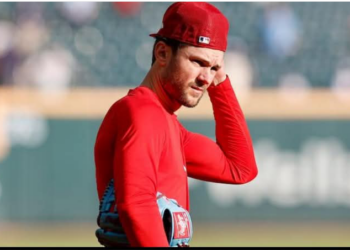
The Philadelphia Phillies could face a difficult decision this offseason, and second baseman Bryson Stott might find himself at the center of the team’s financial calculations.
With Stott projected to earn approximately $9.2 million in 2027 through salary arbitration, Philadelphia’s front office must determine whether his production justifies the expected cost or whether the organization would be better served exploring a trade.
For a franchise with championship aspirations, the decision is about much more than one player’s salary. The Phillies must balance the desire to keep their competitive core together with the financial realities of maintaining an expensive roster.
Superstars such as Bryce Harper, Kyle Schwarber and Aaron Nola already command significant financial commitments. As the organization’s payroll grows increasingly concentrated among established players, the front office may have to make uncomfortable choices involving younger members of the roster.
Could Stott become an unexpected trade candidate? And if Philadelphia decides to move him, would that decision help the club build a stronger championship contender or create another problem at second base?
Those are the questions the Phillies must consider as their offseason plans take shape.
WHY BRYSON STOTT’S PROJECTED $9.2 MILLION SALARY MATTERS
Stott’s projected $9.2 million salary for 2027 is attracting attention because of what it could mean for Philadelphia’s roster-building strategy.
Salary arbitration allows eligible players to negotiate their compensation based on factors such as previous salaries, playing time, performance and comparisons with other players. It provides teams with a degree of contractual control, but it also means that retaining players becomes more expensive as they advance through their careers.
For Stott, the projected figure represents a potential increase in the Phillies’ financial commitment to a player who has developed into an important part of their infield.
However, a $9.2 million salary does not automatically make a player expendable.
The real question is whether the Phillies believe Stott provides enough offensive production, defensive value, versatility and long-term potential to justify that investment.
If the organization views him as an essential contributor to its next championship push, keeping him could make sense. If management believes his role can be filled internally or through a less expensive alternative, the situation becomes more complicated.
Importantly, the $9.2 million figure is a projection rather than a confirmed final salary, and arbitration estimates should not be confused with a completed contract agreement.
THE PHILLIES’ BIG CONTRACTS COULD FORCE DIFFICULT DECISIONS
Philadelphia’s financial commitments are central to understanding why Stott’s future could become a talking point.
Bryce Harper remains one of the defining players of the franchise, while Kyle Schwarber has been an important part of the team’s power-focused offensive identity. Aaron Nola is another major piece of the organization’s long-term plans.
These commitments reflect Philadelphia’s determination to compete at the highest level.
Investing heavily in established stars can help a team maintain a championship window, particularly when those players provide the offensive production, experience and leadership required to compete in October.
But there is another side to that strategy.
When a significant portion of a team’s payroll is committed to a relatively small group of players, the front office has less flexibility to address weaknesses elsewhere. Retaining depth, improving the bullpen, strengthening the bench and pursuing external free agents can become more difficult.
The problem is not necessarily that the Phillies cannot afford Stott.
Rather, the organization must determine whether spending approximately $9.2 million on him represents the best use of its available resources.
That distinction matters.
A franchise can have the financial resources to retain a player while still deciding that allocating those resources elsewhere would improve the roster.
COULD THE PHILLIES TRADE STOTT FOR YOUNG PROSPECTS?
One possible scenario is that Philadelphia explores Stott’s trade value rather than committing to his projected arbitration salary.
A trade could allow the Phillies to acquire younger prospects, strengthen their farm system or address another area of need.
For an organization attempting to remain competitive while preparing for the future, that approach could have some appeal.
Stott is also the type of player who could interest another club looking for an established second baseman with major-league experience.
Teams with a need at the position might value the opportunity to acquire a player who could contribute immediately rather than relying on an unproven prospect.
Philadelphia could potentially use that interest to negotiate a return that includes promising young talent.
However, there is an important caveat: a possible trade is not the same as a confirmed plan.
Without a reported offer, a direct statement from the front office or credible confirmation of active negotiations, it would be premature to suggest that the Phillies have decided to move Stott.
The more reasonable conclusion is that his projected salary could make him a player worth evaluating as the organization considers its offseason options.
WHY TRADING STOTT COULD BACKFIRE
Although trading Stott might provide financial flexibility or bring promising prospects into the organization, the move would carry meaningful risks.
First, Philadelphia would need to find a dependable replacement at second base.
Trading an established major-league player without securing an adequate replacement could create a weakness that becomes increasingly costly over a long season.
Second, the Phillies would have to consider the difference between prospect potential and major-league production.
Young players can develop into valuable contributors, but their progress is never guaranteed. A prospect who looks promising today might require several seasons to become a reliable everyday player.
If Philadelphia is serious about winning a championship in the near future, sacrificing established production for uncertain future value could be a difficult decision to justify.
Third, the organization must consider the broader effect on its roster.
Championship teams need more than a collection of expensive stars. They also need dependable contributors who can handle difficult defensive assignments, produce important hits and provide depth throughout a demanding 162-game season.
If Stott fills those roles effectively, his value could extend beyond what his salary alone suggests.
The Phillies should therefore avoid treating his projected arbitration figure as the only factor in their decision.
THE BIGGER PROBLEM: BUILDING A CHAMPIONSHIP ROSTER AROUND EXPENSIVE STARS
Philadelphia’s situation highlights a challenge faced by many major-league teams: how to maintain a competitive roster when several established players account for substantial portions of the payroll.
Paying elite players can be worthwhile when their performance matches their contracts. The difficulty comes when a team must fill the remaining positions without compromising its overall quality.
The Phillies need to evaluate their roster as a complete unit.
Can they maintain a strong starting rotation? Do they have sufficient bullpen depth? Is the lineup balanced enough to handle different types of postseason pitching? Are there affordable internal options who can contribute consistently?
Those questions should influence the decision about Stott.
If the organization believes it can improve several areas by trading him, the move might be worth exploring. If his departure would create a hole that requires an expensive replacement, the financial benefit could disappear quickly.
The goal should not simply be to reduce payroll.
The goal should be to get the greatest possible value from every roster spot while keeping the team capable of competing for a World Series title.
WHAT WOULD STOTT’S DEPARTURE MEAN FOR THE PHILLIES’ OFFENSE?
Stott’s future also matters because the Phillies need a lineup capable of supporting their biggest offensive stars.
Harper and Schwarber can provide substantial power, but a successful lineup requires more than home runs. Teams benefit from players who can reach base, move runners, contribute situationally and prevent the offense from becoming too dependent on a handful of hitters.
Stott’s overall offensive value must be evaluated in that context.
His batting performance, on-base ability, baserunning, defensive contributions and consistency should all factor into Philadelphia’s assessment.
If his production is strong enough to justify his salary, keeping him could help maintain continuity throughout the lineup.
If the front office believes another player can provide comparable value at a lower cost, a change might be defensible.
But replacing Stott would not automatically make the Phillies better.
The organization would need to demonstrate that the player taking his place could provide sufficient production and that any financial savings would be used intelligently.
Otherwise, Philadelphia could save money while making its lineup less effective.
THE PROSPECT ANGLE: IS NOW THE TIME TO REBUILD THE FARM SYSTEM?
A potential Stott trade would also raise questions about Philadelphia’s long-term player-development strategy.
Prospects can provide affordable production, especially when they reach the major leagues before becoming eligible for more expensive salary arrangements.
A strong farm system also gives a front office more options when injuries occur or when the team needs to make a significant trade.
For the Phillies, acquiring young talent could help replenish the organization’s future options while preserving flexibility for upcoming seasons.
However, there is a difference between adding prospects and acquiring prospects who can genuinely improve the organization.
Philadelphia should prioritize quality over quantity if it considers moving an established player.
A return built around players with realistic major-league potential would be more attractive than a package that looks impressive on paper but offers little certainty.
The front office must also determine whether the expected return would justify giving up a contributor who could help the team immediately.
That balance between present competitiveness and future flexibility will be central to the Phillies’ offseason decisions.
MY PREDICTION: THE PHILLIES SHOULD EXPLORE THEIR OPTIONS BEFORE MAKING A MOVE
My view is that Philadelphia should evaluate Stott’s trade value, but it should not rush to move him simply because his projected salary could reach $9.2 million.
The front office needs to establish three things before making a final decision.
First, it must determine Stott’s actual value to the team, including his defense and overall contribution rather than focusing exclusively on his offensive statistics.
Second, it must identify realistic replacement options. If the Phillies can replace his production internally, a trade becomes easier to consider. If doing so would require signing an expensive free agent or surrendering valuable prospects, keeping Stott could be the better choice.
Third, Philadelphia must assess the quality of any potential trade return.
A deal that brings back legitimate young talent while opening a clear path to improving another position could make sense. A move designed primarily to save money, without a convincing plan for replacing Stott, would be much harder to defend.
My prediction is that Stott’s salary will be a factor in Philadelphia’s offseason evaluation, but his future should ultimately depend on the overall value he provides and the alternatives available to the club.
Unless the Phillies identify a compelling replacement or receive an attractive offer, retaining a productive player could be more beneficial than making a move simply for financial relief.
THE FINAL VERDICT: SHOULD PHILADELPHIA KEEP OR TRADE BRYSON STOTT?
The possibility of a Bryson Stott trade presents the Phillies with a difficult roster-building question.
Philadelphia has invested heavily in established stars, and those financial commitments will inevitably influence decisions involving other players.
A projected $9.2 million arbitration salary could make Stott’s future worth examining, especially if the front office believes that money could be allocated more effectively elsewhere.
But the Phillies must be careful not to confuse an expensive roster with a roster that cannot afford another useful player.
The real issue is whether Stott’s salary matches his value and whether trading him would make the team stronger.
If Philadelphia can secure a promising return and replace his contributions without weakening the infield, a trade could be worth considering.
If not, keeping him might be the smarter move for a team with championship ambitions.
Ultimately, the Phillies must decide whether their best path forward involves maintaining their current core or making difficult changes to create more flexibility.
WHAT DO YOU THINK, PHILLIES FANS?
Would you trade Bryson Stott for young prospects if his salary reaches $9.2 million in 2027, or should Philadelphia keep him and focus on strengthening other areas of the roster?
Is the Phillies’ expensive core becoming a financial problem, or is keeping their best available players the right strategy for pursuing a World Series?
Share your thoughts in the comments. This could become one of Philadelphia’s most interesting offseason debates.







Discussion about this post