

The Philadelphia Phillies have reached a critical crossroads, and another quiet offseason could be a costly mistake. Despite assembling a roster filled with established stars and significant financial commitments, the franchise still faces difficult questions about its ability to take the final step toward a World Series championship.
President of baseball operations Dave Dombrowski now faces a challenge that goes beyond signing another big-name free agent. The Phillies must determine which players remain essential to their championship ambitions, which positions require immediate upgrades, and whether their current roster construction can withstand another demanding postseason.
The 2027 season represents an opportunity to reset the team’s direction without abandoning its championship window. However, doing so will require more than minor adjustments around the edges.
Philadelphia needs a clearer offensive identity, better defensive balance, dependable bullpen depth, and a willingness to make uncomfortable personnel decisions. The organization also must avoid sacrificing its future simply to squeeze another season out of an aging core.
A realistic offseason plan could involve pursuing Japanese star Seiya Suzuki, adding power at second base, reconsidering Trea Turner’s defensive responsibilities, and rebuilding the bullpen with multiple reliable arms rather than concentrating the entire budget on one expensive reliever.
Some of these ideas would be controversial. Others would require creative negotiations and careful financial planning. Together, however, they offer a framework for rebuilding the Phillies into a more balanced contender.
The biggest question is whether Dombrowski is prepared to make the difficult decisions necessary to turn Philadelphia’s championship ambitions into reality.
WHY THE PHILLIES NEED A MAJOR OFFSEASON RESET
The Phillies cannot afford to confuse continuity with progress.
Keeping a successful core together can provide stability, but that strategy becomes less effective when the same weaknesses continue to surface. A roster can feature outstanding individual players and still fall short because its pieces do not complement one another.
Philadelphia’s challenge is to preserve its greatest strengths while correcting the problems that limit its overall ceiling.
The lineup needs to maintain its ability to produce extra-base hits and punish mistakes. At the same time, the club must find ways to generate more consistent offense when its power hitters encounter difficult pitching.
Defensively, the Phillies need to consider whether their current positional arrangements are helping or hurting the team. The infield, in particular, deserves attention as the organization weighs the value of individual offensive production against the importance of reliable defense.
The bullpen is another major concern. A championship-caliber team cannot depend on a single dominant closer to solve every late-inning problem. Injuries, fatigue, unfavorable matchups, and postseason pressure can expose even the strongest relief corps.
That is why the Phillies should approach the winter with a comprehensive plan instead of treating each weakness as an isolated problem.
The goal should not simply be to assemble the most recognizable collection of players. It should be to build a roster capable of winning games in different ways.
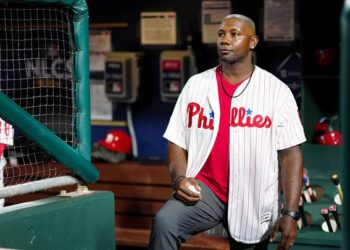
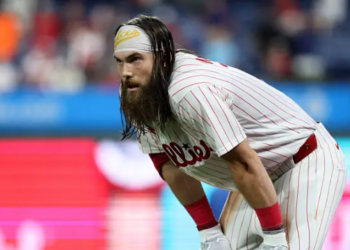
1. BRING RHYS HOSKINS BACK AS A LOW-RISK POWER OPTION
Reuniting with Rhys Hoskins would be an emotional move, but it could also make baseball sense under the right circumstances.
Hoskins remains closely associated with an important period in the Phillies’ recent history. His power helped establish the offensive foundation of the team that reached the 2022 World Series, and his personality made him a recognizable figure among Philadelphia supporters.
Unfortunately, his career trajectory changed dramatically after a torn ACL cost him the 2023 season.
His subsequent production has not returned to its previous level, and his time with Milwaukee and Cleveland has demonstrated the uncertainty surrounding his current offensive value.
Nevertheless, declining production does not automatically make a player useless.
Hoskins has historically possessed two offensive qualities that remain valuable: power and the ability to draw walks. Those skills could make him an interesting depth option if Philadelphia can negotiate a financially reasonable agreement.
The key would be finding the right role.
Bryce Harper remains the natural first-base centerpiece, while Kyle Schwarber occupies the designated hitter position. Hoskins therefore should not be considered a starter who needs a guaranteed place in the everyday lineup.
Instead, the Phillies could explore bringing him to spring training on a minor league contract with an opportunity to earn a roster spot.
In that role, Hoskins could provide right-handed power off the bench, occasional starts against favorable matchups, and another experienced hitter for situations when the Phillies need a home run.
THE BIGGEST ADVANTAGE: Philadelphia could potentially add an experienced power bat without making a major financial commitment.
There are risks, particularly concerning his defense, age, and recent offensive decline. However, a low-cost reunion would allow the Phillies to evaluate his remaining value without sacrificing meaningful payroll flexibility.
The prediction: Hoskins makes sense as a depth signing, provided the Phillies do not mistake nostalgia for a reason to guarantee him a prominent role.
2. CHOOSE A MANAGER WHO WILL HOLD EVERY PLAYER ACCOUNTABLE
Philadelphia’s managerial search could be just as important as its decisions in free agency.
The next manager must understand that leading a roster of established veterans requires more than maintaining a positive clubhouse atmosphere. The job also involves difficult conversations, lineup decisions, defensive adjustments, and the ability to make unpopular choices when the team’s performance demands them.
Alex Cora had emerged as a prominent name in the Phillies’ managerial conversation because of his previous success and professional relationship with Dombrowski. However, according to the supplied report, Cora declined the opportunity.
That development forces Philadelphia to reconsider its options.
One alternative worth discussing is Buck Showalter, whose extensive managerial experience includes four Manager of the Year awards and a career record of 1,727 wins and 1,665 losses, according to the figures provided in the original report.
Showalter’s appeal would center on experience, preparation, and a reputation for demanding accountability.
The Phillies have several established players with significant contracts. Any manager taking over the club must be comfortable evaluating players according to their current contributions rather than their reputations.
That could mean changing batting-order positions, limiting playing time during prolonged slumps, or adjusting defensive assignments when another arrangement gives the team a better chance to win.
However, experience alone does not guarantee success.
Showalter has managed talented teams with championship aspirations, but his teams have also experienced postseason disappointments. Philadelphia would need to determine whether his approach fits the current roster and whether his communication style would resonate with its veteran players.
The organization should also consider younger managerial candidates who bring modern approaches to player development, analytics, and bullpen management.
THE BIGGEST QUESTION IS NOT WHETHER A MANAGER HAS A BIG NAME. IT IS WHETHER HE CAN MAKE DIFFICULT DECISIONS WITHOUT LOSING THE CLUBHOUSE.
The Phillies need someone who can respect their stars while maintaining consistent standards for the entire roster.
That balance could prove more valuable than hiring a manager simply because he has previously won games elsewhere.
3. MAKE SEIYA SUZUKI A PRIORITY IN THE OUTFIELD
If Philadelphia wants to make one significant offensive addition this offseason, Seiya Suzuki deserves serious consideration.
The Japanese-born outfielder has established himself as a productive major league hitter since arriving from Japan. His combination of power, plate discipline, and right-handed hitting would address several potential needs in Philadelphia’s lineup.
According to the statistics in the supplied report, Suzuki posted a .270 batting average, .368 on-base percentage, and .473 slugging percentage in 2026, along with 31 doubles and 26 home runs.
Those numbers illustrate why he could be an attractive target.
Philadelphia’s lineup has featured substantial left-handed power, and another productive right-handed hitter could help create more balanced matchups against opposing pitchers.
Suzuki would also provide a potential upgrade in the outfield, although his defensive record should be evaluated carefully rather than treated as a guarantee of continued excellence.
The Phillies must determine whether he can handle the demands of their preferred defensive alignment while maintaining his offensive production.
There is also a financial consideration.
The original proposal suggests a contract in the neighborhood of five years and $100 million, with flexibility to increase the offer if necessary. That should be treated as a proposed negotiating framework, not a confirmed market price or an established agreement.
Philadelphia would need to compare Suzuki’s expected production with the cost of other available outfielders before making a final decision.
Still, the strategic appeal is clear.
A productive right-handed outfielder could help Philadelphia improve its lineup without requiring the organization to overhaul its entire offensive identity.
Suzuki’s international background also offers the franchise an opportunity to strengthen its connection with Japanese baseball fans and expand its global presence.
That commercial benefit should remain secondary to his performance on the field, but it could add another dimension to the signing.
THE VERDICT: Suzuki would be a compelling target if the Phillies can secure a reasonable contract and establish a defensive role that maximizes his strengths.
4. ADD BRANDON LOWE TO INCREASE THE LINEUP’S POWER
The Phillies could also consider a substantial upgrade at second base by pursuing Brandon Lowe.
Lowe has developed a reputation as a productive power hitter, and the statistics supplied in the original report show why his bat could attract Philadelphia’s attention.
He reportedly finished the 2026 season with an .824 OPS and 35 home runs while playing for Pittsburgh.
A second baseman capable of approaching that level of power would give the Phillies another weapon in the middle of their batting order.
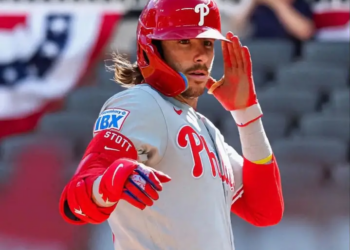
However, signing Lowe would create an important roster question: what happens to Bryson Stott?
Stott has spent much of his Phillies career at second base, but his defensive versatility could provide the organization with options. If Philadelphia believes Lowe offers a meaningful offensive upgrade, it could consider moving Stott to another infield position.
That decision would depend on the team’s evaluation of each player’s defensive ability, offensive production, and long-term value.
Luis Arraez is another consideration. Philadelphia could explore retaining him if the financial terms and projected role make sense, but the club must compare his contact-oriented approach with Lowe’s greater home-run potential.
The choice ultimately comes down to roster construction.
A team does not necessarily become better by adding another hitter with impressive statistics. It becomes better when that hitter fills a weakness without creating an even larger problem elsewhere.
Lowe would offer substantial offensive upside, but his acquisition would require a clear defensive plan and careful consideration of the lineup’s existing left-handed hitters.
The proposed four-year, $80 million framework provides a starting point for discussion, not a guarantee that Lowe would accept such a deal.
Philadelphia should pursue him only if the projected offensive improvement justifies the financial investment.
5. MOVE TREA TURNER TO LEFT FIELD IF THE NUMBERS SUPPORT IT
Few potential Phillies roster decisions would generate more debate than moving Trea Turner away from shortstop.
Turner signed a major contract before the 2023 season, and the organization invested heavily in his speed, offensive ability, and overall value. However, a long-term commitment should not prevent the Phillies from reassessing his defensive position.
The supplied report identifies Turner’s defensive performance and disappointing 2026 offensive production as reasons to consider a change.
It lists his 2026 OPS at .675, a figure that would represent a significant concern for a player expected to contribute near the top of the lineup.
If Turner is struggling defensively and producing less offensively, Philadelphia must investigate whether a positional adjustment could help him regain his effectiveness.
Left field could be one option.
Moving Turner to the outfield might reduce the demands associated with playing shortstop while creating flexibility elsewhere in the infield. It could also open shortstop for a player the organization believes can provide stronger defense.
Bryson Stott is one possible candidate, depending on the team’s evaluation of his ability to handle the position regularly.
However, this proposal deserves careful consideration rather than an automatic endorsement.
MOVING TURNER TO LEFT FIELD WOULD NOT GUARANTEE BETTER DEFENSE OR A STRONGER OFFENSE.
Turner would need to adapt to a new position, and the Phillies would have to determine whether his athleticism and throwing ability translate effectively to the outfield.
The organization would also need to consider how the move affects its other outfielders, including any new player acquired in free agency.
A positional change can sometimes help an established player concentrate on hitting by reducing the demands of a difficult defensive assignment. In other cases, it simply moves a weakness from one part of the field to another.
The best approach would be to evaluate the available defensive metrics, consult the coaching staff, and communicate the reasoning directly to Turner.
His contract makes the decision more complicated financially, but it should not make the decision impossible.
The Phillies should prioritize winning baseball games while treating a veteran star with the respect his contributions deserve.
6. EXPLORE A TRADE INVOLVING BRANDON MARSH
Brandon Marsh has become a recognizable and popular member of the Phillies, but his future deserves an honest evaluation.
Marsh has contributed energy, defensive versatility, and important offensive moments since joining Philadelphia in 2022. His connection with the club and its supporters would make any trade discussion difficult.
However, roster decisions cannot be based entirely on popularity.
According to the supplied report, Marsh made the All-Star team in 2026 but experienced a significant second-half decline. The report also estimates his next arbitration salary at approximately $8.3 million.
Those circumstances create a legitimate question about whether the Phillies should continue using him in his current role.
If Philadelphia signs Suzuki and explores moving Turner to left field, Marsh’s playing time could become more limited.
Paying a substantial salary for a part-time player is not necessarily a mistake, particularly when that player provides valuable defense or excels against a particular type of pitcher. But the Phillies must determine whether Marsh’s expected contributions justify the cost.
A trade could help the organization redistribute resources to positions where it needs more depth.
The Toronto Blue Jays represent one hypothetical trade partner mentioned in the original proposal. Their outfield situation could make an experienced player like Marsh worth investigating, depending on their roster needs and offseason priorities.
The proposed return includes catcher Brandon Valenzuela and utility player Josh Smith.
Such a deal would need to be evaluated carefully.
Valenzuela could provide catching depth behind J.T. Realmuto, while Smith’s ability to cover multiple positions might give Philadelphia more flexibility off the bench.
Nevertheless, the Phillies cannot assume Toronto would accept that package. The Blue Jays would have their own valuation of Marsh, their own budget constraints, and alternative ways to address their roster.
Philadelphia should explore the market without treating a specific trade as inevitable.
If another team offers a return that improves the Phillies’ depth and future flexibility, moving Marsh could make sense.
If the available offers are underwhelming, retaining him may be the better baseball decision.
7. TRADE ORION KERKERING ONLY IF THE RETURN MAKES SENSE
The Phillies must also decide how much patience to extend to Orion Kerkering.
Kerkering entered the majors with considerable promise, supported by an explosive fastball and a slider capable of generating swings and misses.
However, the supplied report describes a difficult 2026 season in which his struggles became significant enough for Philadelphia to send him to Triple-A and leave him off the postseason roster.
That development creates an important question about his future.
Should the Phillies continue investing in his development, or should they trade him while another organization still values his raw ability?
There are reasonable arguments on both sides.
Relief pitchers can experience significant year-to-year fluctuations, particularly when command, confidence, and pitch execution become inconsistent.
A change of scenery could help Kerkering simplify his approach and rediscover the form that made him an exciting young arm.
At the same time, trading a talented pitcher immediately after a difficult season risks selling low.
The Phillies should first determine whether Kerkering’s problems are correctable through mechanical adjustments, improved pitch selection, or a more suitable role.
If the organization believes another club can help him develop, a trade could be appropriate.
The proposed scenario involves the Athletics, who could use additional pitching depth, with Zack Gelof identified as a potential return.
However, Gelof’s offensive rebound and remaining team control would make him a valuable asset. Philadelphia should not assume that Kerkering alone would be enough to secure him.
Any such deal would require negotiations involving player value, salary commitments, and potentially additional prospects or players.
The original proposal also discusses Luis Severino as a possible addition to the transaction, including the financial implications of his reported player option.
That type of complicated trade could theoretically address multiple roster needs, but it would require both organizations to agree on the value of every component.
The Phillies should pursue the broader objective rather than become attached to one elaborate scenario.
THE PRIORITY SHOULD BE IMPROVING THE ROSTER, NOT TRADING A YOUNG PITCHER SIMPLY BECAUSE HIS STOCK HAS FALLEN.
If Kerkering can still become a dependable late-inning reliever, Philadelphia may benefit more by keeping him than by accepting a disappointing return.
8. REBUILD THE BULLPEN WITH MULTIPLE RELIABLE ARMS
If there is one area where Philadelphia should resist taking unnecessary financial risks, it is the bullpen.
A dominant closer can make a tremendous difference, but even the best reliever cannot solve every problem over a six-month regular season and a demanding postseason.
The Phillies need a deeper group of pitchers capable of handling different innings, matchups, and situations.
Jhoan Duran provides an important foundation at the back of the bullpen, while Alex McFarlane is identified in the supplied report as a promising contributor.
However, the club needs more reliable options to bridge the gap between its starting rotation and its closer.
One strategy would be to spread the available money across several relievers rather than spend most of the budget on a single expensive acquisition.
The original proposal identifies Evan Phillips, Alex Vesia, Emilio Pagán, Raisel Iglesias, Paul Sewald, and Shawn Armstrong as possible targets.
Their availability, health, performance projections, and asking prices would need to be verified before the Phillies committed to any of them.
Still, the underlying strategy is sound.
Philadelphia could pursue one dependable left-handed reliever, one experienced setup man, and another lower-cost option capable of handling middle innings.
That approach would give the manager more flexibility and reduce the pressure on Duran to appear in every important game.
The club should also evaluate its internal pitching depth rather than assuming every bullpen problem requires an outside acquisition.
Young pitchers can emerge unexpectedly, but relying on several unproven arms at once would be a dangerous strategy for a team with championship ambitions.
A better bullpen would have several benefits.
It would allow the manager to avoid overworking his most trusted relievers during the regular season. It would create more favorable matchup options against dangerous opposing lineups. Most importantly, it would reduce the likelihood that one injury or prolonged slump destabilizes the entire relief corps.
THE PHILLIES DO NOT NEED THE MOST EXPENSIVE BULLPEN IN BASEBALL. THEY NEED ONE THEY CAN TRUST.
That means prioritizing command, consistency, availability, and the ability to retire hitters in high-leverage situations.
9. PROTECT THE FARM SYSTEM WHILE PURSUING IMMEDIATE SUCCESS
Philadelphia’s desire to win now must be balanced against the need to maintain a productive farm system.
The temptation to trade prospects for established major league players increases when a team believes its championship window is closing. Yet aggressive spending and trading can become counterproductive when the organization sacrifices too much of its future for short-term improvements.
A sustainable offseason should preserve the prospects most likely to become important major league contributors.
Aidan Miller is particularly relevant to the proposed roster plan because he could influence the team’s future infield alignment. If Philadelphia expects him to become a major league option, it should avoid making long-term commitments that unnecessarily block his path.
That does not mean every prospect must be untouchable.
Prospects are valuable because of their potential, but major league teams must eventually convert that potential into production. If a young player can help secure an established contributor who fills a significant need, a trade may be justified.
The important distinction is between a targeted upgrade and a transaction made out of desperation.
Philadelphia should be willing to trade from areas of organizational depth while protecting players who represent a realistic path toward sustained success.
That strategy becomes even more important when the club is considering several free-agent additions.
Free agency can address immediate weaknesses without requiring the Phillies to surrender multiple young players. Conversely, trades can provide flexibility when the free-agent market becomes too expensive.
Dombrowski must determine the right combination of both approaches.
A championship roster needs established stars, reliable supporting players, and younger contributors who can provide production without consuming a disproportionate share of the payroll.
The Phillies should pursue all three.
WHAT A REBUILT 2027 PHILLIES LINEUP COULD LOOK LIKE
If Philadelphia pursued the major ideas outlined above, a possible lineup could look like this:
- Trea Turner, LF: A potential positional change intended to reduce his defensive responsibilities while preserving his offensive upside.
- Bryce Harper, 1B: The established middle-of-the-order presence around whom the offense can be built.
- Kyle Schwarber, DH: A major power threat who can change a game with one swing.
- Seiya Suzuki, RF: A potential right-handed addition who would bring power and on-base ability.
- Brandon Lowe, 2B: A proposed acquisition who could add significant home-run production.
- Bryson Stott, SS: A possible infield adjustment that would depend on his suitability for the position.
- Zack Gelof, 3B: A hypothetical addition whose acquisition would depend on a workable trade agreement.
- J.T. Realmuto, C: An experienced catcher whose workload management would remain important.
- Justin Crawford, CF: A potential center-field option whose role would depend on his readiness and performance.
This is a speculative lineup, not a confirmed roster or a prediction that every proposed transaction will occur.
Several elements would depend on player availability, contract negotiations, defensive evaluations, and the Phillies’ assessment of their younger players.
The lineup would have a more pronounced right-handed presence through Suzuki, Lowe, and Turner, while Harper and Schwarber would remain central to the offense.
However, there is one important risk: the Phillies could become too dependent on home runs.
Lowe and Suzuki would provide additional power, but the organization must also ensure that the lineup can manufacture runs when the long ball disappears.
That requires disciplined at-bats, productive baserunning, situational hitting, and enough contact ability to take advantage of scoring opportunities.
A championship lineup must be capable of winning a 3-2 game as well as a 9-6 slugfest.
THE PROPOSED STARTING ROTATION AND BULLPEN
The starting rotation would remain one of the most important factors in Philadelphia’s championship hopes.
A projected five-man rotation could feature:
- Zack Wheeler
- Cristopher Sánchez
- Jesús Luzardo
- Andrew Painter
- Aaron Nola
That group would offer a mixture of established major league experience and younger upside.
However, the Phillies must evaluate the health, workload, and availability of each pitcher before assuming the rotation will remain intact throughout 2027.
Starting pitching depth is particularly important because even a strong rotation can be disrupted by injuries.
The proposed bullpen would feature Duran as the closer, supported by Iglesias, Vesia, McFarlane, and several additional relief options.
If Philadelphia could assemble that type of group, it would have more flexibility in the late innings and a stronger foundation for navigating a postseason series.
Severino is also discussed in the original proposal as a possible depth starter, depending on the terms of a potential transaction and his contract situation.
That idea illustrates a broader principle: the Phillies should value pitchers who can provide dependable innings even when they are not part of the primary rotation.
A reliable sixth starter can prevent one injury from forcing the organization into an emergency search for pitching.
The same principle applies to the bullpen. Having several trustworthy relievers is more valuable than relying on a small group to handle every critical situation.
Philadelphia’s front office should make pitching depth a central part of its offseason planning.
CAN THE PHILLIES AFFORD THESE CHANGES?
The financial side of the proposed rebuild deserves as much attention as the baseball decisions.
The original report estimates that approximately $75 million could come off Philadelphia’s books during the offseason. That figure should be independently verified against the final contract structure, arbitration decisions, options, and other payroll obligations.
Even if that estimate is accurate, it does not mean the Phillies can spend the entire amount without consequences.
The organization must account for new contracts, existing commitments, arbitration salaries, potential bonuses, and the cost of maintaining adequate depth.
Signing Suzuki and Lowe while also adding multiple relievers could consume a significant portion of the available financial flexibility.
Taking on Severino’s reported option in a trade would create another expense, even if the move delivered useful rotation insurance.
The Phillies must also consider whether a long-term contract for a player in his early thirties would create additional financial pressure later in the deal.
That is particularly important when evaluating outfielders and power hitters whose production could change as they age.
A reasonable offseason budget should therefore include money for unexpected needs rather than allocate every available dollar to projected starters.
Injuries and underperformance are inevitable over a full season. The teams best equipped to survive them are often the ones that preserve enough flexibility to respond.
Owner John Middleton has demonstrated a willingness to invest in the team’s pursuit of success, but spending alone does not guarantee a championship.
The Phillies must make their money work harder by targeting players whose skills address specific weaknesses.
The ideal outcome would be a more balanced roster without a dramatic and unnecessary increase in overall payroll.
HOW THESE MOVES COULD AFFECT THE NL EAST RACE
Philadelphia’s offseason decisions would have consequences beyond its own clubhouse.
The Atlanta Braves remain a natural point of comparison when evaluating the Phillies’ potential to contend for the National League East title.
A stronger Phillies lineup could make the division race more competitive, particularly if Suzuki and Lowe provide the offensive production the club expects.
A deeper bullpen could also prove decisive during a long season when the division’s leading teams face repeated head-to-head matchups.
However, Atlanta will have its own offseason priorities, and Philadelphia cannot assume its rivals will stand still.
The Phillies must concentrate on improving their own roster rather than relying on another club to decline.
The National League postseason also presents a separate challenge.
Winning the division would be valuable, but the ultimate objective is to assemble a team capable of surviving a short playoff series against elite opposition.
That requires starting pitchers who can deliver quality innings, relievers who can handle high-pressure matchups, and hitters who can produce without relying entirely on home runs.
It also requires defensive reliability.
One costly error or a poorly managed bullpen inning can change the direction of a postseason game.
Philadelphia should therefore judge its offseason by how much it improves the team’s ability to perform under pressure, not simply by how many recognizable names it adds.
If the Phillies can strengthen their defense, deepen their pitching staff, and maintain their offensive power, they could improve their chances of competing for the division and making a serious postseason run.
But no collection of offseason transactions can guarantee a championship.
THREE PREDICTIONS FOR THE PHILLIES’ 2027 OFFSEASON
PREDICTION 1: THE PHILLIES WILL TARGET A RIGHT-HANDED OUTFIELDER
Outfield production and lineup balance make this an obvious area to investigate.
Suzuki is an attractive hypothetical target, but Philadelphia should remain open to alternatives if his asking price becomes unreasonable.
The important objective is acquiring a productive hitter who can complement the existing lineup without creating another defensive weakness.
PREDICTION 2: THE BULLPEN WILL RECEIVE MULTIPLE ADDITIONS
Philadelphia should not enter another season expecting Duran to solve every late-inning problem.
Adding more than one dependable reliever would give the manager better matchup options and reduce the workload on the team’s most trusted arms.
The precise names will depend on availability and cost, but bullpen depth should remain a priority.
PREDICTION 3: AT LEAST ONE ESTABLISHED PLAYER COULD FACE A POSITIONAL CHANGE OR TRADE DISCUSSIONS
The Phillies must be willing to reassess how their roster fits together.
Turner’s defensive role, Marsh’s playing time, and Stott’s infield versatility are all legitimate subjects for internal evaluation.
That does not mean a trade or positional switch is inevitable. It means the organization should consider every reasonable option that could improve the team’s overall performance.
The most successful offseason may ultimately involve fewer dramatic moves than the proposal outlined here.
What matters is whether Philadelphia identifies its weaknesses accurately and addresses them with discipline.
FINAL VERDICT: DAVE DOMBROWSKI MUST BUILD A BETTER TEAM, NOT JUST A BIGGER ROSTER
The Philadelphia Phillies do not necessarily need to dismantle their established core to regain their championship momentum.
They need to improve the way that core fits together.
Bringing back Rhys Hoskins on a low-risk deal could provide useful bench power. Pursuing Seiya Suzuki could improve the outfield and strengthen the right-handed side of the lineup. Brandon Lowe could offer another source of home-run production, while a more reliable bullpen would reduce the pressure on Philadelphia’s starting pitchers.
At the same time, the organization must be prepared to reconsider Turner’s defensive assignment, evaluate Marsh’s trade value, and make difficult decisions about the bullpen’s younger arms.
The managerial appointment will also matter. Philadelphia needs a leader who can manage expectations, communicate clearly with veteran players, and make decisions based on the team’s needs rather than individual reputations.
None of these moves is guaranteed to work, and several would require significant negotiations.
The proposed transactions should be viewed as possibilities rather than a checklist that Dombrowski must follow. A deal that looks attractive on paper can become a mistake if the financial terms are excessive or the players involved do not fit the organization’s long-term plans.
Still, the central argument is difficult to ignore.
The Phillies cannot afford to let loyalty to their existing roster become an obstacle to improvement.
Championship teams evolve. They identify weaknesses before those weaknesses become impossible to ignore, and they make difficult decisions while there is still time to benefit from them.
Philadelphia has the resources and the major league talent to remain competitive. The challenge is turning those advantages into a roster with fewer obvious weaknesses and more ways to win.
The 2027 season will not be decided by the number of offseason headlines the Phillies generate. It will be decided by whether their front office makes the right investments, their players remain healthy, and their coaching staff finds the best way to use the talent available.
For Dombrowski, the mission is clear: build a team capable of winning the National League East and competing for a World Series without sacrificing the organization’s future.
Phillies fans have waited long enough for another championship. Now the front office must prove that its next set of decisions can bring that goal closer.


Discussion about this post