

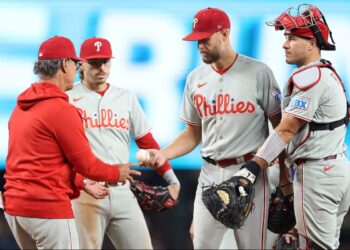
The Philadelphia Phillies are hoping a change in coaching philosophy can help solve an offensive problem that has lingered longer than many fans would like to admit.
After another disappointing postseason exit, the Phillies are entering the offseason with questions about their lineup, their coaching staff, and whether their current roster can deliver a deeper playoff run in 2027. The decision to appoint Peter Fatse as the team’s new hitting coach could prove more significant than it initially appears.
Fatse arrives in Philadelphia after working with the Boston Red Sox and spending part of the 2026 season as a hitting consultant with the Tampa Bay Rays. His experience with the Rays’ analytics department could give the Phillies another way to evaluate their hitters, identify mechanical problems, and develop more individualized offensive strategies.
However, the challenge facing Philadelphia is not simply finding better information. It is turning that information into results when the pressure is highest.
THE PHILLIES ARE HOPING A DIFFERENT APPROACH CAN CHANGE EVERYTHING
Philadelphia’s decision to replace veteran hitting coach Kevin Long reflects the organization’s desire to find answers after an underwhelming offensive season.
According to MLB.com, the Phillies scored 713 runs in 2026, ranking 19th in the majors after finishing eighth in 2025 with 778 runs. The decline highlighted the need for adjustments as the organization looks to remain competitive in the National League.
The team’s offensive difficulties were particularly frustrating because Philadelphia still had an experienced lineup capable of producing considerably more.
Having established veterans is an advantage, but experience alone cannot guarantee consistent production. Even talented hitters can become predictable, struggle against particular pitch types, or fall into mechanical habits that opposing pitchers learn to exploit.
That is where Fatse’s arrival becomes interesting.
The Phillies are not simply bringing in another coach to offer general hitting advice. They are adding someone whose recent experience includes examining the relationship between swing mechanics, analytical information, and player development.
The question is whether his methods can help Philadelphia rediscover the consistency that has sometimes disappeared at crucial moments.
HIS TIME WITH THE RAYS COULD BE MORE IMPORTANT THAN FANS REALIZE
Fatse’s experience in Tampa Bay provides one of the most intriguing aspects of his appointment.
After the Red Sox dismissed him in April, he joined the Rays as a hitting consultant and worked with members of their research and development department.
During that period, Fatse studied how motion-capture technology could provide a more detailed understanding of a hitter’s movements. The system, known as KinaTrax, can help teams analyze biomechanics and identify movement patterns that might otherwise be difficult to recognize.
Fatse explained that his work involved finding more detailed ways to understand individual swings and use that information for coaching, modeling, and player development.
He also credited Rays assistant director of research and development Tim Morales with helping him see new ways to break down and interpret the information.
For Philadelphia, this experience could be valuable because identifying a mechanical issue is only the beginning.
A hitter might be struggling because of timing, balance, movement patterns, pitch recognition, or an approach that has become too predictable. Video and analytical data can help narrow down possible explanations, but the coaching staff still has to determine which adjustment will actually help the individual player.
That distinction matters.
Technology can identify potential problems, but coaches and players must work together to find solutions that translate into better at-bats.
Fatse’s time with the Rays may help him approach those challenges with a fresh perspective.
ADVANCED ANALYTICS WILL NOT FIX THE PHILLIES BY THEMSELVES
Philadelphia has invested in analytical resources and biomechanics, but possessing sophisticated technology does not automatically produce a successful offense.
The real test is how effectively the organization uses its information.
A team can collect extensive data about swing paths, body movements, pitch locations, and opposing pitchers. Yet if the information is too complicated, poorly communicated, or difficult for a player to apply during a game, its practical value becomes limited.
That is particularly important for the Phillies because their lineup contains experienced hitters who already understand their own strengths and weaknesses.
A successful coaching staff must recognize that different players respond to different forms of instruction. Some benefit from detailed mechanical analysis, while others perform better with a simpler adjustment or a clearer plan at the plate.
Fatse appears to understand that distinction.
His stated philosophy emphasizes learning why a player has developed a particular swing and understanding what has made that player successful before recommending changes.
That approach could help him establish productive relationships with Philadelphia’s veterans.
Rather than attempting to rebuild every hitter from scratch, he can evaluate what already works, identify specific weaknesses, and develop targeted adjustments.
The goal should be improvement without unnecessarily disrupting the abilities that made these players successful in the first place.
WINNING OVER BRYCE HARPER, TREA TURNER, AND THE OTHER VETERANS WILL BE CRUCIAL
One of Fatse’s biggest challenges will be earning the trust of Philadelphia’s established hitters.
Kevin Long spent several seasons working with the Phillies and developed relationships with important members of the lineup. Replacing him means introducing a different voice to players who already have established routines and preferred methods of preparation.
That transition will require patience.
Veteran hitters are unlikely to abandon techniques that have worked throughout their careers simply because a new coach arrives with a different analytical perspective.
Instead, Fatse will need to demonstrate that his recommendations can help them prepare more effectively, recognize opposing pitchers, and make adjustments during difficult stretches.
Bryce Harper and Trea Turner are two obvious examples of players whose offensive production will matter enormously to Philadelphia’s ambitions.
The same principle applies throughout the lineup. If the coaching staff can help multiple hitters become more consistent, the cumulative effect could be substantial.
Fatse’s emphasis on collaboration could therefore be just as important as his experience with analytics.
His first major victory might not be changing a swing. It might be convincing the players that his approach can make them better.
WHY THE 2026 SEASON MAKES THIS CHANGE SO IMPORTANT
The Phillies are not entering 2027 as an organization that can afford to ignore its offensive shortcomings.
Philadelphia has built a roster with postseason expectations, but those expectations become harder to meet when the lineup struggles to produce consistently against strong pitching.
The team’s early postseason elimination by the Atlanta Braves only increased the pressure to identify what went wrong and determine which changes are necessary.
Coaching adjustments are one part of that process.
The front office must also evaluate the roster, address potential weaknesses, and determine which players should remain central to the team’s long-term plans.
Fatse cannot solve every problem on his own. He cannot guarantee that every veteran will return to form, prevent injuries, or ensure that the lineup delivers in October.
Nevertheless, a more effective offensive approach could improve Philadelphia’s chances of getting the most out of the players already under contract.
The important question is whether the Phillies can combine better coaching with sensible offseason decisions.
If they make the right moves in both areas, the new hitting coach could become a meaningful part of a larger turnaround.
JOE CRONIN AND EDWAR GONZALEZ GIVE THE PHILLIES ANOTHER OPPORTUNITY
Fatse will not be responsible for the entire hitting operation alone.
Philadelphia also hired Joe Cronin as an assistant hitting coach and retained Edwar Gonzalez in the same role. That gives the organization a coaching group that can share responsibilities while working with the analytics and player development departments.
Having multiple coaches creates opportunities to tailor instruction and preparation to different hitters.
It also makes communication important. If the staff is aligned on its overall philosophy, players can receive consistent guidance while still benefiting from individualized adjustments.
Fatse’s comments about the Rays’ organizational culture offer an interesting perspective on what he values.
He described an environment in which people across different departments appeared aligned and committed to finding ways to improve.
That is a lesson the Phillies could apply to their own operation.
A successful offense requires more than individual talent. It also depends on communication between coaches, analysts, scouts, and players.
When those groups work toward common goals, the organization has a better chance of turning its information into practical improvements.
WHAT SHOULD PHILLIES FANS EXPECT IN 2027?
Expectations should be measured rather than unrealistic.
Fatse’s experience with the Red Sox gives Philadelphia a coach who has worked with major-league hitters, while his time with the Rays adds another perspective on analytical player development.
Those experiences create reasons for optimism, but they do not guarantee that the Phillies will immediately return to the top of the offensive rankings.
The more useful indicators will emerge over time.
Are hitters producing more consistent at-bats? Are they making better decisions against difficult pitches? Can the lineup respond when opposing pitchers exploit a weakness? Are individual players improving without losing the strengths that made them productive?
Those questions will reveal more about Fatse’s impact than any offseason announcement.
The Phillies should also avoid treating every offensive slump as a coaching failure. Baseball is unpredictable, and even a well-prepared lineup will experience difficult stretches.
The objective is not to eliminate every slump. It is to help players recognize problems, make adjustments, and recover more effectively.
If Fatse can accomplish that across the lineup, his appointment could prove valuable.
THE BIGGEST QUESTION IS WHETHER THE RESULTS WILL FOLLOW
The Phillies have made their coaching change, and now the attention turns to implementation.
Fatse’s experience with biomechanics and analytical player development gives him tools that could help Philadelphia address its offensive inconsistencies. His collaborative approach may also help him build relationships with veterans who are accustomed to working with a different hitting coach.
But the ultimate judgment will come from the field.
The Phillies need more than promising explanations for their offensive struggles. They need better execution, more productive at-bats, and a lineup capable of competing against elite pitching when the postseason arrives.
Fatse has an opportunity to help deliver those improvements.
Whether he succeeds will depend on his ability to translate information into understandable instruction, earn the players’ confidence, and work with the rest of the organization to build a more consistent offense.




Discussion about this post