

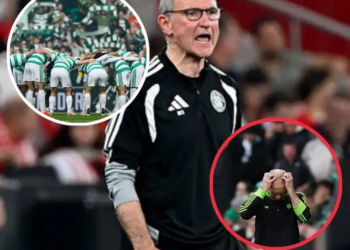
Martin O’Neill is facing growing pressure from frustrated Celtic supporters after another disappointing European night sparked calls for his resignation, fresh criticism of the squad and renewed debate about the club’s ability to compete beyond Scotland.
Following Celtic’s 2-1 Europa League defeat to Celta Vigo at Celtic Park, the anger has extended well beyond the result itself. Supporters have questioned the team’s defensive weaknesses, the lack of physicality in midfield, recruitment decisions and O’Neill’s public criticism of the officiating.
The reaction, reflected in the Daily Record’s Sports Hotline on October 23, highlights a fanbase increasingly divided over where responsibility for Celtic’s European struggles should lie.
Some supporters believe the manager must accept responsibility and consider his future. Others argue that the problems run deeper, pointing towards the boardroom, transfer strategy and a squad they believe is not equipped to compete consistently against stronger European opposition.
The central question is becoming harder to avoid: is Celtic’s European disappointment primarily a coaching problem, a recruitment problem, or a combination of both?
MARTIN O’NEILL FACES RESIGNATION CALLS AFTER CELTIC’S EUROPEAN DEFEAT
The defeat to Celta Vigo has intensified scrutiny of O’Neill, with one supporter, Gerard Milligan from Renfrewshire, arguing that the manager should resign because he is unlikely to be dismissed.
That is a particularly strong verdict, but it captures the frustration of fans who expected a more convincing response from Celtic on a night when a positive European result was desperately needed.
Celtic briefly gave their supporters reason for optimism after taking the lead through Mika Baur shortly after half-time. However, Celta Vigo responded with two goals from Javi Rodríguez in the second half, turning the contest around and leaving the hosts with another painful European defeat.
The manner of the loss is likely to concern O’Neill as much as the final score. Celtic had opportunities to strengthen their position, including a Liam Scales header that struck the crossbar, but ultimately struggled to maintain control as the visitors grew into the match.
The criticism is understandable. Celtic supporters expect their team to compete in Europe, and repeated setbacks can quickly turn disappointment into doubts about the manager’s methods.
However, calls for resignation are not the same as evidence that the club intends to make a managerial change. There has been no confirmation in the supplied report that O’Neill has been ordered to step down or that Celtic have initiated a formal process to replace him.
For now, the pressure is coming from sections of the support rather than an announced decision from the club.
CELTIC’S MIDFIELD WEAKNESS EMERGES AS A MAJOR CONCERN
One of the strongest themes in the fan reaction was the belief that Celtic lack the defensive strength and physical presence required to compete against quality European opposition.
Paul McCormack, writing to the Daily Record’s Hotline, criticised the midfield for failing to challenge opponents effectively and allowing teams too much freedom around the edge of the penalty area.
That criticism points towards a problem that cannot necessarily be solved by changing one player or adjusting one formation.
A midfield must do more than create chances. It also has to protect the defence, close passing lanes, win second balls and prevent opponents from building momentum through central areas.
When those responsibilities are not fulfilled, the consequences can be severe. Centre-backs are forced to defend more frequently, opposition attackers receive time to pick their passes, and Celtic can find themselves retreating towards their own penalty area.
Gerry Campbell also questioned the squad’s defensive balance, arguing that the failure to strengthen the backline during the summer was difficult to understand. He further raised concerns about Benjamin Nygren’s defensive contribution and the possibility of Celtic becoming too easy to play through.
These are supporter assessments rather than independently established conclusions about individual players. Nevertheless, they identify a legitimate tactical question for O’Neill and his coaching staff: does the current midfield provide enough protection when Celtic lose possession?
If the answer is no, the solution could require changes to player roles, the team’s structure or future recruitment.
Simply asking the same group to work harder may not be enough if the squad lacks the right balance of technical ability, athleticism and defensive awareness.
CELTIC’S RECRUITMENT STRATEGY UNDER THE SPOTLIGHT
The anger directed at O’Neill has also extended towards Celtic’s leadership.
Gordon Ashley from Ayr placed responsibility on principal shareholder Dermot Desmond, arguing that the club’s current limitations are connected to decisions made at boardroom level.
His comments reflect a wider debate about Celtic’s ambitions. The club has enjoyed domestic success, but supporters increasingly want to understand how that success can translate into more competitive performances in Europe.
There is an important distinction between dominating Scottish football and consistently challenging clubs from stronger financial leagues.
European competition demands depth, athleticism, tactical flexibility and the ability to cope with sustained pressure. A team can be highly competitive domestically while still struggling when opponents have greater individual quality and more resources available.
That does not automatically mean Celtic must spend recklessly. It does mean recruitment decisions need to be carefully targeted.
If the squad is short of defensive quality or physical midfielders, those weaknesses should be addressed before they become recurring problems. Equally, recruitment cannot be judged solely on transfer fees or the reputations of incoming players. New signings must fit the manager’s tactical requirements and improve the balance of the team.
O’Neill will inevitably face questions about how he uses the players available to him. However, the club’s leadership must also answer for the overall construction of the squad.
If Celtic’s European ambitions exceed the quality of their recruitment, replacing the manager alone may not solve the underlying problem.
REFEREEING CONTROVERSY ADDS ANOTHER LAYER TO THE DEBATE
The defeat to Celta Vigo also reignited arguments about officiating after O’Neill expressed frustration over decisions during the match.
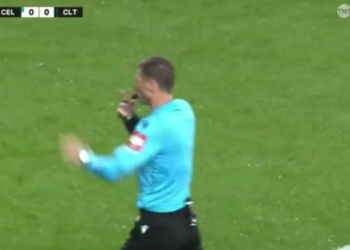
One incident involving Callum Osmand attracted particular attention, with Celtic supporters believing the forward had been pushed in the back without receiving a free kick. Camilo Durán was subsequently booked for protesting.
O’Neill also believed there had been a foul on Durán shortly before Celta’s equaliser, and he was booked while challenging the decision.
Those moments have become part of the wider discussion surrounding Celtic’s latest European disappointment. For supporters already frustrated by the result, controversial decisions can make the defeat feel even more difficult to accept.
However, it is important to separate disagreement with individual decisions from the broader suggestion that Celtic are being deliberately disadvantaged.
One supporter, Alan Milligan, pointed to what he considered a pattern involving matches refereed by Scottish officials, suggesting that Celtic’s results raise questions about the relationship between officiating and performance.
That is a fan’s theory, not proof of a refereeing conspiracy. Establishing such a claim would require reliable match records, a properly defined comparison and evidence beyond a sequence of disappointing results.
Celtic can reasonably ask for clarity about significant decisions through the appropriate channels. But criticism of refereeing should not obscure the footballing issues that contributed to the defeat.
Celta Vigo scored twice after the interval, and Celtic were unable to maintain the advantage they had worked hard to establish. Those facts remain central to understanding the result.
The most productive response would be to assess the disputed incidents objectively while also examining why Celtic lost control of the contest.
ARE CELTIC NOW OUT OF THEIR DEPTH IN EUROPE?
Some supporters have gone further than criticising the performance, questioning whether Celtic are currently equipped to compete even in the Europa Conference League.
Scott McAdam from Glasgow argued that the squad is not good enough for that competition, while Steve McSherry from Uddingston suggested Celtic should concentrate on retaining their domestic title rather than continuing to struggle in Europe.
Those comments illustrate the extent of the frustration, but they should not be mistaken for a settled verdict on Celtic’s overall ability.
European football is unforgiving. A handful of poor performances can create a damaging narrative, particularly when the team repeatedly struggles to defend leads or cope with opponents who dominate possession.
Yet one disappointing run does not automatically establish that Celtic belong at a lower competitive level.
The more useful question is whether the performances reveal recurring weaknesses that the coaching staff can realistically address.
If Celtic are consistently losing midfield battles, conceding avoidable chances and struggling to manage games after taking the lead, those problems need to be corrected regardless of the competition.
There is also a danger in treating the domestic league and Europe as completely separate priorities. Celtic may need to protect their position in Scotland, but strong European performances can help the club attract players, improve its reputation and strengthen its financial position.
Abandoning European ambitions too quickly could be a short-term reaction to a difficult period rather than a sensible long-term strategy.
SHOULD CELTIC USE FRINGE PLAYERS FOR THE REMAINING EUROPEAN MATCHES?
Kenny Wilson offered a different perspective, suggesting that Celtic could use fringe players in their remaining European fixtures and concentrate on retaining the domestic title.
The argument has some logic if Celtic’s European campaign becomes increasingly difficult and the club believes its best opportunity for success lies in Scotland.
Managing player workloads is important, particularly when domestic matches continue to arrive alongside European fixtures. Injuries, fatigue and declining confidence can quickly affect performances across multiple competitions.
However, rotating heavily would carry risks.
European matches provide valuable experience for younger players and squad members who need opportunities to prove themselves. They also give O’Neill a chance to evaluate who can contribute to Celtic’s future plans.
A balanced approach may therefore be more effective than abandoning the competition entirely.
O’Neill could rotate selectively, reward players who perform well in training and give promising squad members meaningful minutes without sacrificing every remaining European fixture.
The decision should depend on Celtic’s position in the competition, the condition of the squad and the importance of upcoming domestic matches.
Most importantly, any rotation should serve a clear purpose. Making wholesale changes simply because supporters have lost patience would not necessarily improve the team’s performances.
THE BIGGEST CHALLENGE FOR O’NEILL IS RESTORING BELIEF
Results are only one part of the problem facing Celtic. The reaction to the Celta Vigo defeat suggests that confidence in the team’s direction is becoming a major concern among some supporters.
When fans begin questioning the manager, the board, the recruitment strategy and the squad’s suitability for European football at the same time, the club faces a broader challenge than one poor result.
O’Neill must find a way to demonstrate that the team can learn from its mistakes.
That means producing more organised defensive performances, finding a midfield combination capable of protecting the backline and ensuring Celtic do not become passive when opponents begin to apply pressure.
The manager also needs to decide whether the current tactical approach suits the players available to him. If Celtic repeatedly struggle with similar problems, supporters will expect evidence that adjustments are being made.
At the same time, the club’s leadership must consider whether future recruitment can address the weaknesses highlighted by the European campaign.
The two responsibilities are connected. A manager needs suitable players to implement his plans, but a well-constructed squad still requires effective coaching and clear tactical organisation.
Neither side can reasonably avoid scrutiny.
PREDICTION: CELTIC’S NEXT EUROPEAN PERFORMANCES COULD SHAPE THE DEBATE
The immediate aftermath of a defeat is rarely the best time to make sweeping decisions about a manager’s future. Nevertheless, the reaction to Celta Vigo means Celtic cannot afford to ignore the concerns being raised.
If O’Neill can produce a stronger defensive structure, improve the team’s midfield balance and deliver more convincing performances, the resignation calls may lose momentum.
If the same weaknesses continue to appear, the pressure will likely intensify, regardless of whether Celtic are performing well domestically.
The board must also decide what level of European competitiveness it expects and whether the squad has been assembled to meet that standard.
For supporters, the key issue is not simply whether Celtic win every match. It is whether the team shows a coherent plan, competes physically and tactically, and demonstrates that lessons are being learned from setbacks.
A defeat can be accepted more easily when the performance offers genuine encouragement. Repeated losses accompanied by familiar mistakes are much harder to defend.
O’Neill’s task is therefore clear: restore confidence through performances rather than arguments.
FINAL VERDICT: CELTIC NEED ANSWERS, NOT JUST ANOTHER ROUND OF BLAME
The Daily Record’s Hotline reaction captures a growing sense of frustration around Celtic following the 2-1 defeat to Celta Vigo.
Some supporters want Martin O’Neill to resign. Others believe the club’s leadership must take responsibility for recruitment decisions, while many are focused on the lack of physicality and defensive organisation within the team.
The refereeing debate has added another layer of anger, but there is no established evidence in the supplied report to support claims of a deliberate conspiracy against Celtic.
The club now needs to address the issues that can be measured and improved: defensive performances, midfield protection, recruitment priorities and the team’s ability to control matches after taking the lead.
Whether O’Neill is the right person to lead that response remains a matter of debate. What should not be in doubt is that Celtic’s European performances must improve if the manager hopes to rebuild confidence among the support.
The coming matches will provide a clearer indication of whether this defeat represents a temporary setback or a more serious problem that requires changes at multiple levels of the club.
For now, the pressure is rising, the questions are multiplying, and Celtic need a convincing response on the pitch.






Discussion about this post