

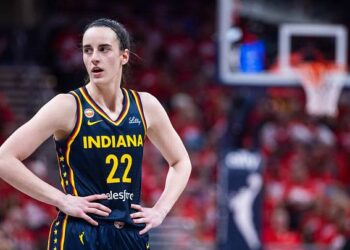
The Indiana Fever’s front-office shakeup has opened the door to a much bigger conversation about the franchise’s culture, its relationship with Caitlin Clark’s enormous fanbase, and whether the organization has done enough to protect its players from racial harassment.
In a sharply worded October 24 opinion piece for NewsOne, writer Nicky Childers argued that the Fever must confront allegations of racism among sections of their fanbase or risk damaging their ability to retain and attract Black talent.
The article arrives at a particularly sensitive moment for Indiana. Team president Kelly Krauskopf stepped away from her position, and general manager Amber Cox departed following a turbulent period for the organization. Meanwhile, unrestricted free agent Kelsey Mitchell faces an important decision about her future, and the franchise must determine how to build a team capable of advancing beyond the first round of the playoffs.
The controversy is about more than executive titles. It raises difficult questions about player safety, fan accountability, leadership, and the responsibility professional sports organizations have when supporters target athletes with abuse.
However, the strongest claims in the debate require careful examination. Allegations of racial harassment should be taken seriously, but broad accusations against an entire fanbase should not be treated as proven simply because they appear in an opinion article.
For the Fever’s next leadership team, the challenge is to distinguish legitimate criticism from abuse, protect players without discrimination, and create a culture in which accountability applies to everyone.
NEWSONE ARTICLE PUTS FEVER FAN CULTURE UNDER THE MICROSCOPE
Childers’ article presents a forceful argument: Indiana’s growing popularity has brought financial rewards, but the franchise must not allow commercial success to overshadow allegations of racism and hostility directed at Black players.
The author argues that the Fever’s association with Clark has attracted supporters with different political and cultural motivations. According to the article, some of those supporters have engaged in racist attacks against players and people who criticize Clark.
The piece also criticizes the organization’s previous handling of concerns about its fanbase, particularly Cox’s reported dismissal of accusations that Fever supporters were racist.
These are serious allegations, and they deserve more than an automatic dismissal or an automatic acceptance.
It is important to distinguish between documented incidents of abuse, claims made by players or agents, the actions of individual fans, and sweeping conclusions about millions of supporters or an entire community.
A fanbase is not a single person with one motivation. Indiana supporters include people who follow Clark, longtime Fever fans, families attending games, and basketball enthusiasts drawn to the team’s rising profile.
That diversity does not excuse racist abuse. It does mean that accountability should focus on specific conduct rather than treating every supporter as responsible for the actions of others.
The central question for the franchise is straightforward: What policies are in place to protect players when fans cross the line, and are those policies being enforced consistently?
CAITLIN CLARK’S POPULARITY HAS CHANGED THE FEVER’S PUBLIC IMAGE
Clark’s arrival transformed the Fever’s national profile and brought unprecedented attention to Indiana women’s basketball.
That attention has created commercial opportunities, increased interest in the team, and placed Clark at the center of conversations that extend well beyond the court.
But a larger audience also brings greater scrutiny.
Clark’s supporters do not all share the same political beliefs, and support for her does not automatically indicate racism. Likewise, criticizing Clark’s performance or discussing her role in the league is not inherently racist.
The problem emerges when legitimate sports debates become vehicles for racial attacks, slurs, harassment, or attempts to intimidate players.
The Fever must be prepared to address that behavior regardless of who commits it or which player is targeted.
Clark herself should not automatically be held responsible for every action taken by someone who supports her. However, prominent athletes can influence the tone of public discussion, and their responses to harmful conduct can carry considerable weight.
The franchise’s responsibility is to establish clear standards for conduct while allowing players to speak in their own voices.
A successful approach would avoid turning the issue into a battle between Clark’s supporters and her critics. The objective should be to ensure that every Fever player can compete without being subjected to racial abuse.
AMBER COX’S COMMENTS HAVE BECOME PART OF THE CONTROVERSY
One of the most contentious parts of the NewsOne article concerns Cox’s reported response to accusations of racism within the Fever fanbase.
Childers characterizes the comments as dismissive of Black players’ concerns and argues that the organization’s response failed to acknowledge the seriousness of the allegations.
That criticism has become part of the wider debate surrounding the franchise’s leadership changes.
However, the timing of Cox’s departure does not, by itself, establish why the organization made the decision. There is not enough evidence in the supplied article to conclude that the Fever dismissed her specifically because of her comments about the fanbase.
That distinction matters.
An executive departure can involve many considerations, and drawing a direct causal connection requires reliable reporting from the organization or people with knowledge of the decision.
Still, the controversy highlights a broader leadership challenge.
When athletes or agents report harassment, executives must respond with more than a defensive public statement. They should explain how complaints are investigated, what conduct violates arena policies, and what consequences may follow.
Even when an executive disputes a broad characterization of the fanbase, the organization can acknowledge that individual incidents of abuse may occur and deserve investigation.
That approach would allow the Fever to defend their supporters against unfair generalizations while still taking the safety and dignity of their players seriously.
RACIAL HARASSMENT IS A PLAYER-SAFETY ISSUE, NOT JUST A PUBLIC-RELATIONS PROBLEM
The NewsOne article cites an allegation that a WNBA agent said Black players were deactivating their social media accounts before games against Indiana to reduce their exposure to racial abuse.
The claim is alarming, but the specific report should be checked against its original source before being presented as independently established fact.
If players are receiving racist messages or threats, the issue extends beyond social media controversy. It becomes a matter of athlete welfare and the league’s responsibility to provide a professional environment in which players can work safely.
The WNBA and its teams cannot eliminate every abusive message posted online. They can, however, establish effective reporting systems and take action against identifiable offenders.
That may include removing people who direct racial slurs or threats at players from arenas, investigating credible complaints, enforcing ticket-holder conduct policies, and cooperating with social media platforms when appropriate.
The same standards should apply whether the target is Clark, Mitchell, Aliyah Boston, Sophie Cunningham, or a player on an opposing team.
The Fever should also communicate those standards publicly. Fans need to understand that attending games does not give them permission to harass players, and athletes need confidence that credible complaints will be taken seriously.
SHOULD THE FEVER BAN FANS WHO ENGAGE IN RACIST ABUSE?
Childers argues that Indiana’s new leadership should take a tougher approach, including revoking season tickets and imposing permanent arena bans on people who racially harass players.
The proposal is controversial, but the underlying principle is reasonable: serious misconduct should have meaningful consequences.
The key is creating a process that is clear, proportionate, and consistently enforced.
A practical policy could include:
- Investigation of complaints: The organization should establish a straightforward way for players, staff, and fans to report harassment.
- Evidence-based decisions: Security personnel should review available evidence, including witness accounts, recordings, and relevant communications.
- Consequences for confirmed misconduct: Depending on the severity and circumstances, penalties could range from removal from an event to suspension or permanent revocation of ticket privileges.
- Consistent enforcement: Rules should apply to all fans, regardless of their favorite player, political views, or relationship with the organization.
- Public transparency: The team should explain its conduct standards and report meaningful information about enforcement without unnecessarily exposing victims’ private information.
A zero-tolerance policy does not have to mean imposing the harshest penalty for every complaint. It should mean that substantiated racial harassment is not ignored and that consequences are determined through a fair process.
The Fever can protect players and preserve a welcoming environment for ordinary supporters at the same time.
KELSEY MITCHELL’S FUTURE MAKES THIS DEBATE EVEN MORE IMPORTANT
Mitchell’s future is one of Indiana’s biggest basketball questions entering the offseason.
As an unrestricted free agent, she can evaluate her options and decide where she believes she has the best opportunity to compete.
The NewsOne article argues that the environment surrounding the Fever could influence whether Black players want to remain with or join the franchise. It specifically connects that concern to Mitchell’s reported comments about the difficulties of dealing with hostility directed at the team.
That is a consequential argument, although the article alone does not establish that fan-related concerns will determine Mitchell’s decision.
Her choice will likely involve several factors, including contract terms, team competitiveness, her role, coaching, and the roster Indiana can assemble.
Still, organizations should not underestimate the importance of workplace culture. Players evaluate more than salaries and statistics when deciding where to spend their careers.
If the Fever want to retain Mitchell, they need to demonstrate that they are serious about building a winning team and maintaining a professional environment in which players feel supported.
That means addressing basketball needs and taking credible reports of harassment seriously.
For Indiana, those responsibilities should complement each other rather than compete.
THE FEVER’S FINANCIAL SUCCESS DOES NOT REMOVE ITS RESPONSIBILITIES
Clark’s popularity has helped drive extraordinary attention toward Indiana and women’s basketball.
The NewsOne article points to the reported increase in the franchise’s valuation, using that growth to argue that the Fever have benefited financially from the popularity surrounding Clark while failing to confront harmful conduct by some supporters.
The financial argument is important, but it should be handled carefully. An increase in a team’s valuation does not prove that racism caused its commercial growth, nor does it establish that all new supporters share the same motivations.
The Fever’s rising profile reflects multiple factors, including Clark’s popularity, the wider growth of women’s basketball, the team’s competitive storylines, and increased media coverage.
Nevertheless, financial success does not excuse an organization from addressing misconduct.
A professional franchise can pursue revenue, welcome new fans, and enforce strong standards of behavior simultaneously.
In fact, clear conduct policies can help build a healthier long-term relationship with supporters. Fans who attend games to enjoy basketball should be able to do so without harassment, and players should not have to tolerate abuse as the price of being in the public eye.
The goal should not be to deliberately shrink the fanbase. It should be to ensure that the franchise’s growth is accompanied by responsible leadership.
WHAT THE FEVER’S NEW LEADERSHIP MUST DO NOW
The departures of Krauskopf and Cox create an opportunity for Indiana to examine how it manages relationships with players, supporters, and the wider basketball community.
The new leadership should begin with a clear assessment of existing policies and the way complaints have been handled.
First, the Fever should make their fan-conduct rules easy to find and understand. Supporters should know what constitutes harassment and what penalties may follow.
Second, the organization should establish a credible process for investigating complaints. Players and staff should know where to report abuse and how those reports will be handled.
Third, the franchise should communicate with players rather than relying exclusively on public statements. Listening to concerns does not require executives to accept every allegation without examination. It requires them to investigate fairly and explain what action can be taken.
Fourth, the team should apply its policies consistently. Racism, threats, and targeted harassment should not be tolerated because the offender supports a popular player or contributes significant ticket revenue.
Finally, the Fever must maintain their focus on winning basketball. Better organizational culture is important, but it does not replace the need for effective roster construction, player development, and sound coaching decisions.
The strongest leadership team will understand that both sides of the organization matter.
THE DEBATE SHOULD NOT BECOME A WAR BETWEEN FEVER FANS
One risk in this controversy is that the discussion becomes another divisive argument about Caitlin Clark rather than a serious examination of fan behavior.
Clark’s supporters should not be collectively labeled racist. Critics of Clark should not be presumed to be motivated by jealousy or hostility toward her success. And allegations of racist abuse should not be dismissed simply because some people believe the discussion has become politically charged.
All three points can be true at the same time.
The appropriate response is to examine specific incidents, identify misconduct where evidence supports it, and hold the responsible individuals accountable.
That approach protects players without punishing innocent fans for the behavior of strangers.
It also gives the Fever an opportunity to bring their community together around a shared expectation: basketball disagreements are part of sports, but racial harassment is unacceptable.
The organization should be able to celebrate Clark’s popularity, appreciate Mitchell’s contributions, support Boston’s development, and welcome fans from every background without turning any player into a symbol in a broader political fight.
FINAL VERDICT: INDIANA MUST SHOW THAT PLAYER PROTECTION MATTERS AS MUCH AS WINNING
The NewsOne article has delivered a forceful critique of the Fever’s culture and challenged the organization to confront allegations of racism more directly.
Its broadest accusations should be evaluated critically, and claims about the reasons for the front-office departures should not be treated as proven without corroboration. But the underlying question deserves serious attention: how does Indiana respond when players are subjected to racial harassment by fans?
The answer should not depend on the player’s popularity, the identity of the offender, or the potential financial consequences.
The Fever can reject sweeping generalizations about their supporters while still acknowledging that racist abuse, when it occurs, requires a meaningful response.
They can protect their players without turning the issue into a fight against their entire fanbase.
And they can pursue a championship while insisting that every person who enters their arena follows the same standards of conduct.
Mitchell’s free agency adds urgency to the offseason, but the organization’s responsibility extends beyond one player’s decision. Indiana needs a competitive roster, a coherent basketball vision, and a culture that allows players to focus on their work without being targeted by abuse.






Discussion about this post