

The Indiana Fever may be finished for the 2026 WNBA season, but the conversation surrounding Caitlin Clark has only become louder.
As the league moves deeper into the postseason without Clark and Indiana, questions are suddenly being raised about just how much of the WNBA’s enormous television momentum has been tied to the Fever superstar.
Reports circulating online have claimed that WNBA ratings have collapsed by as much as 76 percent since Indiana was eliminated by the Las Vegas Aces.
That number should be treated carefully. It does not mean the entire WNBA has suddenly lost 76% of its audience.
What the available numbers do show, however, is something impossible to ignore: Caitlin Clark and the Indiana Fever have been enormous television attractions, and their elimination removes one of the league’s biggest ratings engines at precisely the moment when the championship race is supposed to become its biggest stage.
And that makes the Fever’s early playoff exit far more significant than simply one team losing a series.
THE NUMBERS BEHIND THE CAITLIN CLARK EFFECT
The strongest evidence comes from the games involving Indiana.
Before the Fever were eliminated, the opening game of their first-round series against Las Vegas averaged approximately 2.1 million viewers, making it the most-watched WNBA playoff game ever on ABC.
Game 2, streamed exclusively on Prime Video, still attracted approximately 1.42 million viewers.
Then came the winner-take-all Game 3.
Despite competing against major football and baseball programming, the decisive Fever-Aces matchup averaged approximately 2.25 million viewers, peaking at roughly 2.7 million. It became one of the largest non-Finals audiences in WNBA playoff history.
That is the part of this story that should not be lost.
The WNBA did not suddenly become unpopular when Clark left the playoffs.
Instead, the Indiana-Las Vegas series became one of the biggest television attractions of the postseason.
THE 76% CLAIM NEEDS CONTEXT
This is where the viral headline requires some caution.
There is a huge difference between saying:
“WNBA ratings fell 76% after Caitlin Clark was eliminated.”
and saying:
“Some WNBA playoff audiences fell dramatically after the Fever were eliminated.”
The second statement is much easier to support.
The league itself reported that the 2026 first round averaged about 1.3 million viewers across 10 games, making it the most-watched first round in WNBA history.
So the bigger story isn’t that the WNBA suddenly collapsed.
It is that the ceiling appears dramatically higher when Clark and the Fever are involved.
That distinction matters.
INDIANA WAS ALREADY THE LEAGUE’S BIGGEST TV DRAW
This wasn’t a trend that appeared overnight.
Throughout the 2026 regular season, Fever games repeatedly dominated the league’s television rankings.
The Fever produced massive audiences across multiple networks, including games against the Chicago Sky, Atlanta Dream, New York Liberty and other opponents.
One particularly striking example came in August, when Fever-Dream averaged approximately 2.58 million viewers on ESPN, becoming the largest WNBA audience ever recorded on cable at that point.
Another report noted that the five most-watched WNBA games on ESPN networks during the season all involved Indiana.
That tells us something important.
Clark isn’t simply attracting viewers when Indiana plays another marquee franchise.
She is turning ordinary regular-season matchups into television events.
THE FEVER’S IMPACT GOES BEYOND TELEVISION
The Clark effect cannot be measured exclusively through television ratings.
Indiana has also become one of the WNBA’s biggest attendance attractions.
The Fever were averaging just over 4,000 fans per game before Clark arrived, while attendance has increased dramatically during the Clark era. Indiana has also been among the league’s strongest road draws.
That creates a ripple effect.
More attention means greater ticket demand.
Greater ticket demand creates larger crowds.
Larger crowds create a stronger atmosphere.
More national attention creates more media coverage.
And that media attention creates more casual fans who may eventually become permanent WNBA supporters.
That is why Clark’s value to the league cannot simply be reduced to a television rating.
THE BIGGEST QUESTION IS WHAT HAPPENS NEXT
The real test for the WNBA begins now.
With Indiana eliminated, the league needs its remaining stars and franchises to carry the postseason.
A’ja Wilson and the defending champion Las Vegas Aces have an obvious opportunity.
So do teams featuring established stars such as the New York Liberty, Minnesota Lynx, Dallas Wings and other remaining contenders.
The league doesn’t need every game to reach two million viewers.
It needs enough compelling games, personalities and rivalries to keep the audience engaged until the championship is decided.
And there is encouraging evidence that this can happen.
Non-Fever WNBA audiences have also grown substantially. ESPN reported that its average viewership for non-Fever games was up significantly from the previous season, demonstrating that the league’s broader popularity has expanded even beyond Indiana.
CAITLIN CLARK’S ABSENCE STILL CHANGES THE EQUATION
At the same time, pretending Clark’s absence doesn’t matter would be equally unrealistic.
It clearly does.
The difference is between saying “Clark is the WNBA” and recognizing that Clark is currently one of the WNBA’s most powerful individual audience drivers.
Those aren’t the same thing.
The WNBA can continue growing without Clark playing in every playoff game.
But it is also reasonable to acknowledge that the league’s commercial ceiling is higher when its most recognizable young superstar is on the court.
That is especially true during the postseason, when casual viewers have less incentive to watch teams they don’t already know.
THE ACES JUST ELIMINATED A MASSIVE RATINGS DRAW
There is also an ironic twist to Indiana’s elimination.
Las Vegas didn’t just eliminate the sixth-seeded Fever.
The Aces eliminated one of the most commercially valuable teams remaining in the postseason.
The three-game series generated enormous audiences, with Game 3 becoming one of the most-watched WNBA playoff games outside the Finals.
From a basketball standpoint, Las Vegas did exactly what it needed to do.
From a league-business perspective, however, the result creates a fascinating dilemma.
The defending champions advanced.
One of the league’s biggest draws did not.
That is the tension between competitive sports and entertainment economics.
CAITLIN CLARK STILL WON SOMETHING IMPORTANT
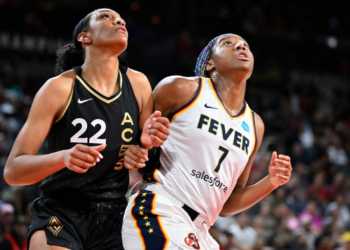
Indiana’s season ended with a painful 94-83 defeat in Las Vegas.
A’ja Wilson erupted for 36 points and 10 rebounds, while Clark finished with 18 points as the Aces advanced to the semifinals.
But Clark’s season still demonstrated why the WNBA’s television future is so closely connected to her career.
She returned from an injury-plagued 2025 campaign and immediately restored Indiana to the national spotlight.
The Fever weren’t simply participating in the postseason.
They were generating appointment television.
That is a very different level of influence.
WHAT THIS MEANS FOR THE FEVER
For Indiana, the ratings discussion should actually increase the pressure heading into the offseason.
The Fever now know they have something extremely valuable.
They have a superstar capable of attracting national audiences.
They have a growing fan base.
They have a young core featuring Clark and Aliyah Boston.
And they have become one of the most recognizable franchises in women’s basketball.
The next challenge is turning attention into championships.
That means improving the roster around Clark, protecting the team’s depth and finding ways to become more effective against elite playoff defenses.
The Aces exposed some of Indiana’s weaknesses.
The Fever cannot afford to treat the ratings success as a substitute for basketball success.
THE 2027 SEASON COULD BE EVEN BIGGER
If Clark returns healthy in 2027, the WNBA could have an enormous opportunity.
Imagine Indiana entering next season with another year of chemistry, an improved roster and the motivation of consecutive postseason eliminations by Las Vegas.
That creates a potentially explosive storyline.
Clark versus Wilson.
Fever versus Aces.
Indiana trying to finally break through.
Las Vegas trying to protect its championship status.
And an increasingly large national audience waiting to see what happens.
That is exactly the type of rivalry the WNBA should want.
THE BIGGER LESSON FOR THE WNBA
The biggest mistake would be interpreting the current numbers as proof that the WNBA cannot survive without Caitlin Clark.
The evidence doesn’t support that conclusion.
The first round’s record audience proves the league has developed meaningful interest beyond a single player.
But the opposite extreme would be just as misguided.
The numbers clearly demonstrate that Caitlin Clark matters enormously.
She brings casual viewers.
She creates national storylines.
She drives attendance.
She creates enormous social-media engagement.
And she gives people who might never have watched a WNBA game a reason to tune in.
The smart strategy isn’t to choose between “Clark matters” and “the league is bigger than Clark.”
The answer is both.
FEVER FANS HAVE EVERY REASON TO WATCH WHAT COMES NEXT
For Indiana supporters, the ratings conversation should ultimately be less about celebrating another team’s struggles and more about recognizing what the Fever have become.
Indiana is no longer an afterthought.
The franchise is now one of the WNBA’s biggest national attractions.
The 2026 postseason proved it again.
The Fever-Aces series produced enormous audiences, while the league simultaneously recorded its most-watched first round ever.
So if the viral 76% figure is being used to suggest that the entire WNBA has collapsed, that conclusion goes too far.
But if the number is being used to spark a conversation about the enormous audience difference created by the absence of Caitlin Clark and the Fever, that conversation is absolutely worth having.
And perhaps the most intriguing part is this:
The WNBA has already seen what happens when Clark is on the biggest stage.
Now the league has to prove it can keep building the audience while she waits for another opportunity to return to it.
For the Indiana Fever, that opportunity could come sooner than many people expect.






Discussion about this post