

Indiana Fever general manager Amber Cox has reignited the conversation about Caitlin Clark’s influence on women’s basketball after delivering a strong message about the superstar’s impact on the WNBA.
Following Indiana’s elimination from the 2026 playoffs, Cox spoke openly about Clark’s importance to the league’s growth, pointing to the increased attention, television ratings, and full arenas that accompanied her arrival in 2024. Her remarks were a clear acknowledgment of Clark’s commercial influence, while also recognizing the work of players and figures who helped build the league before her.
The comments have generated fresh discussion among basketball fans about Clark’s role in the WNBA’s rise in popularity—and whether the league has fully recognized the significance of the attention she brings.
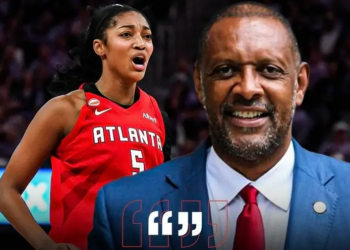
However, one distinction matters: the viral image describing Cox’s remarks as a “confession about Caitlin Clark’s existence” is a dramatic social-media framing, not a verified quotation from Cox. Her actual comments were about Clark’s influence on the league, not a personal revelation.
AMBER COX SENDS A STRONG MESSAGE ABOUT CAITLIN CLARK
During her end-of-season media availability on October 3, Cox emphasized that Clark had become a major turning point for the WNBA’s commercial momentum.
Cox pointed to the league’s ratings and attendance, explaining that the surge in attention began when Clark entered the professional ranks in 2024. She also stressed that recognizing Clark’s influence does not diminish the contributions of other players or the people who worked to grow women’s basketball over many years.
Her message was unmistakable: Clark deserves recognition for the impact she has made.
That acknowledgment carries weight because it came from a senior executive of the franchise that employs Clark. Rather than avoiding the debate surrounding the superstar’s popularity, Cox directly addressed what Clark has meant to the Fever and the wider league.
The significance extends beyond compliments. In professional sports, greater attention can influence sponsorship opportunities, broadcast interest, ticket demand, merchandise sales, and the commercial value of the entire competition.
Clark’s presence has helped make the Fever one of the WNBA’s most closely watched teams. The challenge now is converting that attention into sustained success on the court.
WHY THE VIRAL “CONFESSION” HEADLINE IS GETTING ATTENTION
The phrase used in the viral image is designed to provoke curiosity. By describing Cox’s comments as a confession, it suggests that the executive revealed something previously hidden about Clark.
But the verified remarks do not establish that interpretation.
Cox publicly credited Clark with helping accelerate the WNBA’s growth. That is an important statement, but it should not be confused with a secret admission, an internal dispute, or proof of a previously concealed position.
The distinction matters because Caitlin Clark stories can quickly become part of larger arguments about the league, its players, its leadership, and its fan base. A provocative headline can attract clicks, but a headline that promises a revelation the evidence does not support can mislead readers and damage a publisher’s credibility.
The more compelling story is already there: a Fever executive openly recognized the scale of Clark’s influence while the franchise faces difficult decisions about how to build a championship-caliber team around her.
CAITLIN CLARK’S IMPACT GOES BEYOND THE BOX SCORE
Clark’s value to Indiana cannot be measured solely by points, assists, or shooting percentages.
Her popularity has helped bring new audiences to women’s basketball, creating opportunities for the Fever to reach fans who might not previously have followed the WNBA closely. That attention can benefit teammates, opponents, broadcasters, sponsors, and the league as a whole.
There is also an important basketball dimension to her influence. Defenses must account for Clark’s range and passing ability, while teammates can benefit from the space and opportunities her presence creates.
Yet commercial influence and championship success are not interchangeable.
The Fever still need a balanced roster, consistent health, reliable defense, and effective execution in high-pressure playoff moments. Clark can be a central piece of that process, but no individual player can solve every roster problem alone.
For Indiana, the next stage is proving that the attention surrounding the franchise can accompany meaningful progress in the postseason.
THE FEVER’S BIGGEST OFFSEASON QUESTION IS ROSTER CONSTRUCTION
Indiana’s first-round playoff exit against the Las Vegas Aces left the franchise with a familiar challenge: how to turn its talent into a team capable of advancing deeper into the playoffs.
The future of Kelsey Mitchell is one of the most important questions facing the organization. Mitchell has established herself as a major scoring threat, and Clark has spoken publicly about how much she values playing alongside her.
Retaining a productive backcourt would give Indiana continuity, but the front office must also consider salary-cap limitations, positional balance, defensive needs, and the depth required to survive a long season.
Clark has indicated that she wants an open dialogue with the front office about roster construction. At the same time, she has acknowledged that Cox is the general manager and ultimately makes the final decisions.
That relationship will be important during the offseason. Indiana needs to listen to its star players while maintaining a clear plan for building a roster that can compete against the league’s strongest teams.
A headline about Clark’s popularity may generate debate today, but the decisions Indiana makes in the coming months will have a much greater effect on its championship ambitions.
RECOGNIZING CLARK DOES NOT MEAN DISMISSING THE REST OF THE WNBA
One of the most sensitive parts of the discussion is how to recognize Clark’s influence without diminishing the players who helped establish the league.
Cox explicitly addressed that distinction in her remarks. Her argument was not that Clark single-handedly created women’s basketball or that other stars lack commercial value. Instead, she described Clark’s arrival as a catalyst that helped accelerate the league’s growth.
That is a more useful way to understand the debate.
The WNBA had established players, championship teams, devoted fans, and a history of growth long before Clark entered the league. Clark’s popularity added another powerful source of attention, bringing more people into a competition that already had its own stars and traditions.
Both realities can be true.
The league’s long-term success will depend on turning new interest into lasting investment in the entire competition—not simply one player or franchise. That means telling compelling stories about multiple teams, supporting emerging stars, improving the fan experience, and delivering a competitive product.
Clark’s popularity can open the door. The league must continue giving fans reasons to stay.
WILL THE PRESSURE ON AMBER COX INCREASE?
Cox’s comments have placed renewed emphasis on the relationship between Clark’s commercial influence and Indiana’s basketball decisions.
When a franchise has a player who attracts extraordinary attention, expectations rise. Fans want the organization to build a contender, retain important teammates, and take advantage of the opportunity created by its star’s popularity.
That pressure will likely intensify if Indiana struggles to translate its regular-season performances into postseason progress.
Still, it would be premature to conclude that Cox’s remarks reveal an internal disagreement or that the Fever are preparing for a major organizational shake-up. The comments available publicly support a more straightforward interpretation: management recognizes Clark’s importance and must now continue building around the team’s long-term goals.
The real test will be the decisions that follow.
Can Indiana retain the right players? Can it improve its depth and defensive consistency? Can the coaching staff develop a system that makes the most of Clark’s playmaking while keeping the team competitive when she is unavailable?
Those questions are more consequential than the viral caption.
WHAT THIS MEANS FOR THE FEVER’S CHAMPIONSHIP HOPES
Indiana has a valuable foundation in Clark, but championship contention requires more than star power and public attention.
The Fever must build a roster capable of handling different playoff matchups, defending elite scorers, and maintaining offensive production when opponents focus their game plans on Clark. They also need consistent availability from their core players and the ability to execute under pressure.
Keeping Mitchell would offer continuity and scoring, although the front office must weigh that possibility against the cost of building out the rest of the roster. Other additions may be necessary to strengthen the team’s defense, rebounding, and bench production.
The salary cap and free-agent market will influence what is possible. There is no guarantee that Indiana can retain every key player or land every desired target.
Nevertheless, Cox’s acknowledgment of Clark’s impact reinforces the importance of making the most of the opportunity in front of the franchise. The Fever have a star who attracts attention, but the next goal must be building a team that can consistently challenge for a championship.
FINAL VERDICT: THE REAL STORY IS BIGGER THAN A VIRAL CAPTION
Amber Cox’s comments provide a clear acknowledgment of Caitlin Clark’s influence on the WNBA’s recent growth. They also highlight the responsibility facing Indiana as it attempts to turn that attention into lasting basketball success.
The viral image may frame the remarks as a dramatic confession, but the verified statement is meaningful without exaggeration. Clark has helped attract attention to the league, and the Fever now have to make smart decisions about the roster surrounding her.
The next chapter will not be decided by a social-media headline. It will be shaped by Indiana’s offseason strategy, the future of its key free agents, the development of its young players, and its ability to close the gap against the league’s best teams.
Caitlin Clark has helped change the level of attention surrounding the Fever. Now Indiana must show that it can turn that attention into championship progress.






Discussion about this post