

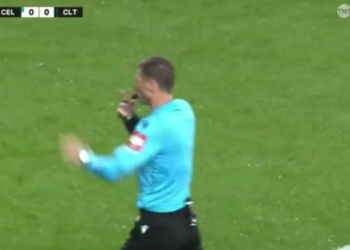
Celtic’s controversial 2-1 Europa League defeat to Celta Vigo has sparked fresh questions about the standard of officiating in European football, with referee Georgi Kabakov facing scrutiny over two major decisions that angered Martin O’Neill and the Celtic support.
The Bulgarian official was at the centre of two contentious first-half and second-half incidents at Celtic Park on Thursday night. First, Celtic were denied a foul after Callum Osmand appeared to be pushed in the back as he advanced towards the penalty area. Later, O’Neill believed Camilo Durán had been fouled shortly before Celta scored their equaliser from a free-kick.
Those decisions have become even more controversial following the circulation of reports about Kabakov’s previous disciplinary history in Bulgaria.
In October 2025, the Bulgarian Football Union announced that it had suspended Kabakov and fellow official Vladimir Valkov indefinitely over their performance as VAR officials during a domestic league match. The decision followed a controversial goal in which a handball had not been penalised.
That history raises legitimate questions about how referees are assessed and appointed for major European fixtures. However, it does not, by itself, establish that Kabakov was unfit to officiate Celtic’s match or that UEFA made an improper appointment.
For Celtic, the immediate frustration is clear: a night that offered an opportunity to recover momentum in Europe instead ended in another damaging defeat, accompanied by a fresh debate about the officials.
THE CALL ON CALLUM OSMAND THAT LEFT CELTIC FURIOUS
The first major flashpoint came during the opening half.
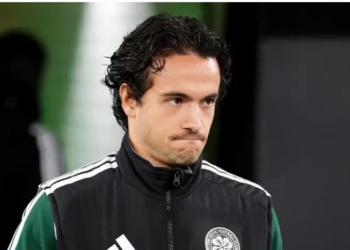
Osmand was moving towards the Celta Vigo penalty area when he appeared to receive a two-handed push in the back. Kabakov allowed play to continue, prompting protests from Celtic players and supporters.
Durán was subsequently booked for his reaction to the decision, adding to the frustration inside Celtic Park.
Celtic’s official match report also described the incident as a two-handed push that brought the attack to an end. Sky Sports reported the resulting penalty-area incident as a major talking point, although the contact occurred outside the box.
That distinction matters. Had a foul been awarded, the immediate question would have been the location of the infringement and whether Celtic should have received a free-kick in a dangerous position, rather than a penalty.
The decision nevertheless denied Celtic an opportunity to continue a promising attack.
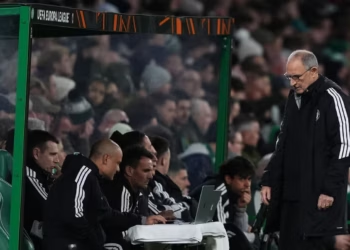
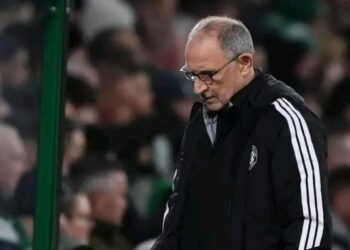
O’Neill later said Kabakov told him VAR had checked the incident, but the decision was not changed. The Celtic manager questioned what the review was examining because he believed the foul was obvious.
For supporters, the frustration was not simply that a free-kick was not awarded. It was that the incident appeared to offer an opportunity for VAR to help establish whether an infringement had occurred.
The available reports do not establish that UEFA subsequently judged the decision to be incorrect. But the incident deserves examination because it became one of the defining moments of the evening.
THE SECOND DECISION THAT ANGERED MARTIN O’NEILL
Celtic’s frustration intensified after the break, when Mika Baur gave the hosts a 1-0 lead in the 47th minute.
The home side then had an opportunity to extend its advantage when Liam Scales sent a header against the crossbar. Instead of taking control of the match, Celtic were pegged back by a Celta Vigo side that eventually scored twice in quick succession.
The equaliser arrived in the 68th minute, when Javi Rodríguez headed home from a free-kick.
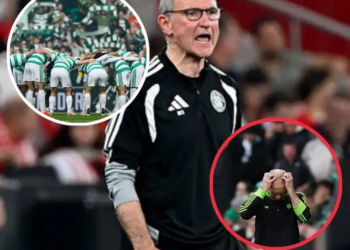
O’Neill believed Celtic should have received a foul against Durán in the moments immediately before the free-kick was awarded to the Spanish side.
Speaking after the match, the Celtic manager said he felt the referee had overlooked an infringement in Celtic’s favour before awarding the opposition a set-piece. He was booked for protesting the decision.
That sequence inevitably intensified the controversy.
Celta scored from the resulting set-piece, meaning the decision was followed directly by a goal that changed the match’s momentum. Rodríguez then struck again in the 71st minute, completing the turnaround.
It would be inaccurate to claim that the officiating alone caused Celtic’s defeat. The team failed to protect its lead, struggled to control important periods, and conceded twice in a short spell.
Nevertheless, those shortcomings do not make questions about the decisions any less legitimate.
A team can perform below its best and still have grounds to question whether key calls were handled correctly.
KABAKOV’S 2025 SUSPENSION IS NOW BACK IN THE SPOTLIGHT
The strongest documented concern surrounding Kabakov’s history comes from Bulgaria.
On October 7, 2025, the Bulgarian Football Union’s refereeing committee announced that Kabakov and Vladimir Valkov had been suspended indefinitely following what it described as unsatisfactory performances as VAR officials in a league match between Slavia Sofia and Lokomotiv Sofia.
Contemporary reporting said the controversy centred on a goal awarded after a handball in the build-up that had not been penalised.
That is a significant part of the referee’s record and understandably attracts attention after another contentious VAR-related debate.
However, the wording of the official announcement is important. The suspension concerned his performance as a VAR official in a particular domestic match. It does not establish that he was permanently barred from refereeing, nor does it prove that every later decision he made was wrong.
An indefinite suspension is a serious disciplinary measure, but its longer-term implications depend on what happened afterwards, including whether the suspension was lifted, what assessments followed, and what criteria governed subsequent appointments.
Those are precisely the details that deserve clarification before the incident is used to draw broader conclusions about UEFA’s decision-making.
The question is not whether a referee can ever recover from a poor performance. It is how governing bodies evaluate officials after significant disciplinary incidents and what evidence supports their return to important matches.
QUESTIONS ABOUT OTHER CONTROVERSIES NEED CAREFUL VERIFICATION
The criticism circulating around Kabakov also refers to other controversial matches, including Liverpool’s European fixture against Toulouse in November 2023 and a Bulgarian domestic match involving Levski Sofia and Ludogorets in August 2024.
Those incidents should be assessed individually rather than combined into a single claim that the referee has repeatedly been proven wrong.
A disputed decision does not automatically establish misconduct, and criticism from a club or manager is not equivalent to an official disciplinary finding.
Likewise, a referee’s previous mistake does not prove that a later decision was incorrect.
For a convincing argument, Celtic supporters need a clearly documented timeline: what decision was made, what the relevant match officials and governing bodies said, whether any formal review took place, and whether disciplinary action followed.
The 2025 Bulgarian Football Union announcement provides a verifiable starting point. Further allegations should be supported by reliable reporting or official records before being presented as established facts.
That approach would make any complaint from Celtic stronger, not weaker.
DID UEFA HAVE GOOD REASON TO APPOINT KABAKOV?
This is the central question raised by the controversy.
UEFA appoints referees to European competitions through its own officiating structures. The relevant issue is whether the organisation had assessed Kabakov’s subsequent performances and was satisfied that he met the required standards for a Europa League fixture.
The existence of a previous suspension does not automatically disqualify an official from future appointments. However, it makes the circumstances surrounding his return to important matches a reasonable subject for scrutiny.
Several questions would be relevant:
- Was Kabakov’s 2025 suspension lifted, and when?
- What assessments were completed before he returned to European appointments?
- Were the incidents at Celtic Park reviewed by UEFA’s refereeing authorities?
- What was the VAR team’s assessment of the challenge on Osmand?
- Was there an official explanation for the decision immediately before Celta’s equaliser?
These are questions that can be answered through official records and an appropriate review process.
There is currently no verified evidence in the material cited here that UEFA knowingly appointed an unsuitable referee or ignored a formal warning about this particular fixture.
But supporters do not need to allege a conspiracy to demand transparency.
The legitimacy of a competition depends partly on confidence that officials are selected and assessed through consistent standards.
CELTIC’S PERFORMANCE MUST ALSO REMAIN PART OF THE CONVERSATION
Although the refereeing decisions deserve attention, Celtic cannot ignore the footballing reasons behind the defeat.
Baur’s goal put the hosts in front, and Scales came close to doubling the advantage when his header struck the crossbar. Yet Celta remained dangerous and ultimately punished Celtic’s defensive weaknesses.
Rodríguez’s equaliser came from a set-piece, while his second goal demonstrated the visitors’ ability to capitalise on another opportunity.
Celtic therefore had more than one problem to solve.
The team needed to manage its lead more effectively, defend the set-piece that produced the equaliser, and respond with greater composure after conceding. Those are areas that O’Neill and his coaching staff must address regardless of what any review concludes about the officiating.
The wider European picture makes the defeat even more damaging. Celtic entered the match looking to recover from defeats against Ferencváros and Benfica, but the loss to Celta Vigo left them without a point after three Europa League matches.
That record places greater pressure on the remaining fixtures and leaves the club with little room for further mistakes.
Refereeing controversy can dominate the immediate reaction, but Celtic’s route back into contention will depend on improving performances as well as receiving fair decisions.
SHOULD CELTIC MAKE AN OFFICIAL COMPLAINT?
If Celtic believe the Osmand incident, the foul before the equaliser, or other decisions fell below the required standard, the club can seek clarification through the appropriate channels.
A formal approach would be most effective if it focused on specific incidents and requested explanations of the decisions and the VAR process.
That would be more productive than making unsupported allegations about Kabakov’s motives or UEFA’s intentions.
The club could ask whether the relevant incidents were reviewed and what conclusions were reached. It could also seek clarity on how the VAR officials assessed the challenge on Osmand and why no intervention followed.
Any decision to make a formal complaint remains a matter for Celtic. There is no verified confirmation in the sources cited here that the club has already submitted one.
For supporters, the important point is that asking for accountability is not the same as claiming that officials deliberately acted against a team.
A transparent review would help establish whether the decisions were consistent with the applicable laws and officiating standards.
FINAL VERDICT: UEFA QUESTIONS ARE FAIR, BUT THE EVIDENCE MUST LEAD THE ARGUMENT
Kabakov’s previous suspension in Bulgaria gives the current controversy additional context, while the two disputed incidents at Celtic Park have understandably angered O’Neill and Celtic supporters.
The challenge on Osmand, the decision immediately before Celta’s equaliser, and the use of VAR are all legitimate subjects for further examination.
But the strongest case for scrutiny rests on documented facts, not speculation.
Celtic lost 2-1 after taking the lead, and its defensive shortcomings contributed to the result. At the same time, the club can reasonably seek explanations for decisions that it believes affected the match.
UEFA should be able to explain how officials are assessed and how contentious incidents are reviewed when credible questions arise.
That does not require assuming that Kabakov was appointed improperly or that the match was deliberately influenced.
It requires a straightforward standard: decisions should be evaluated on the evidence, officials should be held accountable through established procedures, and clubs should be able to understand how important calls are reached.
For Celtic, the priority now is to demand clarity where appropriate, learn from the defeat, and ensure the remaining European campaign is not undermined by the same combination of missed opportunities and defensive errors.




Discussion about this post