

The Philadelphia Phillies are heading into an offseason that could shape the franchise’s future for years to come, and their biggest problem might not be a lack of money. It could be how they spend it.
Philadelphia has invested heavily in building a roster capable of winning the World Series, assembling a core featuring Bryce Harper, Kyle Schwarber, Trea Turner, J.T. Realmuto and an established starting rotation. Yet the team’s latest postseason disappointment has raised uncomfortable questions about whether its expensive roster needs another major upgrade or a more substantial change in direction.
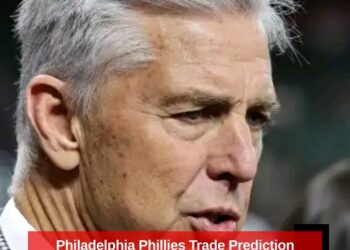
President of baseball operations Dave Dombrowski now faces a difficult balancing act: strengthen the roster without allowing an already enormous payroll to become an obstacle to future flexibility.
The headline figure of $250 million captures the scale of the problem, although the Phillies’ actual financial commitments depend on whether payroll is measured by player salaries or the competitive-balance-tax calculation. Estimates placed their 2026 luxury-tax payroll above $300 million, putting them among baseball’s biggest spenders.
And despite that investment, Philadelphia exited the postseason in the National League Wild Card Series against the Atlanta Braves.
That early elimination has made the coming winter particularly important.
The Phillies do not necessarily need to tear everything down. But they cannot assume that bringing back the same roster and hoping for a different outcome will be enough.
THE PHILLIES’ BIGGEST PROBLEM ISN’T JUST MONEY
Philadelphia has already demonstrated that ownership is willing to spend aggressively.
The club entered 2026 with substantial financial commitments, including long-term contracts for Harper and Turner, a major investment in Schwarber, and an expensive rotation led by Zack Wheeler and Aaron Nola.
Those contracts reflect the organization’s determination to compete for a championship while its established stars remain in position to contribute.
However, expensive rosters create a different challenge when several weaknesses emerge simultaneously.
The Phillies need to improve their offensive consistency, strengthen their bullpen and determine how much production they can realistically expect from their current outfield options.
At the same time, they must consider the financial implications of retaining their own free agents and pursuing outside additions.
According to MLB.com’s offseason analysis, Dombrowski acknowledged that the club has several highly paid players and must determine how best to use its available resources. He also emphasized that ownership has supported efforts to improve the team.
That distinction matters.
The Phillies are not necessarily incapable of spending more money. The challenge is determining whether additional spending will produce enough improvement to justify the cost.
Adding another expensive player simply because the team is disappointed would not automatically solve its problems.
Philadelphia needs targeted upgrades that address the weaknesses most likely to prevent it from winning a championship.
DAVE DOMBROWSKI FACES PRESSURE AFTER ANOTHER POSTSEASON DISAPPOINTMENT
Dombrowski has built a reputation as an executive willing to make aggressive moves when he believes a team is close to winning.
That approach helped Philadelphia assemble a roster with considerable star power, but the latest postseason exit has intensified scrutiny of the decisions that come next.
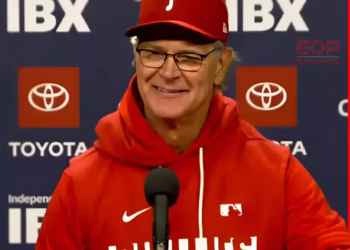
The Phillies finished the regular season after a difficult start that cost manager Rob Thomson his job. Don Mattingly took over and helped stabilize the club, but Atlanta eliminated Philadelphia in the Wild Card Series.
The organization subsequently retained Mattingly as its full-time manager on a two-year contract.
That decision provides some continuity in the dugout, but the roster still requires attention.
Dombrowski has indicated that he does not intend to trade away his established core simply to create a dramatic change. He has also acknowledged the need to complement the team’s expensive veterans with additional contributors.
That leaves the Phillies with a complicated offseason strategy.
They must decide which players remain essential to the championship pursuit, which positions need outside reinforcements and whether younger players are ready to take on larger responsibilities.
The executive’s challenge is not simply to make headlines in free agency.
It is to construct a team capable of performing consistently during the regular season and surviving the pressure of October baseball.
THE AGING CORE IS BECOMING A BIGGER CONCERN
Philadelphia’s veteran core remains talented, but the organization must plan for the inevitable effects of aging.
Harper, Schwarber, Turner and Realmuto have all played important roles in the club’s recent success. However, long-term roster construction requires the front office to consider how their production, defensive responsibilities and workload might change over time.
The concern is not that these players suddenly become incapable of contributing.
Rather, the Phillies cannot assume that every veteran will continue performing at the same level throughout the remainder of his contract.
Turner’s 2026 season was particularly disappointing offensively, while Realmuto also struggled to produce at his usual level. MLB.com’s offseason review identified both players among the everyday contributors whose production fell below expectations.
Those struggles highlight why Philadelphia needs more than star power.
A championship roster requires enough depth to withstand periods when established players underperform or need additional rest.
The Phillies could respond by improving their bench, introducing younger players into regular roles and giving their veterans more opportunities to recover between games.
They also need to identify which positions require immediate outside help and which can be addressed internally.
The most dangerous offseason mistake would be assuming that expensive contracts guarantee future production.
Philadelphia must build a roster that can support its stars rather than relying on them to carry every weakness.
THE OUTFIELD COULD BECOME ONE OF THE PHILLIES’ BIGGEST PRIORITIES
The outfield presents another important challenge.
Philadelphia needs to determine whether its current combination of veterans and younger players can provide enough offense, defensive reliability and consistency.
The club’s 2026 offensive performance exposed several weaknesses. MLB.com’s review noted that Harper and Schwarber were the only everyday players to finish above league-average offensive production by OPS+, while other regulars struggled to maintain consistent results.
Those figures illustrate why the Phillies need more dependable production throughout the lineup.
An outfield upgrade could help address that problem, particularly if the organization can find a player who provides both offensive value and defensive versatility.
However, the front office must be careful about spending heavily on a name rather than a specific skill set.
The ideal acquisition would complement the existing lineup, improve the team’s defensive options and provide enough consistency to justify the financial commitment.
Philadelphia also has prospects who could compete for opportunities.
MLB.com’s offseason assessment highlighted young outfielders and other developing players as potential contributors, meaning the club does not necessarily have to fill every opening through free agency.
The decision will depend on how confident the organization is in their readiness.
If a prospect can handle a regular major-league role, the Phillies could use their financial resources elsewhere.
If the organization believes that player needs more development, signing an established outfielder may be the safer option.
THE BULLPEN NEEDS HELP, BUT THE PHILLIES HAVE ALREADY MADE ONE MOVE
The bullpen is another area that requires attention after an inconsistent season.
Philadelphia needs reliable relief pitching capable of protecting leads, handling difficult matchups and reducing pressure on its starting rotation.
Left-handed relief is particularly relevant when constructing a balanced bullpen, although the organization must evaluate its existing options before deciding how much additional help is necessary.
The Phillies have already taken an initial step by agreeing to bring back left-hander Tim Mayza for the 2027 season on a major-league contract. Dombrowski announced the agreement on October 15.
That move provides some continuity, but it should not automatically be interpreted as a complete solution.
One dependable reliever cannot compensate for every weakness in a bullpen.
Philadelphia must determine whether it needs another left-handed specialist, a high-leverage arm or a versatile reliever capable of handling multiple innings.
The answer will depend on the composition of the bullpen and the availability of suitable free agents.
The Phillies should also avoid overlooking internal options who could earn larger roles through spring training.
A combination of selective free-agent additions and improved performance from existing pitchers could provide a more sustainable solution than committing heavily to multiple relievers.
WHY PHILADELPHIA MAY HAVE LESS FINANCIAL FLEXIBILITY THAN FANS EXPECT
The Phillies’ financial situation is complicated by the difference between their actual payroll and their competitive-balance-tax payroll.
Their projected 2026 luxury-tax payroll was approximately $317.5 million, according to MLB Trade Rumors’ payroll tracker, placing them above the highest luxury-tax threshold.
That does not mean the Phillies cannot make additional acquisitions.
It does mean that the cost of adding players may extend beyond their advertised salaries because luxury-tax penalties can increase the financial consequences of spending.
The organization must therefore weigh several considerations:
- The immediate improvement a new player could provide.
- The length and structure of the proposed contract.
- The effect on future payroll flexibility.
- The availability of younger, less expensive alternatives.
- The risk that a long-term deal could become difficult to manage later.
These considerations become particularly important when pursuing players who are expected to attract significant interest from competing teams.
The Phillies cannot assume they will win every bidding war simply because ownership has spent aggressively in the past.
Nor should they abandon a valuable target solely because of the price if the player fills a critical need.
The challenge is to determine where spending produces the greatest competitive return.
WHAT HAPPENS IF THE PHILLIES MISS THEIR TOP FREE-AGENT TARGETS?
This is where the offseason could become especially complicated.
If Philadelphia fails to sign its preferred outfielder or bullpen targets, the front office will need alternative plans.
The worst response would be to panic and commit substantial money to a player who does not fit the roster simply to demonstrate that the organization is doing something.
That approach can create long-term problems without addressing the weaknesses that contributed to the postseason exit.
Instead, the Phillies should prepare multiple options for each major need.
For the outfield, that could mean pursuing a primary free-agent target while also evaluating trade possibilities and prospects who are nearing major-league readiness.
For the bullpen, the organization could target one established reliever while reserving opportunities for younger pitchers who perform well in spring training.
The Phillies should also examine whether smaller, carefully selected additions could provide more value than a single expensive acquisition.
That strategy would not necessarily satisfy fans hoping for a blockbuster signing.
But it could improve the roster without adding another long-term financial burden.
The goal should be to build the strongest possible team, not to win the offseason headlines.
A disciplined alternative plan could prove more valuable than an expensive signing made under pressure.
THE FARM SYSTEM COULD PLAY A CRUCIAL ROLE
Philadelphia’s farm system is another important part of the equation.
Prospects cannot be expected to solve every problem immediately, but a productive development pipeline can help an expensive major-league roster remain competitive.
One player specifically mentioned in MLB.com’s offseason analysis was Aidan Miller, whom the organization views as a promising prospect when healthy. The club also has younger players who could contribute in the near future.
That creates an important decision for Dombrowski.
Should the Phillies continue relying primarily on established veterans, or should they create more opportunities for younger players to establish themselves?
The answer does not have to be one or the other.
Philadelphia can preserve its championship core while introducing prospects into positions where they have a realistic chance to succeed.
Doing so could improve roster depth and reduce the need to purchase every contribution through free agency.
However, the organization must avoid rushing prospects simply because they are cheaper than established major-league players.
Development takes time, and an unprepared prospect may struggle under the pressure of competing for a championship.
The Phillies need to evaluate each player’s readiness individually.
SHOULD THE PHILLIES MAKE A BLOCKBUSTER TRADE?
A major trade is another possibility, but it comes with risks.
Philadelphia has an established core and a rotation that Dombrowski has indicated he does not want to weaken. He has also said the organization is not looking to trade major veterans such as Harper, Schwarber, Turner and Realmuto.
That narrows some of the most obvious paths to a dramatic roster overhaul.
The Phillies could still explore deals involving players outside that core if the return addresses an important need.
However, trading prospects for a short-term upgrade can reduce the organization’s ability to replenish its roster in future seasons.
That risk is particularly important for a team already carrying substantial long-term contracts.
A blockbuster would make sense only if Philadelphia believes the incoming player provides enough value to justify the financial and prospect costs.
Otherwise, the front office could find itself with fewer young assets and little additional flexibility.
The best trade is not necessarily the biggest one.
It is the deal that improves the roster without creating a new problem somewhere else.
WHAT THE PHILLIES MUST DO TO RETURN TO WORLD SERIES CONTENTION
Philadelphia does not need to abandon its current competitive window, but it must be realistic about what went wrong in 2026.
The team’s early postseason elimination exposed the limitations of relying on an expensive roster that did not consistently produce across the lineup.
To improve, the Phillies should prioritize three areas.
First, improve the offensive depth. Harper and Schwarber remain important pieces, but the lineup needs more reliable production from the players around them.
Second, strengthen the bullpen. Bringing back Mayza provides one piece of the solution, but Philadelphia must determine whether additional high-leverage help is necessary.
Third, develop younger contributors. Prospects who are ready for major-league opportunities could provide the organization with affordable production and greater roster flexibility.
These priorities should guide the club’s spending decisions.
If the Phillies can address those weaknesses without overcommitting to expensive contracts, they could improve their chances of making a deeper postseason run.
But there are no guarantees.
Baseball’s postseason format creates uncertainty, and even the strongest rosters can be eliminated quickly.
The objective is to build a team with enough depth, versatility and consistent production to give itself the best possible chance.
FINAL VERDICT: THE PHILLIES CANNOT AFFORD TO WASTE ANOTHER OFFSEASON
The Philadelphia Phillies enter the 2026–27 offseason facing an uncomfortable reality.
Their payroll is enormous, their veteran core is getting older, and their latest postseason run ended earlier than the organization wanted.
Yet the solution is not necessarily to spend even more money.
Dave Dombrowski must identify the weaknesses that matter most, determine which younger players are ready to contribute and use free agency or trades to address the remaining gaps.
The Phillies have already invested heavily in their championship ambitions. The challenge now is making sure those investments translate into a more complete roster.
Their agreement with Tim Mayza is an initial step, but the outfield, offensive depth and broader bullpen picture still deserve attention.
If Philadelphia misses its preferred free-agent targets, the front office must be prepared to pursue sensible alternatives rather than spend recklessly.
The organization still has a core capable of competing, but its next decisions will help determine how much longer that opportunity remains open.
The Phillies’ biggest offseason question is not whether they can spend money. It is whether Dave Dombrowski can spend it wisely enough to turn a costly roster into a championship team.
And that is the challenge Philadelphia must solve before another season begins.



Discussion about this post