

The Philadelphia Phillies have built one of Major League Baseball’s most talented rosters, but maintaining a championship-caliber team comes with a price. With several stars carrying significant contracts, the organization must constantly evaluate whether its biggest financial commitments are delivering the expected value.
Among those contracts, Trea Turner’s deal has increasingly become a subject of discussion.
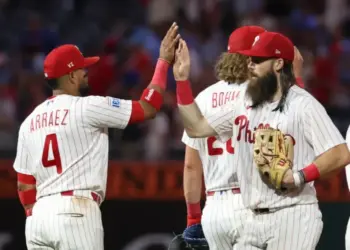
Turner signed an 11-year, $300 million contract with the Phillies before the 2023 season, making him one of the highest-paid players in franchise history. The agreement was designed to keep an elite shortstop in Philadelphia through his prime years and beyond. At the time, the move appeared to be a statement of intent from a team determined to contend for championships.
But long-term contracts are rarely judged solely on the first few seasons. As Turner moves deeper into the deal, questions surrounding his production, age, defensive value and the future flexibility of the Phillies’ payroll are likely to become increasingly important.
Turner Remains a Major Part of Philadelphia’s Plans
It would be unfair to describe Turner as a complete failure under his massive contract. The veteran shortstop has demonstrated the offensive ability that made him one of baseball’s most coveted free agents.
His combination of speed, contact ability and power makes him a unique offensive threat. Turner can change a game with his bat, on the bases and in the field when he is playing at his best.
The Phillies also knew when they signed him that they were not simply paying for one season. They were investing in a player they believed could remain an important part of their lineup for many years.
That distinction is important.
A contract does not become problematic simply because a player has an occasional disappointing season. The bigger concern is whether his production will continue to match the financial commitment as he gets older.
Age Could Become the Biggest Concern
The greatest risk associated with Turner’s contract is not necessarily his current performance. It is the length of the agreement.
An 11-year contract is an enormous commitment for any position player. The Phillies are essentially betting that Turner can remain productive well into his 30s.
That is a difficult prediction to make.
Turner’s greatest weapons have historically included his elite athleticism and speed. However, speed is one of the tools that can decline most noticeably with age. If his athleticism decreases, some of the qualities that have made him such an explosive player could become less effective.
The Phillies therefore need to think beyond what Turner is producing today. They have to consider what his contract could look like several years from now.
A deal that looks reasonable when a player is in his late 20s can become much more challenging when that same player reaches his mid-30s.
Defense Adds Another Layer to the Discussion
Turner’s value is also closely connected to his position.
Shortstop is one of the most demanding defensive positions on the diamond. A player must possess quick reactions, range, arm strength and athleticism to consistently handle the position at a high level.
If Turner eventually loses some of his speed or range, Philadelphia could face a difficult decision.
Moving him to another position could preserve his bat while reducing the defensive demands placed on him. However, that could also create a domino effect across the roster.
The Phillies would then need to determine who plays shortstop and whether Turner remains valuable enough to justify his contract at another position.
That is precisely the kind of problem long-term contracts can create.
The Phillies Cannot Ignore the Financial Implications
Philadelphia’s front office has shown a willingness to spend aggressively in pursuit of a championship. The organization has committed significant money to several star players, and that strategy has helped create a roster capable of competing with the best teams in the National League.
However, payroll flexibility is not unlimited.
Every large contract occupies money that could otherwise be used to strengthen another area of the roster. If Turner continues producing at an elite level, his contract can be justified as the cost of keeping a franchise-caliber player.
If his production declines significantly, however, the Phillies could find themselves paying substantial money for diminishing returns.
That would be especially problematic if the club needs to address pitching, bullpen depth, defensive weaknesses or other positions in the future.
This Does Not Mean Philadelphia Should Move Turner
The discussion surrounding Turner’s contract should not automatically lead to calls for the Phillies to trade him.
Trading a player with such a massive contract would be extremely complicated. More importantly, Turner remains an important offensive weapon and a central figure on a team with championship aspirations.
The better approach may be to manage his workload carefully, maximize his offensive strengths and prepare for the possibility that his role could evolve later in the contract.
Philadelphia could eventually reduce his defensive responsibilities or transition him to another position if necessary.
The key will be making that adjustment before declining athleticism becomes a serious problem.
The Real Question Is What Happens Later
For now, the Phillies’ biggest concern should not be whether Turner is worth every dollar of his contract in a single season.
The more important question is whether the organization can continue getting enough value from the deal as the years pass.
Long-term contracts are ultimately evaluated over their entire lifespan. Turner does not need to remain an MVP candidate for all 11 seasons for the agreement to be considered successful. He simply needs to provide enough offensive and overall value to justify the financial and roster commitment.
That becomes increasingly difficult as players age.
Philadelphia has built much of its recent success around star power, and Turner remains one of the most recognizable pieces of that strategy. But the same contract that helped convince him to join the Phillies could eventually become one of the organization’s biggest challenges.
For that reason, Trea Turner’s contract deserves close attention—not necessarily because the deal is already a disaster, but because its length creates a significant long-term risk for the Phillies.
If Turner continues producing at a high level, Philadelphia will have little reason to complain. If his athleticism and production decline faster than expected, however, the Phillies could eventually find themselves dealing with one of the most difficult contracts on their books.
And for a team determined to remain a contender, how Philadelphia manages Turner’s massive commitment could have major implications for its future.





Discussion about this post