

The Indiana Fever–Las Vegas Aces playoff series was already filled with emotion, physical basketball and enormous pressure.
Then came a moment that pushed the conversation beyond basketball.
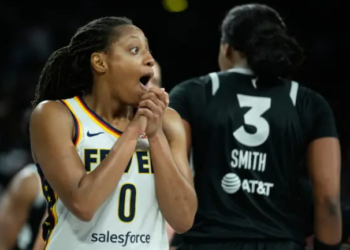
During Game 2 in Indianapolis, Aces superstar A’ja Wilson became involved in a heated exchange with a courtside fan. Wilson was seen pointing and shouting toward the spectator before teammates and members of the Aces staff intervened.
Officials assessed Wilson a technical foul.
But she was not ejected.
And after the game, the incident became one of the biggest talking points surrounding the series.
The controversy grew even louder when the WNBA determined that Wilson would not face an additional suspension or fine ahead of the decisive Game 3.
For critics, that decision raised questions about consistency and accountability.
For Wilson’s supporters, the situation was more complicated because the player said the fan had stepped toward her and pointed at her.
Either way, the incident has opened a much bigger discussion about where professional athletes and spectators should draw the line.
THE MOMENT THAT SET SOCIAL MEDIA ON FIRE
The incident occurred during the fourth quarter of Indiana’s 99–89 Game 2 victory.
Wilson had just been involved in a play near the basket when the confrontation developed.
Video showed Wilson moving toward a fan seated behind the basket while pointing and exchanging words. Teammates quickly intervened, preventing the situation from becoming physical.
Wilson was assessed a technical foul for unsportsmanlike conduct.
The fan was initially escorted away from the area but was later permitted to return after arena security determined that he had not violated the Fan Code of Conduct.
That detail became particularly important.
Because while Wilson was criticized for responding to the fan, Wilson also argued that the spectator had moved toward her and pointed at her.
After the game, she made it clear that she considered that behavior unacceptable.
WHY FEVER FANS ARE QUESTIONING THE DECISION
The biggest issue for many fans isn’t necessarily whether Wilson was angry.
Athletes are human beings.
They can become frustrated.
They can hear things from spectators that viewers at home never hear.
They can react emotionally in the heat of a playoff game.
The larger question is whether the same standards are applied consistently whenever players and spectators cross the line.
That is where the WNBA’s decision became controversial.
The league’s rules state that a player who deliberately enters the spectator stands during a game must be ejected. However, officials reviewed the incident and determined that Wilson had remained in the court area, specifically the player escape lane adjacent to the basket, rather than entering the stands.
That distinction ultimately determined the outcome.
Wilson received a technical.
But there was no ejection and no additional league punishment.
THE RULEBOOK IS MORE SPECIFIC THAN SOCIAL MEDIA MAKES IT SOUND
This is where the online conversation needs some context.
Some viral posts have suggested that any player who approaches a fan automatically receives a multi-game suspension.
That is not an accurate description of what happened here.
The WNBA rule specifically addresses deliberately entering the spectator stands.
The critical question in Wilson’s case was therefore not simply, “Did she approach a fan?”
It was:
Did she actually enter the spectator stands?
Officials reviewed the incident and concluded that she did not.
That decision is controversial, but it is different from the claim that the WNBA simply ignored its own rulebook.
The distinction between the court area and the stands became the central issue.
THAT DOESN’T MEAN THE CONTROVERSY ISN’T VALID
At the same time, fans are completely justified in asking whether the league should provide clearer explanations when controversial incidents occur.
Professional sports leagues depend heavily on consistency.
Fans invest money, emotion and time into watching games. When a highly visible incident happens, they want to understand why one player receives a technical foul, why another situation produces an ejection, or why a particular incident receives no additional discipline.
Silence can create suspicion.
A detailed explanation can prevent it.
In this case, the WNBA did not publicly offer an extensive statement explaining the decision. Reports based on league and officiating information supplied the reasoning that Wilson remained in the court area.
That left social media to fill the information gap.
And social media rarely fills information gaps calmly.
THE BIGGER ISSUE IS PLAYER-FAN BOUNDARIES
There is another side of this story that should not be ignored.
Fans absolutely have the right to criticize players.
They can boo.
They can celebrate opposing players making mistakes.
They can express frustration.
But professional athletes are not obligated to tolerate threats, intimidation or behavior that crosses into personal harassment.
The WNBA’s own Fan Code of Conduct says fans are expected to respect players and prohibits disruptive behavior, including foul or abusive language and obscene gestures. It also provides for penalties against spectators who violate the code.
That matters.
The responsibility does not belong exclusively to players.
Spectators have responsibilities too.
If a fan crosses a line, arena security should handle the situation before an argument develops into something more serious.
AND PLAYERS HAVE RESPONSIBILITIES TOO
But the other side of the equation is equally important.
Players are the professionals.
They represent their teams, the league and, increasingly, a generation of young fans watching them closely.
That means emotional control matters.
A superstar can be provoked and still be expected to understand that reacting aggressively can create consequences.
This is particularly important in women’s basketball because the WNBA has attracted an enormous number of younger fans.
Young girls watching their favorite players are not only studying jump shots and defensive techniques.
They’re also watching how stars handle pressure, disagreement, criticism and conflict.
That doesn’t mean athletes have to remain silent when someone crosses a line.
It means the response matters.
A’JA WILSON’S OWN RESPONSE ADDED ANOTHER LAYER
One of the more revealing parts of the controversy came after the game.
Wilson acknowledged that she had received a technical foul and apologized to her teammates for putting them in that situation.
At the same time, she strongly defended herself, saying she believed the fan had stepped toward her and pointed at her.
That combination is worth considering.
Wilson did not simply pretend the incident never happened.
She recognized that her reaction hurt her team by giving Indiana a technical free throw.
But she also maintained that there was a boundary she was unwilling to let a spectator cross.
That is a more complicated story than the simple social-media narrative of “player attacks fan.”
THE FEVER BENEFITED FROM THE CHAOS ON THE COURT
There is also a basketball angle that should not be overlooked.
At the time of the confrontation, Indiana was leading 90–79.
The Fever ultimately won 99–89 to force a decisive Game 3.
Wilson finished Game 2 with 22 points and nine rebounds, but Indiana’s defense did a much better job containing her than it had in Game 1, when she exploded for 38 points and 16 rebounds.
That means the controversy should not completely overshadow what Indiana accomplished.
The Fever had already put themselves in position to win the game.
The confrontation was dramatic, but it wasn’t the reason Indiana won.
The basketball itself mattered.
WHY THIS MATTERED GOING INTO GAME 3
The disciplinary decision meant Wilson remained available for the biggest game of the series.
That was enormous.
Game 3 was a winner-take-all playoff game.
Without Wilson, Las Vegas would have faced an enormous disadvantage.
Instead, the Aces entered the decisive contest with their four-time MVP available.
And Wilson ultimately delivered.
She scored 36 points and grabbed 10 rebounds as Las Vegas defeated Indiana 94–83 and advanced to the semifinals.
That result adds another interesting layer to the controversy.
The debate over whether Wilson should have been suspended was enormous before Game 3.
But when the game actually arrived, she settled the basketball portion of the argument on the court.
THE WNBA CANNOT AFFORD TO LET SOCIAL MEDIA WRITE THE RULEBOOK
Perhaps the biggest lesson for the league is communication.
The WNBA does not need to punish players simply because social media demands punishment.
It also should not change rules because one fan base is angry.
What the league does need is consistency.
If officials determine that a player did not enter the stands, explain the distinction.
If a fan violates the code of conduct, explain what happened.
If a player receives only a technical because the situation falls short of an ejection-worthy offense, explain that too.
Clear communication makes controversial decisions easier to understand.
Silence makes them look arbitrary.
THE “DOUBLE STANDARD” ARGUMENT NEEDS EVIDENCE
The internet is now full of claims that the WNBA gives preferential treatment to certain players or that an “old guard” receives special treatment.
Those are serious accusations.
But they should not be presented as established facts without evidence.
A more productive question is whether the league applies the same standards consistently across all players, regardless of their popularity, team or status.
That is something fans can legitimately demand.
Superstars should not receive one set of rules.
Rookies should not receive another.
Established champions should not receive another.
And the league’s biggest stars should not be protected from accountability simply because they are important to the product.
Consistency is what creates credibility.
THIS IS BIGGER THAN A’JA WILSON
It would be easy to make this entire story about Wilson.
But the real issue is bigger.
The WNBA is experiencing enormous attention, and with that attention comes greater scrutiny.
Every controversial call becomes a national conversation.
Every player confrontation becomes viral content.
Every disciplinary decision gets analyzed frame by frame.
That is the reality of being a major professional sports league.
The solution isn’t to eliminate emotion from basketball.
Emotion is part of sports.
The solution is to establish clear boundaries and enforce them consistently.
WHAT THIS MEANS FOR THE FEVER AND THEIR FANS
For Indiana fans, the controversy was frustrating because the Fever were in the middle of a genuine championship opportunity.
Caitlin Clark, Aliyah Boston and Kelsey Mitchell were trying to knock off one of the WNBA’s most experienced teams.
Every possession mattered.
Every technical mattered.
Every distraction mattered.
The Fever eventually lost Game 3, 94–83, ending their season.
But the series demonstrated that Indiana had become capable of challenging Las Vegas in a high-pressure playoff environment.
The next step is turning those competitive moments into a series victory.
THE REAL WINNER SHOULD BE ACCOUNTABILITY
The most constructive conclusion to this controversy is not that A’ja Wilson is a terrible person.
There is not enough evidence to make that judgment from one heated basketball incident.
Nor is it reasonable to say the WNBA is doomed because of one disciplinary decision.
The more useful conclusion is that professional sports need clear boundaries for both players and fans.
Players should be protected from abusive or threatening spectators.
Fans should be protected from inappropriate player behavior.
Officials should enforce the rules.
And the league should explain controversial decisions clearly enough that fans understand how the rules were applied.
That’s accountability.
And that’s what both the WNBA and its rapidly growing fan base should demand.
FINAL TAKEAWAY
The A’ja Wilson–Fever fan confrontation became much bigger than a technical foul.
It became a debate about player responsibility, fan behavior, league discipline, consistency and the standards expected from professional athletes.
Wilson was not suspended because officials determined she remained in the court area rather than entering the stands. She was, however, assessed a technical foul for unsportsmanlike conduct.
Fans are free to disagree with that decision.
But the strongest criticism isn’t to declare someone’s entire character based on one emotional moment.
It is to demand something much more important:
One rulebook. One standard. Consistent enforcement.
That’s how a growing league earns the trust of its fans.
And as the WNBA continues to attract bigger audiences and greater scrutiny, that trust may become just as important as what happens on the basketball court.




Discussion about this post