

The WNBA is approaching one of the biggest leadership transitions in its history, and Indiana Fever fans have a legitimate reason to pay attention.
Cathy Engelbert will retire as WNBA commissioner at the end of 2026 after more than seven years in charge. Now, the search for her successor is officially becoming a major basketball-business story.
And there is one detail that has immediately caught the attention of Caitlin Clark fans.
The NBA has retained Excel Search & Advisory to help lead the search for the next WNBA commissioner.
Excel has a direct connection to Clark because Caitlin Clark is represented by Excel Sports Management.
That does not mean Clark is selecting the next commissioner.
It does not mean her representatives will decide who runs the league.
And it certainly does not prove that the next commissioner will be someone chosen to favor Indiana or Clark.
But the connection is notable enough to spark a much larger conversation about what fans want from the WNBA’s next era.
CATHY ENGELBERT’S DEPARTURE CHANGES THE CONVERSATION
Engelbert’s departure represents the end of an important chapter for the WNBA.
She became the league’s first commissioner in 2019 and presided over a period of substantial growth in viewership, attendance, digital engagement, merchandise sales, sponsorship revenue and franchise valuations.
During her tenure, the league also pursued expansion, negotiated new media rights arrangements and reached a new collective bargaining agreement that dramatically changed player compensation.
The WNBA announced that Engelbert will retire at the end of 2026.
That means whoever follows her will inherit a league that is considerably different from the one Engelbert took over.
The next commissioner will therefore have to deal with both the opportunities created by that growth and the challenges that have accompanied it.
WHY EXCEL’S INVOLVEMENT HAS CAUGHT FEVER FANS’ ATTENTION
The interesting part isn’t that Caitlin Clark is somehow choosing the next commissioner.
She isn’t.
The important detail is that the firm assisting with the executive search belongs to the broader Excel organization, which also represents Clark.
Excel’s basketball division publicly lists Clark among its clients, and reporting on the commissioner search identifies Excel Search & Advisory as the executive-search arm involved in the process.
That overlap naturally raises questions.
What qualities will the NBA look for?
Will the next commissioner prioritize player relations?
Will officiating become a bigger priority?
How will the league handle player safety?
Will communication between the league office and players improve?
And perhaps most importantly, what does the WNBA need as it enters its next stage of growth?
Those questions are much bigger than Caitlin Clark.
CAITLIN CLARK HAS BECOME PART OF THE LEAGUE’S BIGGEST CONVERSATIONS
It is impossible to discuss the modern WNBA without acknowledging the enormous attention surrounding Clark.
Since entering the league, she has become one of its most recognizable stars and one of the most heavily discussed players in women’s basketball.
That visibility means issues involving Clark often become league-wide conversations.
When Clark discusses officiating, fans listen.
When she is involved in a physical play, social media reacts.
When the Fever play a nationally televised game, the audience extends far beyond traditional WNBA followers.
That doesn’t mean every controversy involving Clark should automatically become a league policy issue.
It does mean the league has to recognize that its most visible players can influence how millions of fans perceive the product.
OFFICIATING WILL BE ONE OF THE BIGGEST TESTS
If the next commissioner wants to build trust with fans, officiating is likely to be near the top of the agenda.
The WNBA has already acknowledged that officiating needs continued improvement.
In July, the league announced the creation of a centralized Replay Center beginning with the 2027 season. The system will use the NBA’s replay facility in Secaucus, New Jersey, and is designed to improve the consistency and efficiency of reviewable decisions.
The league has also discussed its officiating task force and additional resources for referee development.
Those changes are significant.
But technology can only solve certain problems.
A replay center can help officials review eligible plays.
It cannot automatically eliminate every disagreement over whether a foul should have been called in the first place.
That distinction will remain important.
THE CAITLIN CLARK BLOODY-MOUTH INCIDENT ADDED FUEL TO THE DEBATE
The officiating discussion became particularly intense during Indiana’s season-ending Game 3 against the Las Vegas Aces.
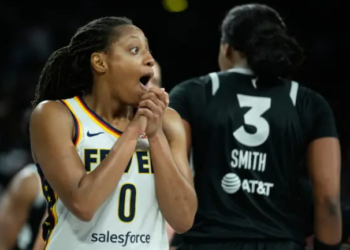
With just over three minutes remaining, Clark went up for a rebound and made contact with Jewell Loyd. Clark’s mouth was left bleeding, and she briefly left the court for treatment before returning.
No foul was called on the play.
After returning, Clark approached an official and visibly showed the official her bleeding mouth while questioning why the play had not been reviewed.
Reports described the contact as appearing inadvertent, while the absence of a foul call nevertheless became a major talking point among Fever supporters.
The Aces eventually won 94–83.
The controversy therefore became part of a much larger postgame discussion about officiating and physical play.
THE NUMBERS MAKE THE OFFICIATING DEBATE EVEN MORE INTERESTING
Another statistic that attracted attention from the Fever-Aces finale was the free-throw disparity.
Las Vegas attempted 35 free throws.
Indiana attempted 20.
That does not, by itself, establish that officials favored one team.
Free-throw totals can be influenced by playing style, shot selection, defensive strategy, possession patterns and the types of contact occurring during a game.
But large disparities naturally attract scrutiny, particularly during an elimination game.
For the WNBA, this is precisely why transparency matters.
Fans should be able to distinguish between an unusual statistical difference and evidence of inconsistent officiating.
Those are not automatically the same thing.
PLAYER SAFETY IS ANOTHER PRIORITY
The conversation goes beyond whistles.
The WNBA has experienced increasing attention around physical play and player safety as the league has grown.
Clark herself has also spoken publicly about harassment directed toward WNBA players.
That is important because the league now operates in a dramatically larger media environment.
Players are exposed to enormous social-media audiences.
Fans can react instantly.
Controversial incidents can reach millions of people within minutes.
The next commissioner will therefore inherit a league where player protection includes much more than what happens between the baselines.
THE NEW COMMISSIONER WILL HAVE TO MANAGE A MUCH BIGGER WNBA
This may ultimately be the most important point.
The WNBA of 2027 will not be the same WNBA that existed when Engelbert arrived in 2019.
The league has expansion plans.
Player salaries are changing.
Media rights are becoming increasingly important.
More fans are watching.
More companies want relationships with WNBA players and teams.
And stars such as Clark have brought new audiences into the sport.
Growth creates opportunity.
It also creates pressure.
A larger league needs stronger infrastructure, better communication and increasingly professional operations.
CAITLIN CLARK SHOULD NOT BE THE ONLY MEASURE OF THE NEXT COMMISSIONER
This is where the conversation needs balance.
It would be easy for Fever fans to view the commissioner search entirely through Clark’s experience.
But the WNBA has 13 teams today and plans to reach 18 teams by 2030.
Every franchise has different needs.
Every player deserves consistent treatment.
Every fan base deserves a league that operates transparently.
A commissioner should therefore be judged on how effectively they serve the entire league rather than on whether they appear favorable to one superstar.
Clark’s influence is significant.
But the future of the WNBA cannot depend on one player.
WHAT SHOULD FANS WATCH DURING THE SEARCH?
There are several things worth watching as the process develops.
OFFICIATING TRANSPARENCY
Will the league provide more information about controversial calls and non-calls?
Will the new replay infrastructure make reviews faster and clearer?
Will fans have better access to explanations after major incidents?
PLAYER SAFETY
How will the league respond to physical play?
How will it protect players from harassment?
Will players feel comfortable raising concerns directly with league leadership?
COMMUNICATION
This could become one of the most important issues.
Fans increasingly expect leagues to explain major decisions.
Players expect the same.
When controversial situations occur, silence can allow speculation to fill the vacuum.
A commissioner who communicates clearly can potentially reduce that problem.
FAN EXPERIENCE
The WNBA’s growth depends on bringing new fans into the sport while retaining the people who have supported it for decades.
That means improving arenas, broadcasts, digital platforms, officiating explanations and the overall relationship between the league and its supporters.
THE EXCEL CONNECTION SHOULD BE WATCHED — NOT OVERSTATED
The relationship between Excel and Caitlin Clark is certainly interesting.
But fans should be careful about turning that connection into something it isn’t.
Excel Search & Advisory is an executive-search business.
Excel Sports Management represents athletes, including Clark.
Those are related parts of the broader organization, but that does not mean Clark personally controls the search.
The NBA’s Adam Silver remains the person ultimately responsible for selecting the WNBA commissioner.
That distinction matters.
A connection can be noteworthy without being evidence of favoritism.
THIS COULD BE AN OPPORTUNITY FOR A FRESH START
The leadership change gives the WNBA an opportunity to evaluate what worked during Engelbert’s tenure and what still needs improvement.
The league’s growth under Engelbert is undeniable.
But growth also exposes weaknesses.
More attention means more scrutiny.
More stars mean more complicated player relationships.
More fans mean more expectations.
More television coverage means controversial moments receive greater examination.
The next commissioner will therefore inherit both an opportunity and a responsibility.
WHAT FEVER FANS SHOULD WANT FROM THE NEXT COMMISSIONER
Rather than focusing only on whether the next commissioner is a “Caitlin Clark person,” the better question is what principles the league should operate under.
Fans can reasonably ask for:
CONSISTENT OFFICIATING.
CLEAR PLAYER-SAFETY STANDARDS.
TRANSPARENT DISCIPlinary EXPLANATIONS.
BETTER COMMUNICATION.
A STRONGER FAN EXPERIENCE.
FAIR TREATMENT OF EVERY TEAM AND PLAYER.
Those standards would benefit Clark.
They would also benefit A’ja Wilson, Angel Reese, Breanna Stewart, Napheesa Collier, Kelsey Mitchell, Aliyah Boston and every other player in the league.
THE FEVER’S FUTURE IS BIGGER THAN ONE OFFSEASON
Indiana’s season has now ended after Las Vegas defeated the Fever 94–83 in Game 3.
But the organization has entered a different phase.
The Fever are no longer simply trying to become relevant.
They are trying to become championship contenders.
That means every offseason decision matters.
Coaching.
Roster construction.
Player development.
Defense.
Depth.
And the relationship between the organization and its stars.
The league office also matters because league rules, officiating standards and player-safety policies affect every team.
THE NEXT COMMISSIONER WILL INHERIT A LEAGUE AT A CROSSROADS
The WNBA doesn’t need to choose between growth and accountability.
It needs both.
The league can celebrate rising attendance while demanding better officiating.
It can sign major media deals while improving communication.
It can expand to new markets while protecting players.
And it can embrace stars such as Caitlin Clark without turning the entire league into a one-player operation.
That balance may define the next era.
FINAL TAKEAWAY
Cathy Engelbert’s retirement marks the end of one WNBA era.
The selection of her successor will help define the next one.
The fact that Excel Search & Advisory has been retained to lead the search is particularly interesting because the broader Excel organization represents Caitlin Clark.
But that connection should be viewed as a reason to watch the process, not as evidence that Clark is choosing the next commissioner.
The real story is bigger.
The WNBA is entering a period of enormous growth, and the next commissioner will inherit a league with more money, more attention, more teams and more scrutiny than ever before.
For Caitlin Clark fans, Fever fans and WNBA supporters generally, this is the moment to ask a simple question:
WHAT SHOULD THE NEXT ERA OF THE WNBA LOOK LIKE?
Better officiating?
Greater transparency?
Stronger player protection?
Better communication?
A better fan experience?
Those conversations are now more relevant than ever.
And whoever eventually takes over the commissioner’s office will have the opportunity to shape the answers.







Discussion about this post