

The Indiana Fever’s season ended Thursday night, but the debate surrounding the officiating in their playoff elimination against the Las Vegas Aces is far from over.
Las Vegas defeated Indiana 94–83 in a tense winner-take-all Game 3, advancing to the WNBA semifinals and ending the Fever’s postseason for the second consecutive year.
But alongside A’ja Wilson’s spectacular 36-point performance, another storyline has dominated the postgame conversation: officiating.
Several calls and no-calls generated intense reactions throughout the game, including a particularly controversial foul involving Lexie Hull and Brianna Turner that resulted in Indiana head coach Stephanie White receiving a technical foul.
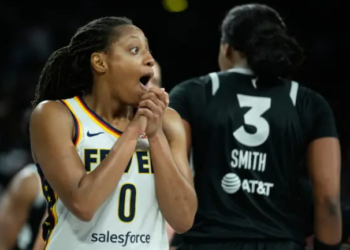
Late in the fourth quarter, Caitlin Clark was also visibly bleeding after being hit in the mouth by Jewell Loyd while competing for a rebound. No foul was called on the play.
For Fever supporters, the combination of those moments created an understandably frustrating ending.
However, one viral claim circulating online goes considerably further, alleging that the WNBA has terminated the entire three-person officiating crew.
There is currently no reliable confirmation that this has happened.
THE CONTROVERSIAL LEXIE HULL FOUL
One of the biggest officiating flashpoints came early in the second quarter.
Hull became involved in a physical battle with Turner, and the Fever guard ultimately went to the floor.
Officials ruled the contact against Hull.
That decision immediately drew protests from Indiana.
White strongly argued that Turner had been responsible for bringing Hull down, but instead of the call being overturned, the Fever coach was assessed a technical foul.
The WNBA’s official Game 3 recap confirms the sequence, noting that White was called for the technical after arguing that Turner had brought down Hull.
For Indiana, the frustration was understandable.
The Fever were playing an elimination game against the defending champions, and a disputed foul followed by a technical against the head coach represented a potentially important momentum swing.
WHY THE CALL BECAME SUCH A MAJOR TALKING POINT
The controversy was not simply about one foul.
It was about the timing.
Indiana was playing a team with extensive playoff experience in a game where the losing team would immediately begin its offseason.
Every possession mattered.
Every foul mattered.
Every coaching decision mattered.
That is why a disputed whistle can feel considerably more consequential in a winner-take-all playoff game than it would during a regular-season matchup.
The Fever’s bench clearly believed the officials had interpreted the Hull-Turner contact incorrectly.
But there is an important distinction between saying the call was controversial and claiming that the league later determined the officials were definitively wrong.
There is currently no verified WNBA announcement making that determination.
THE CAITLIN CLARK BLOODY-MOUTH INCIDENT
The officiating discussion became even louder late in the game.
Clark was battling Jewell Loyd for a rebound when Loyd’s arm made contact with Clark’s mouth.
Clark immediately reacted to the collision.
She was visibly bleeding and briefly left the court before returning to the game.
A photograph distributed through Reuters shows Clark displaying her bleeding mouth to an official during the second half.
No foul was called.
That decision generated another wave of criticism from Fever fans.
The incident was especially striking because Clark returned to the floor and continued playing despite the injury.
WAS THE CONTACT INTENTIONAL?
The available reporting has described the contact as occurring during the rebound rather than as a deliberate attempt to strike Clark.
That distinction matters.
A player can make illegal contact without intending to hurt an opponent, and officials must determine whether the action meets the standard for a foul.
At the same time, the fact that Clark was visibly bleeding naturally made the sequence more emotionally powerful for viewers.
It is therefore reasonable for fans to debate the decision.
What is not established is that the officials deliberately ignored a foul or that the league subsequently determined the crew had manipulated the game.
Those are much stronger claims requiring evidence.
DID THE WNBA FIRE THE ENTIRE OFFICIATING CREW?
This is the biggest claim circulating online.
According to the report being shared on social media, the WNBA supposedly terminated all three officials immediately after Game 3 because of a series of “egregious errors.”
But I could not verify that announcement through the WNBA’s official reporting or reliable major news coverage.
In fact, the official WNBA Game 3 recap discusses the controversial sequences but does not report that the officiating crew was dismissed.
That is an important warning for Fever fans and sports publishers.
A dramatic headline can spread extremely quickly after a controversial game, especially when clips are circulating online.
But viral attention does not establish that a league disciplinary decision actually occurred.
THE OFFICIAL CREW WAS KNOWN BEFORE THE GAME
The scheduled Game 3 officiating crew was Tiara Cruse, Timothy Greene and Ryan Sassano, with Agon Abazi listed as the alternate, according to a referee assignment report published before the game.
That provides another reason to be cautious about claims that the entire crew was immediately dismissed.
A real league decision of that magnitude would normally be expected to generate clear official or reputable reporting.
No such confirmation has been established in the sources reviewed for this article.
THE FEVER HAD MORE THAN ONE REASON TO BE FRUSTRATED
The officiating controversy cannot be viewed in isolation.
The entire game was unusually physical.
Clark and Turner each received technical fouls just over three minutes into the game after Turner entered an Indiana huddle and Clark shoved her away.
The Hull sequence then produced another technical for White.
And Clark’s bloody-mouth incident became the final major officiating flashpoint.
The official WNBA recap described the game as carrying the intensity expected when both teams’ seasons were on the line.
That atmosphere helps explain why emotions were so high.
BUT THE ACES STILL HAD TO WIN THE GAME
For all the controversy, Las Vegas deserves credit for what happened on the basketball court.
The Aces eventually won 94–83.
A’ja Wilson was the difference-maker.
The four-time WNBA MVP scored 36 points and grabbed 10 rebounds, providing Las Vegas with the dominant performance it needed in an elimination game.
Chelsea Gray added 23 points, while Jackie Young scored 18.
Indiana had strong performances of its own.
Kelsey Mitchell scored 23 points.
Aliyah Boston produced 19 points and 10 rebounds.
Clark finished with 18 points after scoring 11 in the opening quarter.
The problem for Indiana was sustaining its early offensive success while containing Las Vegas’ stars.
INDIANA ACTUALLY MADE LAS VEGAS SWEAT
The final score does not tell the entire story.
Las Vegas threatened to take control in the third quarter, building a 67–55 advantage.
But Indiana refused to disappear.
The Fever cut the deficit to two points twice in the fourth quarter.
That means Indiana was within striking distance of completing another comeback against the defending champions.
Ultimately, however, the Aces found enough answers to close the game.
That resilience is something the Fever can take into the offseason.
THE BIGGER QUESTION IS WHAT COMES NEXT
The controversy will generate headlines for a few days.
Indiana’s roster decisions could shape the franchise for years.
The Fever have Caitlin Clark.
They have Aliyah Boston.
They have Kelsey Mitchell, whose future becomes an important offseason question.
They also have a coaching staff and front office that now have another postseason series from which to evaluate the roster.
The next step is determining what Indiana needs to compete more consistently with teams such as Las Vegas.
CLARK’S DEVELOPMENT REMAINS CENTRAL
Clark’s performance in Game 3 was a mixture of encouraging moments and difficult stretches.
She exploded for 11 points in the first quarter but was limited to seven points over the remainder of the game.
That does not erase what was an important season for the Fever star.
Clark returned to postseason basketball after missing the previous playoffs because of injury.
She helped Indiana reach the postseason again and then played in a three-game series against one of the league’s most accomplished teams.
The experience should provide another valuable lesson for her development.
THE FEVER’S OFFSEASON CANNOT BE ABOUT OFFICIATING ALONE
If Indiana wants to become a championship contender, the organization cannot spend the entire offseason focusing on controversial calls.
The officiating debate may be legitimate.
But the Fever have larger basketball questions to solve.
They need to evaluate their defensive consistency.
They need greater roster depth.
They need more players capable of creating offense when Clark is heavily pressured.
And they need to determine how to build a roster that can withstand the physical demands of postseason basketball.
Those decisions will matter much more than whether a particular referee receives a future assignment.
THE VIRAL CLAIM SHOULD BE TREATED WITH CAUTION
The idea that the WNBA immediately fired an entire officiating crew is certainly an attention-grabbing story.
But attention is not confirmation.
As of the latest reliable reporting reviewed, the WNBA has not been verified as announcing the termination of the Game 3 officiating crew.
What is confirmed is that Indiana’s bench strongly objected to the Hull foul, White received a technical while protesting the call, Clark was later left bleeding after contact with Loyd, and the Fever ultimately lost 94–83.
Those facts are already enough to explain why the game generated so much discussion.
THE FEVER’S SEASON IS OVER, BUT THE CONVERSATION ISN’T
Indiana’s 2026 campaign ended in disappointing fashion.
The Fever pushed the defending champions to a decisive Game 3 and twice threatened to erase a fourth-quarter deficit.
But Wilson and the Aces ultimately prevailed.
Now Indiana faces an offseason filled with questions about roster construction, free agency, defensive improvement and the next stage of Clark’s development.
As for the officiating controversy, Fever fans are entitled to scrutinize the calls and debate whether officials got particular sequences right.
But until the WNBA itself confirms otherwise, claims that the league has “axed the entire officiating crew” should not be presented as established fact.
The most important response from Indiana will ultimately come on the basketball court.
The Fever have shown that they can reach the postseason.
Now the challenge is figuring out how to stay there — and eventually advance beyond it.





Discussion about this post