

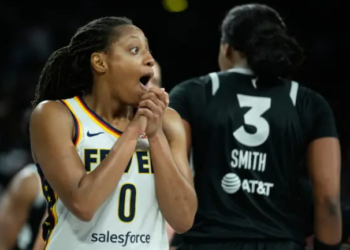
The Indiana Fever and Chicago Sky rivalry produced another explosive moment when Sky guard DiJonai Carrington was ejected after a hard foul on Fever guard Sophie Cunningham.
The incident immediately changed the atmosphere inside the arena and became one of the biggest talking points surrounding Indiana’s 90-86 victory.
However, some versions of the story circulating online have mixed up the players and teams involved.
The incident was not between Carrington and Nyara Sabally, and it was not a Sky-Toronto Tempo game. The confrontation occurred during a Chicago Sky vs. Indiana Fever matchup, with Cunningham on the receiving end of the foul. It also happened late in the first quarter, rather than the third.
WHAT HAPPENED BETWEEN CARRINGTON AND CUNNINGHAM?
Cunningham was racing toward the basket on a fast break and had an opportunity to finish a layup.
Carrington chased the play from behind and attempted to defend the shot. During the attempt, Carrington’s left arm made significant contact with Cunningham’s face and neck area, sending the Fever guard hard to the floor.
Cunningham was able to get back to her feet, and emotions immediately boiled over.
The two players exchanged words before teammates and Fever personnel intervened to prevent the confrontation from escalating further.
Officials initially assessed a Flagrant 1 foul.
After reviewing the play, however, the officials upgraded it to a Flagrant 2, which automatically resulted in Carrington’s ejection.
WHY THE FOUL BECAME A FLAGRANT 2
The distinction between a Flagrant 1 and Flagrant 2 is important.
A Flagrant 2 is considered a more serious level of contact and results in an automatic ejection.
The officiating crew determined that the play involved a significant wind-up, impact and follow-through, with Cunningham in a vulnerable position during the fast break.
That decision ended Carrington’s afternoon after only a few minutes of action.
Carrington had actually started the game well.
She had scored eight points in roughly four minutes and had provided an early spark for Chicago before the foul abruptly ended her involvement.
CUNNINGHAM WAS CLEARLY UPSET AFTER THE PLAY
The immediate aftermath was almost as dramatic as the foul itself.
Cunningham got up and moved toward Carrington, visibly angry about the contact.
Players and staff stepped in quickly.
Makayla Timpson was among those who helped separate the players, while Fever personnel also moved toward the situation.
The officials ultimately determined that Cunningham’s reaction did not warrant a technical or other penalty.
Crew chief Maj Forsberg later explained that the officials considered Cunningham’s reaction appropriate given the severity of the contact.
STEPHANIE WHITE OFFERED AN IMPORTANT PERSPECTIVE
While Cunningham believed the contact was unnecessary, Fever head coach Stephanie White offered a somewhat different interpretation of Carrington’s intentions.
White acknowledged that the foul was hard but said she did not believe Carrington intentionally set out to strike Cunningham in the neck.
That distinction matters.
There is a difference between saying a foul was dangerous or excessive and concluding that a player deliberately intended to injure another player.
The officials’ decision dealt with the nature of the contact and the circumstances of the play rather than requiring an assumption about Carrington’s personal intentions.
CARRINGTON’S SOCIAL MEDIA POST ADDED ANOTHER LAYER
The story did not end when Carrington left the court.
After her ejection, Carrington posted the words “WHITE PRIVILEGE” while tagging the Indiana Fever on Threads.
She later posted “8/23,” referencing the next scheduled meeting between Chicago and Indiana.
The first post generated significant discussion because of the circumstances surrounding the ejection.
Cunningham rejected the suggestion that race had anything to do with the officiating decision and pointed out that she herself had previously been ejected following a hard foul.
Carrington later clarified that she did not intend her post to mean that the Flagrant 2 ruling itself was the result of white privilege.
That clarification is important because the social-media reaction quickly became broader than the basketball incident itself.
THE FEVER WON DESPITE THE CHAOS
Despite losing Carrington, Chicago remained competitive.
The Fever eventually secured a 90-86 victory.
Caitlin Clark and Kelsey Mitchell were major contributors, with Clark scoring 26 points and Mitchell adding 27.
For Indiana, the victory was important because it demonstrated the team’s ability to remain focused while dealing with an unusually emotional game.
The Fever improved to 20-12, while Chicago fell to 12-20 at the time.
WHY THIS MATTERS FOR THE FEVER
Indiana has become one of the WNBA’s most closely watched teams, meaning virtually every game involving the Fever receives enormous attention.
That creates an unusual environment for opponents.
Physical defense is nothing new in professional basketball, but highly publicized incidents can quickly become part of the larger narrative surrounding the Fever.
For Indiana, the most important takeaway is that the team cannot allow emotional exchanges to distract from its basketball objectives.
Cunningham’s ability to remain on the floor after the incident was particularly important.
Rather than allowing the confrontation to completely derail the Fever, Indiana eventually finished the game and secured the victory.
CARRINGTON’S EJECTION ALSO HURT CHICAGO
From Chicago’s perspective, losing Carrington so early was a significant competitive disadvantage.
She had entered the game as an important source of energy and had already scored eight points.
Removing a player who is contributing immediately can dramatically alter a team’s rotation.
The Sky therefore had to redistribute minutes and offensive responsibilities for the remainder of the afternoon.
That became especially difficult against an Indiana team featuring Clark and Mitchell.
THIS WAS NOT A HEADBUTT OR A THIRD-QUARTER INCIDENT
One of the most important corrections for readers is the description of the actual incident.
There is no reliable reporting supporting the claim that Carrington headbutted Nyara Sabally in the third quarter.
The documented incident involved Carrington’s arm making contact with Sophie Cunningham’s head/neck area during a first-quarter fast break.
Officials reviewed the play and upgraded it to a Flagrant 2, leading to Carrington’s ejection.
Nyara Sabally was playing for the Toronto Tempo, not the Indiana Fever, during the 2026 season. The Tempo and Sky had their own meetings during the season, which may explain how the names became mixed together in some online versions of the story.
THE FEVER-SKY RIVALRY CONTINUES TO PRODUCE DRAMA
Indiana and Chicago have developed one of the WNBA’s most closely watched rivalries, particularly because of the enormous attention surrounding Caitlin Clark.
The Carrington-Cunningham confrontation added another chapter.
But the bigger story is what happens when the emotion settles down.
The Fever need to translate their growing attention into consistent basketball execution.
Chicago, meanwhile, needs to find ways to compete without allowing individual incidents to dominate the team’s story.
WHAT FANS SHOULD TAKE FROM THE INCIDENT
The biggest lesson is that physicality in professional basketball has limits.
Defenders are expected to compete aggressively, particularly on fast breaks, but officials have the responsibility to determine when contact crosses the line.
In this case, the officiating crew initially called a Flagrant 1 before reviewing the play and upgrading it to a Flagrant 2.
That process demonstrates why replay review has become such an important part of modern WNBA officiating.
It allows officials to reconsider the severity of contact when the initial live decision does not fully capture what happened.
THE BIGGER FEVER STORY
For Indiana, the Carrington incident ultimately became a footnote to a valuable road victory.
The Fever walked away with the win, their leading scorers remained productive, and Cunningham continued playing after the collision.
For Carrington and Chicago, the ejection became a much larger storyline because it occurred during a nationally watched Fever matchup and was followed by her controversial social-media post.
But the basketball result remained clear.
Indiana won 90-86.
And the incident provided another reminder that when the Fever take the court, the attention often extends well beyond the final score.
The next time Indiana and Chicago meet, fans will undoubtedly remember what happened.
But for both teams, the ultimate objective remains the same: turn the emotion, intensity and attention into winning basketball.



Discussion about this post