

The Philadelphia Phillies are approaching a critical crossroads, and their next managerial decision could shape the franchise’s championship ambitions for years to come. With Rob Thomson out of the picture and Don Mattingly serving as interim manager, the organization faces an important question: Should it pursue a proven World Series-winning manager in Alex Cora or explore a different direction?
Cora’s availability presents an intriguing opportunity for Philadelphia. His history of postseason success, experience managing under pressure, and established relationship with Phillies president of baseball operations Dave Dombrowski make him a compelling candidate.
However, the potential appointment is not without controversy.
Cora’s connection to the Houston Astros’ sign-stealing scandal remains a significant part of his managerial legacy. While he later returned to the Boston Red Sox and continued managing at the highest level, bringing him to Philadelphia would invite renewed debate about accountability, leadership, and the type of culture the Phillies want to establish.
For a franchise built around championship expectations, this is not simply a question of hiring a baseball manager. It is a decision about leadership, public perception, and whether the organization believes its current roster needs a familiar voice or an entirely new approach.
WHY THE PHILLIES ARE CONSIDERING ALEX CORA
The connection between Cora and Dombrowski is one of the strongest arguments supporting a potential reunion in Philadelphia.
Dombrowski hired Cora to manage the Boston Red Sox before the 2018 season. Their partnership quickly produced spectacular results, culminating in a World Series championship that year.
Boston finished the 2018 regular season with 108 victories before defeating the Los Angeles Dodgers in the World Series. Cora’s team demonstrated an impressive combination of offensive production, pitching depth, and postseason execution.
That championship remains the biggest selling point in his managerial résumé.
For Dombrowski, hiring Cora would mean bringing in someone whose leadership he has already experienced firsthand. The Phillies executive would not need to rely entirely on interviews, recommendations, or promises about how a candidate might handle a demanding clubhouse.
He has already seen what Cora can accomplish when given a competitive roster.
That familiarity could make the hiring process easier, particularly for an organization that wants to return to serious championship contention without spending another season adjusting to an unfamiliar managerial philosophy.
Nevertheless, familiarity can become a weakness when executives allow past success to overshadow present circumstances.
The Phillies must determine whether Cora is the right manager for the team they have today, not simply the manager who succeeded in Boston eight years ago.
THE BIGGEST ARGUMENT IN CORA’S FAVOR: HE KNOWS HOW TO WIN
Hiring a manager with a World Series championship on his résumé can bring immediate credibility to a clubhouse.
Cora has experience guiding a talented roster through the pressure of a full regular season and into October. His managerial record, as reported in the original October 6, 2026, article, stood at 620 wins and 541 losses, with an 18-10 postseason record.
Those numbers help explain why Philadelphia could view him as an attractive candidate.
The postseason is a different environment from the regular season. Managers must make difficult pitching decisions, respond to unfavorable matchups, manage bullpen workloads, and keep players focused when one bad inning can change an entire series.
A manager’s decisions can become even more consequential when a team has championship expectations.
Philadelphia understands that reality.
The Phillies have invested heavily in building a roster capable of competing with the National League’s strongest teams. With established stars such as Bryce Harper and Zack Wheeler central to the franchise’s ambitions, the organization cannot afford to treat every managerial change as an experiment.
Cora’s experience could help Philadelphia establish a clearer identity, particularly when games become tight and tactical decisions carry enormous consequences.
His previous success also offers a potential advantage in player communication. An experienced manager who understands the expectations surrounding a major-market franchise may be better equipped to navigate pressure from fans, media, and ownership.
Still, a championship from 2018 does not guarantee another one in Philadelphia.
The Phillies would need to evaluate Cora’s recent managerial performance, his ability to adapt to the current roster, and whether his approach aligns with the organization’s long-term plans.
The strongest argument for Cora is not simply that he has won a World Series. It is that he has demonstrated the ability to manage a championship-caliber team under extraordinary pressure.
Whether he can reproduce that success in Philadelphia is the question that matters most.
THE ASTROS SIGN-STEALING SCANDAL CANNOT BE IGNORED
Any serious discussion about Cora must address his role in the Houston Astros’ sign-stealing scandal.
During the 2017 season, the Astros used an illegal electronic sign-stealing system to decode opponents’ signs. MLB’s investigation found that Cora, then Houston’s bench coach, played a significant role in developing and operating the scheme.
The scandal resulted in major disciplinary consequences for the organization and contributed to Cora and the Red Sox mutually parting ways before the 2020 season.
Cora subsequently returned to manage Boston in 2021.
Although the controversy has become less prominent over time, it remains an important part of his professional history.
For Philadelphia, hiring Cora would mean accepting both sides of his reputation: the manager who helped guide Boston to a championship and the coach whose involvement in a major baseball scandal damaged the credibility of the sport.
Some fans would likely prioritize his experience and winning record. Others might question whether the organization should entrust its clubhouse to a manager associated with one of MLB’s most notorious controversies.
Neither reaction should surprise the Phillies.
Championship ambitions often encourage teams to pursue proven winners, but a franchise’s decisions also communicate its values. Philadelphia would need to be comfortable explaining why Cora represents the right person to lead its players.
The issue should not automatically disqualify him from consideration. However, it deserves more attention than a simple acknowledgment that the scandal happened years ago.
A successful hiring decision must account for both a candidate’s accomplishments and the lessons his professional history offers.
If the Phillies pursue Cora, they should be confident that his leadership philosophy, accountability standards, and approach to competition fit the culture they want to build.
WHY DAVE DOMBROWSKI’S RELATIONSHIP WITH CORA MATTERS
Dombrowski’s influence could be decisive in the Phillies’ managerial search.
His previous experience working with Cora gives him a level of familiarity that other candidates might struggle to match. He understands Cora’s approach to managing players, preparing for games, and navigating the expectations of a major-market organization.
That history could help the Phillies move quickly if both sides decide a reunion makes sense.
However, it also creates a potential concern.
When executives hire people they have worked with before, the comfort of an established relationship can sometimes outweigh the benefits of conducting a broad search.
Philadelphia should resist that temptation.
The organization needs to compare Cora with other qualified candidates, including managers with different leadership styles, developmental philosophies, and approaches to in-game decision-making.
A comprehensive search would not undermine Dombrowski’s judgment. Instead, it would provide evidence that the Phillies selected their next manager because he was the strongest fit rather than the most familiar option.
There is also the question of Dombrowski’s own future.
The October 6 report anticipated that he would receive a contract extension and remain responsible for choosing the next manager. If that expectation materializes, his next appointment will be particularly important because it could define the direction of the franchise for several seasons.
The Phillies need a manager who can complement their roster, communicate effectively with their stars, and work productively with the front office.
Cora may be capable of doing all three.
But the organization should demand clear answers about how his plans would translate into better performance on the field.
WHAT ABOUT DON MATTINGLY?
Mattingly remains another important part of the Phillies’ managerial conversation.
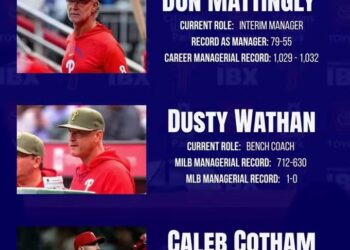
He is serving as interim manager after Thomson’s departure, and the organization has not formally settled his future for the 2027 season.
His existing contract with Philadelphia does not necessarily mean he will manage the team next season or remain on the coaching staff.
Mattingly brings extensive baseball experience, including previous managerial positions with the Los Angeles Dodgers and Miami Marlins. His background gives Philadelphia an alternative to making an immediate commitment to an outside candidate.
Keeping Mattingly would offer a degree of continuity.
Players would not have to adjust to an entirely new leadership structure, and the organization could use its offseason to evaluate its needs before making a permanent appointment.
However, continuity is valuable only when it helps the team move forward.
If the Phillies believe a different managerial voice is necessary to maximize their roster, retaining Mattingly simply because he is already in place would not necessarily solve the problem.
The decision should come down to performance, communication, and strategic fit.
Mattingly also deserves to be evaluated independently rather than treated as a temporary obstacle to a potential Cora reunion.
If the Phillies choose another manager, the organization must determine whether Mattingly has a meaningful role in its future. If it chooses to retain him, it should be because leadership believes he is the right person for the job.
Anything less risks turning an important personnel decision into an exercise in convenience.
THE PHILLIES’ REAL PROBLEM MAY BE BIGGER THAN THE MANAGER
Philadelphia’s managerial search raises a more uncomfortable question: Can changing the person in the dugout solve the problems that have prevented the team from consistently reaching its ultimate goal?
A manager can influence clubhouse morale, lineup construction, bullpen deployment, defensive positioning, and the team’s response to adversity.
Those responsibilities are significant, but they do not eliminate the need for strong roster construction.
The Phillies must also assess their offensive consistency, pitching depth, defensive reliability, and ability to perform against elite postseason competition.
Harper cannot carry the entire offensive burden. Wheeler and the rest of the pitching staff cannot be expected to compensate for every weakness elsewhere on the roster.
Even a World Series-winning manager cannot manufacture production when key players struggle or when a team’s depth is insufficient.
That is why Dombrowski’s responsibilities extend beyond finding the right person to lead the dugout.
The front office must build a roster that gives the manager multiple ways to win. That includes identifying weaknesses before they become postseason liabilities and ensuring that the team has enough depth to survive injuries and performance fluctuations.
Hiring Cora could improve Philadelphia’s leadership structure, but it should not be presented as a complete solution to every issue affecting the franchise.
The best outcome would involve a manager and front office working together to address the team’s weaknesses rather than expecting one new appointment to transform everything.
HOW A CORA HIRING COULD AFFECT BRYCE HARPER AND ZACK WHEELER
The next manager’s relationship with Philadelphia’s established stars will be essential.
Harper is a central figure in the franchise’s identity, while Wheeler has been an important part of its pitching ambitions.
Both players operate in an environment where expectations are high and postseason opportunities carry enormous significance.
A new manager must establish trust with veteran players while maintaining consistent standards across the entire roster.
Cora’s experience with championship expectations could help him navigate that responsibility. His time in Boston involved managing high-profile players and dealing with the scrutiny that comes with competing in a demanding market.
Nevertheless, Philadelphia is not Boston, and its clubhouse has its own personalities, expectations, and internal dynamics.
The Phillies would need to determine whether Cora’s communication style would resonate with the current roster. That assessment should include discussions with players and coaches who understand the team’s daily environment.
A successful manager must know when to challenge players, when to provide support, and when to make difficult decisions regardless of a player’s reputation.
The objective is not to hire someone who will simply keep the clubhouse comfortable.
It is to hire someone who can help the players perform at their highest level while maintaining accountability throughout the season.
If Cora can establish that balance, his appointment could benefit Philadelphia. If he cannot, his championship résumé will offer little protection against the challenges of a demanding season.
COULD ALEX CORA ACTUALLY CHOOSE PHILADELPHIA?
Another important question is whether Cora wants to manage the Phillies in 2027.
As of the October 6 report, his interest in returning to a managerial position remained uncertain.
That uncertainty matters because Philadelphia cannot assume that a familiar relationship with Dombrowski will automatically produce an agreement.
Cora may prefer to take time away from managing, consider other opportunities, or wait until the baseball landscape becomes clearer.
The offseason could also be complicated by labor uncertainty.
A potential MLB lockout ahead of the 2027 season could disrupt offseason preparations and create uncertainty around the league’s schedule. The precise consequences would depend on negotiations and any eventual labor agreement.
For a manager considering his next job, that uncertainty could influence the timing of a decision.
The Phillies should therefore prepare alternatives rather than build their entire search around one candidate.
The report also noted that the New York Mets had removed the interim designation from Andy Green, making that position unavailable as a potential destination for Cora at the time.
Even so, Philadelphia should not assume that the Phillies job is automatically his only option or that he would accept it if offered.
A managerial search requires flexibility, particularly when the preferred candidate’s intentions remain unclear.
THREE POSSIBLE DIRECTIONS FOR PHILADELPHIA
The Phillies have several paths available, and each carries different risks.
SCENARIO ONE: HIRE ALEX CORA
This would be the boldest option.
Philadelphia would acquire a manager with a World Series championship, substantial experience, and an established relationship with Dombrowski.
The potential reward would be immediate credibility and a clear attempt to maximize the team’s championship window.
The risk would be hiring a candidate whose past controversy could overshadow his appointment while assuming that previous success will translate into future results.
For this option to succeed, the Phillies would need a clear plan for improving the roster and establishing expectations throughout the clubhouse.
SCENARIO TWO: RETAIN DON MATTINGLY
Keeping Mattingly would preserve continuity and give the organization an opportunity to avoid rushing into a permanent decision.
It could also allow the front office to evaluate other candidates and make a more deliberate choice.
The downside is that Philadelphia would need convincing evidence that Mattingly is the right long-term fit rather than simply the easiest option.
If the organization believes a new managerial voice is necessary, continuity alone should not determine the outcome.
SCENARIO THREE: PURSUE A DIFFERENT CANDIDATE
A broader search could uncover a manager whose strengths better match the Phillies’ current needs.
That candidate might offer a different approach to player development, tactical decision-making, or clubhouse leadership.
The challenge would be finding someone with the experience and credibility to handle a roster expected to compete for championships.
The Phillies should not dismiss an unfamiliar candidate simply because Cora has a more recognizable résumé.
Ultimately, the strongest choice will be the manager who best fits the team’s needs, not necessarily the one with the most impressive past accomplishment.
MY PREDICTION: THE PHILLIES SHOULD PURSUE CORA, BUT ONLY AFTER A FULL SEARCH
Cora deserves serious consideration.
His championship experience, postseason record, and previous relationship with Dombrowski make him an appealing candidate for a team that wants to compete at the highest level.
However, the Phillies should avoid treating him as the automatic solution.
The organization needs to conduct a thorough evaluation of his recent performance, leadership philosophy, and plans for managing its current roster. It should also assess other candidates before committing to a decision.
If Cora demonstrates that he can address Philadelphia’s needs and both sides agree on the expectations of the job, hiring him would be a defensible move.
The Astros scandal should remain part of that evaluation, but it should not replace an objective assessment of his qualifications and subsequent managerial career.
My expectation is that Philadelphia will prioritize experience and familiarity while exploring its alternatives. If Dombrowski believes Cora remains the best available fit, the two could make sense together again.
But the team must also recognize that its championship ambitions will depend on more than one appointment.
The next manager needs a roster capable of winning, a front office willing to address weaknesses, and an organization committed to accountability from top to bottom.
Without those elements, even the most experienced manager could struggle.
THE FINAL VERDICT: ALEX CORA COULD BE THE RIGHT HIRE, BUT THE PHILLIES CANNOT AFFORD TO GET THIS WRONG
Philadelphia’s managerial decision will carry consequences well beyond the next press conference.
The team needs a leader who can manage its stars, make difficult strategic decisions, and guide the roster through the pressure of a championship race.
Cora has demonstrated that he can lead a World Series-winning team. That achievement makes him a legitimate candidate, regardless of the controversy surrounding his time in Houston.
At the same time, the Phillies must look beyond reputation and nostalgia.
Dombrowski’s familiarity with Cora is an advantage, but the organization should demand evidence that their reunion would address the team’s current needs.
Mattingly remains an alternative, and a broader search could reveal other candidates worth serious consideration.
The most important decision is not whether the Phillies can land a famous manager. It is whether they can identify the leader who gives their existing roster the best chance to win another championship.
Philadelphia does not need the most recognizable name in the dugout. It needs the right person to turn its championship ambitions into results.
If Cora is that person, the Phillies should pursue him with conviction. If he is not, Dombrowski must be willing to look elsewhere.
The stakes are too high for anything less than a careful, honest evaluation.





Discussion about this post