

The Philadelphia Phillies did not simply lose a Wild Card Series to the Atlanta Braves. They may have lost it weeks earlier.
Philadelphia’s disappointing postseason exit has raised a difficult question for a team that entered September with legitimate championship aspirations: Did the Phillies’ late-season collapse put them in a playoff position where their best pitchers could no longer be deployed the way they needed?
The answer, based on how the final weeks unfolded, is difficult to ignore.
The Phillies finished September with a 10-14 record, sliding from the top Wild Card position to the No. 6 seed in the National League. Their struggles continued into the final homestand, where they went 2-4 against the Rays and Brewers.
They eventually secured a postseason berth, but doing so required their top players to keep taking the mound until the very end.
That became particularly significant with Zack Wheeler.
WHEELER’S REGULAR-SEASON START CREATED A POSTSEASON PROBLEM
Wheeler was asked to pitch in the regular-season finale because Philadelphia had not yet officially secured its playoff spot.
The veteran right-hander delivered exactly what his team needed, throwing six innings of one-run baseball to help clinch the postseason berth.
But there was a hidden cost.
Because Wheeler had to pitch that game, he was unavailable to start the opening two games of the Wild Card Series. Instead of entering October with its ace lined up for the beginning of the series, Philadelphia had to work around the consequences of its late-season struggles.
That is where the Phillies’ September record became more than just an ugly statistic.
Every loss in the final weeks mattered because Philadelphia was not merely fighting for a playoff invitation. It was fighting for the ability to control its pitching rotation once October arrived.
THE BRAVES GOT THE BENEFIT OF PHILADELPHIA’S PITCHING DILEMMA
The Phillies still had quality arms available.
Jesús Luzardo started Game 1 and gave Philadelphia five solid innings after returning from injury. Cristopher Sánchez started Game 2, which Philadelphia won to force a decisive third game.
But the ideal postseason rotation never materialized.
Aaron Nola ultimately received the Game 3 start, while Wheeler was used out of the bullpen. Nola surrendered a three-run homer to Michael Harris II and did not make it out of the second inning.
Wheeler eventually entered the game and provided four innings of relief, but by then Philadelphia was already facing a significant deficit.
The Phillies lost 6-2, ending their season.
It is impossible to say with certainty that Wheeler starting Game 1 or Game 3 would have changed the outcome. Baseball does not work that way.
But it is equally difficult to dismiss how much different the series might have looked if Philadelphia had entered October with its rotation properly aligned.
THIS WAS BIGGER THAN ONE PITCHER
It would be unfair to place the entire postseason failure on Wheeler’s schedule.
Philadelphia had other problems.
The offense struggled to consistently produce, the bullpen showed vulnerability, and the team failed to capitalize on important opportunities. In Game 1, the Phillies had a late lead before Jhoan Duran surrendered a three-run homer to Austin Riley.
Those moments ultimately mattered just as much.
Still, starting pitching is supposed to be one of Philadelphia’s biggest advantages.
When a team’s rotation is built around proven postseason-caliber arms, the ability to deploy those pitchers at maximum effectiveness becomes a strategic weapon.
The Phillies simply did not have that weapon fully available when they needed it most.
THE REAL LESSON FROM THE SEPTEMBER COLLAPSE
The biggest takeaway may not be that the Phillies needed to win the Wild Card Series.
It is that regular-season positioning has consequences far beyond seeding.
A strong September could have given Philadelphia more control over its postseason rotation. Instead, the Phillies spent the final weeks trying to secure their place in October.
That forced difficult decisions.
Wheeler had to pitch when the team needed him. Nola’s schedule had to be manipulated. The bullpen was asked to cover innings. And the Phillies entered the decisive game without the clean starting-pitching arrangement they wanted.
Trea Turner acknowledged the problem after the elimination, essentially pointing back to the team’s inability to play well enough down the stretch to set up its rotation properly.
That is perhaps the most revealing part of the entire story.
PHILADELPHIA HAD A CHAMPIONSHIP-LEVEL ROSTER — BUT NOT A CHAMPIONSHIP-LEVEL FINISH
The Phillies’ season should not be judged solely by their final three games.
They had enough talent to contend.
Their rotation was capable of dominating opponents. Their lineup featured established offensive stars. They had postseason experience and a roster built with October baseball in mind.
But championship teams must also understand that how you finish the regular season can determine how difficult the postseason becomes.
Philadelphia essentially entered October already having spent some of its pitching flexibility.
That does not guarantee a different result against Atlanta.
It does, however, mean the Phillies made their path harder than it needed to be.
DON MATTINGLY’S COMMENTS HIGHLIGHT THE DIFFICULT REALITY
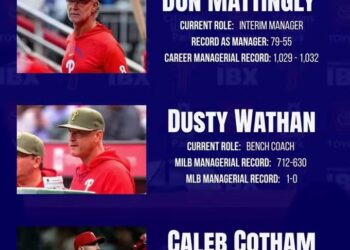
Interim manager Don Mattingly acknowledged the obvious problem after the elimination.
The Phillies would have preferred to enter the postseason with their pitchers rested and lined up exactly as planned.
Instead, they had to fight until the final day to get into the postseason.
That distinction is important.
The Phillies did not have the luxury of treating the final weekend like preparation for October. They were still trying to earn their postseason place.
And once the playoffs began, there was no opportunity to reset the rotation.
October does not reward teams for what they intended to do. It rewards teams for being ready when the games become decisive.
WHAT THIS MEANS FOR THE PHILLIES GOING FORWARD
Philadelphia’s front office now faces an offseason filled with important questions.
The team must determine whether the roster needs significant changes or whether the core simply needs another opportunity with better health and stronger execution.
The bullpen deserves attention. The offense needs greater consistency. And the organization must consider how to prevent another late-season slide from compromising its postseason strategy.
The Phillies cannot assume that having talented players automatically produces a championship.
They need depth.
They need flexibility.
And perhaps most importantly, they need to make sure that when October arrives, their best players are positioned to have their biggest impact.
COULD THIS SEASON CHANGE HOW PHILADELPHIA APPROACHES 2027?
It should.
If there is one lesson from this postseason disappointment, it is that Philadelphia cannot afford another September collapse.
A team with championship ambitions should be thinking about October before October begins.
That means monitoring workloads, protecting the rotation, building bullpen depth and, above all, creating enough separation in the standings that the final week of the season does not become a desperate fight for survival.
The Phillies had to use Wheeler in the regular-season finale because they had no choice.
Next year, the goal should be to make sure they never reach that situation again.
FINAL VERDICT: THE PHILLIES DID NOT LOSE IN SEPTEMBER — BUT SEPTEMBER HELPED PUT THEM IN A BAD POSITION
The Braves deserve credit for winning the series.
Philadelphia had opportunities and failed to take advantage of enough of them.
But the Phillies’ late-season struggles undeniably complicated their postseason plans.
Going 10-14 in September meant Philadelphia entered October without the luxury of a perfectly aligned rotation. Wheeler’s regular-season finale start was a direct consequence of that situation, and his eventual Game 3 relief appearance illustrated just how unusual the pitching plan had become.
Would a different rotation have guaranteed a series victory?
Absolutely not.
Could it have improved Philadelphia’s chances?
There is a very strong argument that it would have.
And that may be the most frustrating part for Phillies fans.
The championship window does not disappear because of one Wild Card loss. But if Philadelphia wants to turn its considerable talent into another deep October run, the organization must make sure its next postseason opportunity is not undermined by the final few weeks of the regular season.
The Phillies didn’t simply need to get into the playoffs. They needed to arrive there in position to use their best weapons. This time, they didn’t.




Discussion about this post