

The Indiana Fever’s 2026 season ended with another painful loss to the Las Vegas Aces, but Caitlin Clark’s message afterward offered something more important than another night of frustration: a glimpse into why she believes Indiana can eventually become a championship team.
The Fever fell 94-83 to Las Vegas in Game 3 of the first round on October 1, ending Indiana’s postseason for the second consecutive year at the hands of the Aces. Clark finished with 18 points and four blocks, while the Fever struggled to maintain the offensive rhythm they established with a 31-point first quarter.
For Clark, however, the conclusion of the season was not simply about another early playoff exit.
It was about recognizing how far the Fever had come, understanding where they fell short and making it clear that the work is far from finished.
CLARK REFUSES TO DEFINE THE SEASON BY THE LOSS
Clark’s postgame message was notably measured considering the circumstances.
Rather than directing blame toward teammates, coaches or officials, she expressed pride in a Fever team that had endured an enormous amount of pressure throughout the season.
She acknowledged the constant attention surrounding Indiana and admitted that there were moments when the Fever gave away opportunities that could have placed them in a better position entering the playoffs.
That admission may ultimately be one of the most important parts of Clark’s comments.
The Fever finished the regular season as the sixth seed after going 4-4 over their final eight games. A stronger finish could have dramatically changed the playoff path and potentially kept Indiana away from Las Vegas in the opening round.
In other words, Clark understands that championship teams cannot afford to wait until the postseason to find their best basketball.
That lesson could become extremely valuable for Indiana going forward.
THIS WAS A DIFFERENT CAITLIN CLARK
There is another reason Clark’s comments deserve attention.
This was not the same player who watched the Fever’s 2025 playoff elimination from the sideline because of injury.
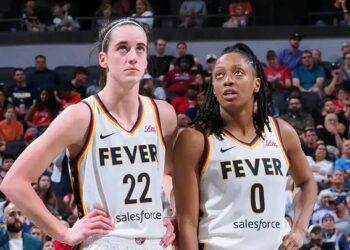
Clark returned to the court in 2026 and described the season as the most basketball she had played in any year of her career. She also emphasized how much her offseason work had translated onto the court and said she improved across virtually every area of her game.
That matters enormously for Indiana.
The Fever did not simply get their superstar back. They got a more experienced Clark who had another year to understand the physicality, pace and defensive demands of professional basketball.
And perhaps most encouragingly, Clark does not appear satisfied.
She believes there are still significant areas where she can improve.
That should be an uncomfortable thought for the rest of the WNBA.
THE BLOODY MOUTH MOMENT SUMMED UP THE FEVER’S NIGHT
Clark’s final playoff game also contained one of the defining moments of Indiana’s season.
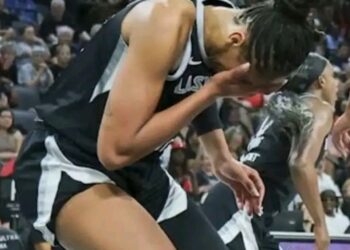
Late in Game 3, she took contact to the face from Aces guard Jewell Loyd while competing for a rebound. Clark briefly left the court and returned with a visibly bloody mouth, but no foul was called on the play.
The incident immediately became another talking point surrounding Clark and the Fever.
Indiana had already spent much of the season under an enormous microscope, and the officiating conversation became impossible to separate from the playoff atmosphere.
Clark herself did not pretend to have an explanation for the missed call.
But there is a larger basketball lesson here.
If Indiana wants to make a championship run, it cannot allow controversial officiating, hostile environments or physical playoff basketball to determine its emotional rhythm.
Championship teams eventually learn how to survive all of it.
THE FEVER ACTUALLY SHOWED CHAMPIONSHIP POTENTIAL
It would be easy to look at another first-round elimination and conclude that Indiana remains far away.
That would be too simplistic.
The Fever pushed the Aces hard during the series and demonstrated that they could play at a level capable of challenging one of the league’s elite teams.
Game 2 was particularly encouraging, with Clark producing 27 points and 15 assists as Indiana forced a decisive third game.
Then, in Game 3, Indiana opened with an explosive 31-point first quarter.
The problem was sustaining it.
After that opening period, the Fever failed to score more than 18 points in any of the remaining three quarters. Clark also cooled dramatically after scoring 11 points in the first quarter.
That inconsistency is exactly where Indiana must improve.
Against an elite championship-caliber opponent, one great quarter is not enough.
A’JA WILSON PROVIDED THE HARDEST LESSON
On the other side, A’ja Wilson demonstrated precisely why Las Vegas remains such a difficult obstacle.
Wilson erupted for 36 points and 10 rebounds in the deciding game, while Chelsea Gray and Jackie Young also provided significant offensive support.
That is the standard Indiana is chasing.
The Fever have elite offensive talent, but championship basketball requires multiple players capable of taking control when the primary option is struggling.
Clark cannot be expected to solve every problem.
Neither can Aliyah Boston.
Neither can Kelsey Mitchell.
Indiana needs a system and roster capable of surviving nights when one or two stars are not shooting efficiently.
That may be the biggest offseason lesson of all.
KELSEY MITCHELL’S FUTURE COULD CHANGE EVERYTHING
One of the biggest questions surrounding the Fever now involves Kelsey Mitchell.
Mitchell has spent her entire WNBA career in Indiana and remains one of the team’s most important scorers. However, her future is part of the offseason conversation, with free agency potentially forcing the Fever to make difficult roster decisions.
That decision will have major consequences for Clark.
Mitchell gives Indiana something extremely valuable: another perimeter scorer who can punish defenses for overloading toward Clark.
Removing that threat would change the way opponents defend the Fever.
At the same time, Indiana has to think beyond scoring.
If the goal is a championship, the Fever need defensive versatility, reliable depth and players who can consistently perform when the game becomes physical.
The front office therefore faces a delicate balancing act.
CLARK’S NEXT STEP COULD BE THE SCARIEST PART FOR THE WNBA
Perhaps the most encouraging thing Clark said was not about what happened in 2026.
It was about what comes next.
Clark made it clear that she still sees plenty of room for improvement and that she enjoys the process of working on her game.
That mindset could become a major advantage.
Clark already possesses elite shooting range, passing creativity and the ability to completely alter defensive schemes.
If she becomes more consistent attacking the basket, improves her ability to punish physical defensive pressure and continues developing defensively, the ceiling becomes significantly higher.
The 2026 season may ultimately be remembered less as the year Indiana failed to win a playoff series and more as the year Clark fully returned to herself.
INDIANA’S CHAMPIONSHIP WINDOW IS OPEN — BUT IT WON’T STAY OPEN FOREVER
The Fever have something many rebuilding teams spend years searching for: a franchise centerpiece capable of changing the trajectory of the organization.
But having Clark is not the same as automatically winning championships.
Indiana now has to turn potential into consistency.
The regular-season finish has to improve.
The defense has to become more dependable.
The roster has to become deeper.
And the Fever have to find ways to make Clark’s brilliance sustainable over an entire playoff series rather than relying on spectacular individual stretches.
The Aces provided a painful reminder of that reality.
Las Vegas did not eliminate Indiana because the Fever lacked talent.
They eliminated them because championship experience, depth and consistency still mattered when the pressure reached its highest point.
THE 2027 FEVER SHOULD HAVE A DIFFERENT EXPECTATION
There is no reason for Indiana to enter the next season simply hoping to make the playoffs.
That standard has changed.
With Clark, Boston and an increasingly experienced supporting cast, the expectation should be to compete for a deep postseason run.
Clark herself has previously expressed confidence that the Fever have the talent to eventually win a championship, while also acknowledging how much parity exists throughout the league.
That is the correct perspective.
Indiana does not need to panic after another first-round loss.
But it cannot ignore the warning signs either.
The next offseason should be about turning a talented team into a complete team.
CAITLIN CLARK’S MESSAGE SHOULD EXCITE FEVER FANS
The easiest story to tell after Indiana’s elimination is that the Fever failed again.
The more interesting story is that Clark appears convinced the best version of this team has not arrived yet.
She returned from an injury-disrupted 2025 season, played a much larger workload, helped Indiana reach the playoffs and showed improvement across her game. Now she enters another offseason with a clear understanding of what postseason basketball demands.
That should give Fever fans reason for optimism.
The loss to Las Vegas hurts.
The missed opportunities hurt.
The second consecutive elimination by the Aces hurts even more.
But Indiana’s championship window is not closing.
It may only be beginning.
And if Caitlin Clark’s own assessment is any indication, she has no intention of treating the 2026 ending as the final chapter.
For the Fever, the challenge now is simple to describe and difficult to accomplish:
Take everything that went wrong in 2026 and turn it into the foundation for a championship run in 2027.





Discussion about this post